


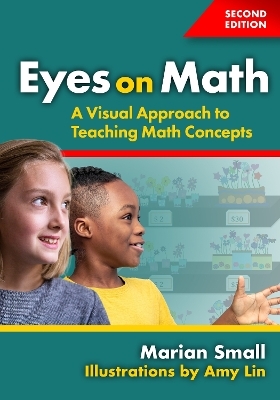
Eyes on Math
Teachers' College Press (Verlag)
978-0-8077-8717-5 (ISBN)
This full-color resource will help K–8 teachers find new ways to clarify concepts that students find difficult.
This extensively updated teaching resource provides over engaging, full-color visuals with explanations of how they can be used to stimulate mathematics learning, to explain mathematical concepts, and to assess students' mathematical understanding in grades K–8.
Readers are provided with a strong mathematical background, downloadable copies of the visuals they can use directly, and helpful questions to raise with their students. Expected answers for each question and follow-up extensions are also provided. This expanded second edition includes 5 new Notice and Wonder activities to get mathematical conversations started and 5 new Student Assessment activities with suggestions for visuals that students can create to help teachers assess comprehension.
This user-friendly book will help teachers find new ways to clarify concepts that students find difficult. It will also help teachers working with students with low reading ability, including English language learners and special education students.
Book Features:
3 visuals, including color artwork and graphics.
Questions and tasks to use with students in leading the instructional conversation.
Expected answers and explanations of why each question is important.
Prompts for students to show their understanding of a concept by using visuals.
Vital mathematical background and context.
Marian Small is an international professional developer, conference speaker, bestselling author, former dean of education at the University of New Brunswick, and longtime professor of mathematics education. Visit Marian's website at www.onetwoinfinity.ca for in-person and online professional development. Amy Lin is the director of teaching and learning at Seneca College. Amy has worked as a teacher in elementary, secondary, and postsecondary levels and as a mathematics coach, a curriculum consultant, administrator, and ministry researcher.
Preface ix
Acknowledgments xiii
. Background
Visualization in Math
Focusing on the Important Math 3
Building Mathematical Communication 4
2. Grades K–2 7
Notice and Wonder
Strawberries 8
Egg Cartons
Bracelets 2
Daisies 4
Donuts
Explaining Concepts
Counting Up by s 8
Counting Back by s 2
Counting Up by 2s 22
Counting Back by 2s 24
Counting Up by 5s 2
Counting Back by 5s 28
Counting Up by s 3
Counting Back by s 32
Comparing Numbers by Matching 34
Benchmark Numbers: All About 5 3
Benchmark Numbers: All About 38
Ordinal Numbers 4
Addition as Combining 42
Adding and Adding 44
Addition: Commutativity 4
Addition: Changing Addends, But Not the Sum 48
Adding or Subtracting 5
Subtraction as Taking Away 52
Subtraction to Compare 54
Relating Addition and Subtraction 5
Naming Two-Digit Numbers 58
Naming Three-Digit Numbers
Place Value: Grouping in Tens 2
Place Value: Positions 4
Comparing Sizes of Numbers
Fractions: Halves 8
Fractions: Quarters 7
Measurement: Meaning of Length 72
Measurement: Effect of Unit Size 74
Measurement: Standard Units of Length 7
2-D Shapes Versus 3-D Shapes 78
Comparing 2-D Shapes 8
Comparing 3-D Shapes 82
Composing Shapes 84
Shape Puzzles 8
Student Assessment: Draw or Model to Explain
Rearranging Addends 89
Subitizing 8 9
Ordinal Numbers: Points of View 9
Subtracting by Adding 9
Nonstandard Measurement 92
3. Grades 3–5 95
Notice and Wonder
Quilts 9
Design 98
Juice
Tennis 2
Pastries 4
Explaining Concepts
Multiplication: Equal Groups
Multiplication: Commutativity 8
Multiplication: The Distributive Principle
Multiplication: 2-Digit by 2-Digit 2
Division as Equal Groups or Sharing 4
Division: Remainders
Rounding Numbers 8
Place Value: Multiplying and Dividing by Powers of 2
Place Value: Renaming Numbers 22
Factors: What They Are 24
Factors Come in Pairs 2
Fractions: Representing 28
Fractions: Equivalence 3
Fractions: Comparing 32
Fractions: Mixed Number/Improper Fraction Relationship 34
Fractions: Common Denominators 3
Adding Fractions 38
Multiplying Fractions 4
Fractions: Multiplying as Resizing 44
Fractions as Division 4
Decimals: Relating Hundredths to Tenths 48
Decimals: Equivalence 5
Decimals: Adding and Subtracting 52
Measurement: Time Intervals 54
Measurement: Area of Rectangles 5
Perimeter Versus Area 58
Measurement Conversions
Graphs With Scales 2
Coordinate Grids 4
Classification of Shapes
Parallel and Perpendicular Lines 8
Lines of Symmetry 7
Patterns Versus Nonpatterns 72
Algebraic Thinking: Growing Additively 74
Algebraic Thinking: Shrinking Additively 7
Algebraic Thinking: Growing Multiplicatively 78
Student Assessment: Draw or Model to Explain
Fractions of a Set 8
Fraction as Division 8
Relating Quotients 82
Comparing Products 83
Factors 84
4. Grades –8 87
Notice and Wonder
Roller Coasters 88
A Giant Burger 9
Going to a Concert 92
Basketball 94
A Solar Eclipse 9
Explaining Concepts
Common Factors 98
Common Multiples 2
Square Roots 2 2
Fraction Division 2 4
Ratios: Multiple Ratios Describe Any Situation 2
Equivalent Ratios 2 8
Equivalent Rates 2
Solving Rate Problems 2 2
Describing Percent 2 4
Uses of Integers 2
The Zero Principle 2 8
Subtraction of Integers as a Directed Distance 22
Multiplication and Division of Integers 222
Area of a Parallelogram 224
Area of a Triangle 22
The Pythagorean Theorem 23
Pi 232
How Measurements Are and Are Not Related 234
Mean 23
Variability 238
Sampling 24
Probability: What It Means 242
Unpredictability 244
Rotations, Reflections, and Translations 24
Scale Drawings 248
Dilations 25
Angles With Parallel Lines 252
Equivalent Expressions 254
Equation as a Balance 25
Different Types of Equations 258
What Is Linear? 2
Role of the Slope in the Equation of a Line 2 2
Systems of Equations 2 4
Function Rules 2
Student Assessment: Draw or Model to Explain
Subtracting Negatives 2 8
Relating Percents 2 9
Square Root Estimates 27
Dividing Fractions 272
Common Factors 273
Appendix: Connections Between Topics and Common Core Standards 275
References 279
Index 28
About the Authors 285
| Erscheinungsdatum | 30.01.2025 |
|---|---|
| Verlagsort | New York |
| Sprache | englisch |
| Maße | 184 x 260 mm |
| Themenwelt | Schulbuch / Wörterbuch |
| Sozialwissenschaften ► Pädagogik | |
| ISBN-10 | 0-8077-8717-5 / 0807787175 |
| ISBN-13 | 978-0-8077-8717-5 / 9780807787175 |
| Zustand | Neuware |
| Informationen gemäß Produktsicherheitsverordnung (GPSR) | |
| Haben Sie eine Frage zum Produkt? |
aus dem Bereich


