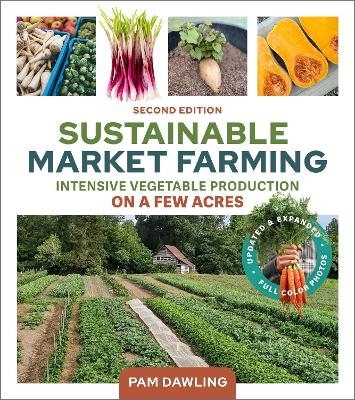
Sustainable Market Farming, Second Edition
New Society Publishers (Verlag)
978-1-77406-001-8 (ISBN)
Grow a profitable, resilient vegetable farm on just a few acres with this fully revised, year-round guide. Learn the best ways to plan, plant, and harvest abundant, high-quality crops in any climate, maximize yields, and manage your market garden like a seasoned professional.
Whether you're starting out or expanding an established farm, this updated edition gives you the confidence, strategies, and practical tools to run a sustainable, efficient, and profitable vegetable enterprise. Packed with step-by-step guidance, it's the book you'll return to year after year.
Master every aspect of market farming:
Plan and organize your farm for maximum efficiency and profit
Use climate-smart techniques and season extension strategies
Manage pests, diseases, and weeds organically with integrated approaches
Improve soil health with regenerative practices
Grow a wide range of vegetables with detailed cultivation guides
Optimize sowing, crop rotation, succession planting, harvest, and storage.
Written for beginning growers, aspiring market gardeners, and experienced farmers, this guide provides the confidence and know-how to produce abundant, high-quality crops sustainably.
About the Author
Pam Dawling brings over 40 years of sustainable vegetable production experience, including 14 years of hoophouse growing. She is the author of the bestselling Sustainable Market Farming, contributing editor to Growing for Market, and a sought-after speaker at sustainable agriculture conferences. She blogs weekly at sustainablemarketfarming.com and consults with new and beginning farmers. Pam managed Twin Oaks community farm in Virginia for 25 years, feeding 100 people year-round.
Start growing smarter, more resilient vegetables today and elevate your market farm to its full potential.
Pam Dawling has been farming and mentoring emerging growers in sustainable vegetable production in a variety of climates for over four decades. She was the garden manager at Twin Oaks Community ecovillage for 25 years, where she was responsible for training the garden crew and providing tasty, fresh, organic seasonal produce for 100 people year-round from only 3.5 acres. Pam regularly does consultancy work for new and beginning farmers, and is in demand as a presenter at sustainable agriculture conferences and events. She is a contributing editor with Growing for Market magazine and writes a popular weekly blog at www.sustainablemarketfarming.com. Pam is the author of the original edition of Sustainable Market Farming, as well as The Year-Round Hoophouse. She lives in Louisa, Virginia.
Foreword by Andrew Mefferd
Acknowledgements
Introduction: Sustaining Community and Agriculture
Part I: Techniques
Planning
Chapter 1: Year-Round Production
Chapter 2: Create Your Crop Plan and Field Manual
Chapter 3: Crop Review
Chapter 4: Crop Rotations for Vegetables and Cover Crops
Chapter 5: Seed Storage, Inventory and Orders
Chapter 6: Scheduling Transplants
Chapter 7: How Much to Grow
Planting
Chapter 8: Crop Spacing
Chapter 9: Transplanting Tips
Chapter 10: Direct Sowing
Chapter 11: Hot Weather Germination of Seeds
Chapter 12: Succession Planting for Continuous Harvesting
Sustainable Crop Protection
Chapter 13: Season Extension
Chapter 14: Mulches, Organic and Plastic
Chapter 15: Cold-Hardy Winter Vegetables
Chapter 16: Growing Vegetables Year-Round in a Hoophouse
Soil and Crop Quality
Chapter 17: Maintaining Soil Fertility
Chapter 18: Drip Irrigation
Chapter 19: Cover Crops
Chapter 20: Cover Crops Chart
Chapter 21: Sustainable Disease Management
Chapter 22: Sustainable Weed Management
Chapter 23: Sustainable Pest Management
Harvest and Beyond
Chapter 24: Manual Harvesting Techniques
Chapter 25: Winter Vegetable Storage
Chapter 26: Root Cellars
Part II: Crops
Legumes
Chapter 27: Snap Beans (Bush and Pole)
Chapter 28: Southern Peas, Asparagus Beans and Limas
Chapter 29: Fava Beans (Broad Beans)
Chapter 30: Edamame
Chapter 31: Snap Peas and Snow Peas
Chapter 32: Peanuts
Brassicas
Chapter 33: Broccoli, Cabbage, Kale. Kohlrabi and Collards in Spring
Chapter 34: Broccoli, Cabbage, Kale and Collards in Fall
Chapter 35: Asian Greens
Other Greens
Chapter 36: Spinach
Chapter 37: Chard and Other Summer Greens
Chapter 38: Lettuce All Year Round
Roots
Chapter 39: Carrots, Beets and Parsnips
Chapter 40: Celery and Celeriac
Chapter 41: Radishes for All Seasons
Chapter 42: Turnips and Rutabagas
Cucurbits
Chapter 43: Summer Squash and Zucchini
Chapter 44: Winter Squash and Pumpkins
Chapter 45: Cucumbers and Muskmelons
Chapter 46: Watermelons
Alliums
Chapter 47: Garlic
Chapter 48: Bulb Onions
Chapter 49: Potato Onions
Chapter 50: Leeks
Chapter 51: Unusual Alliums
Nightshades
Chapter 52: Tomatoes
Chapter 53: Peppers
Chapter 54: Eggplant
Chapter 55: Potatoes
The Orphan Crops
Chapter 56: Okra
Chapter 57: Sweet Corn
Chapter 58: Sweet Potatoes
Chapter 59: Asparagus
Seed Crop Production
Chapter 60: Seed Growing
Chapter 61: The Business of Seed Crops by Ira Wallace
Resources
Index
About the Author
| Erscheinungsdatum | 09.04.2025 |
|---|---|
| Zusatzinfo | 250 Illustrations, color |
| Verlagsort | Gabriola Island |
| Sprache | englisch |
| Maße | 203 x 229 mm |
| Gewicht | 971 g |
| Themenwelt | Sachbuch/Ratgeber ► Natur / Technik ► Garten |
| Schulbuch / Wörterbuch ► Lexikon / Chroniken | |
| Weitere Fachgebiete ► Land- / Forstwirtschaft / Fischerei | |
| ISBN-10 | 1-77406-001-9 / 1774060019 |
| ISBN-13 | 978-1-77406-001-8 / 9781774060018 |
| Zustand | Neuware |
| Informationen gemäß Produktsicherheitsverordnung (GPSR) | |
| Haben Sie eine Frage zum Produkt? |
aus dem Bereich