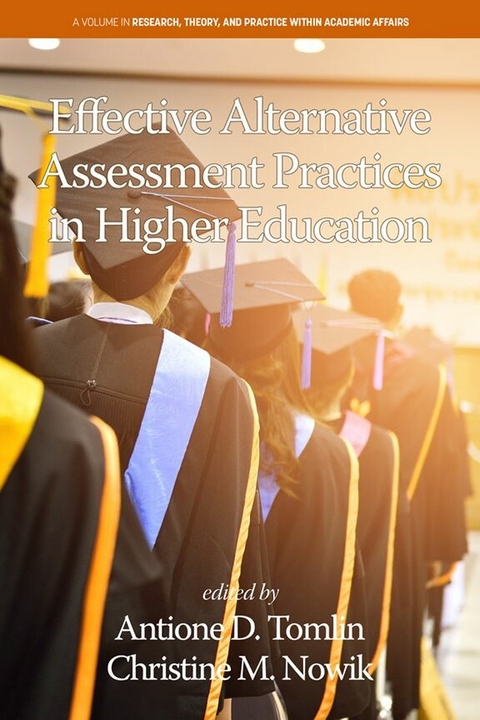
COVID-19 and increased attention to how institutions of higher education (IHEs) serve an increasingly diverse student population have brought conversations about "e;standard"e; practices from the margins to the center as faculty explore how to improve learning and student success for all students.Historically, IHEs were built by a privileged class for a privileged class, a system, and structure built on specific epistemologies, practices, and habits of mind and language that replicate privilege and leave many students underserved in their academic pursuits.One way faculty have increased equity in their college classrooms is through the use of alternative assessment (alt-assessment) practices. This volume aims to share the experiences of faculty who have leveraged "e;non-traditional"e; grading paradigms for the sake of increasing student learning, a sense of belonging, and equity in their classrooms. Meant to orient faculty who are considering how to implement alt-assessment in their own classes as well as those who are already employing various grading frameworks, this volume will celebrate new and innovative approaches, share lessons learned, and invite a broader coalition of faculty into the stream of conversation about pedagogical innovation.Faculty, educators, and practitioners share their approaches to alternate assessment in this volume, as well as the critiques, lessons, and outcomes associated with their pedagogical decisions. Written by practitioners for practitioners, we hope the book will provide theoretical and practical guidance for alternative assessment practices such as ungrading, contract grading, standards-based grading, and labor-based grading across various disciplines and within different academic contexts.
| Erscheint lt. Verlag | 1.3.2024 |
|---|---|
| Sprache | englisch |
| Themenwelt | Schulbuch / Wörterbuch ► Lexikon / Chroniken |
| Sozialwissenschaften ► Pädagogik ► Erwachsenenbildung | |
| ISBN-13 | 979-8-88730-579-0 / 9798887305790 |
| Informationen gemäß Produktsicherheitsverordnung (GPSR) | |
| Haben Sie eine Frage zum Produkt? |
 PDF (Adobe DRM)
Größe: 2,7 MB
Kopierschutz: Adobe-DRM
Adobe-DRM ist ein Kopierschutz, der das eBook vor Mißbrauch schützen soll. Dabei wird das eBook bereits beim Download auf Ihre persönliche Adobe-ID autorisiert. Lesen können Sie das eBook dann nur auf den Geräten, welche ebenfalls auf Ihre Adobe-ID registriert sind.
Details zum Adobe-DRM
Dateiformat: PDF (Portable Document Format)
Mit einem festen Seitenlayout eignet sich die PDF besonders für Fachbücher mit Spalten, Tabellen und Abbildungen. Eine PDF kann auf fast allen Geräten angezeigt werden, ist aber für kleine Displays (Smartphone, eReader) nur eingeschränkt geeignet.
Systemvoraussetzungen:
PC/Mac: Mit einem PC oder Mac können Sie dieses eBook lesen. Sie benötigen eine
eReader: Dieses eBook kann mit (fast) allen eBook-Readern gelesen werden. Mit dem amazon-Kindle ist es aber nicht kompatibel.
Smartphone/Tablet: Egal ob Apple oder Android, dieses eBook können Sie lesen. Sie benötigen eine
Geräteliste und zusätzliche Hinweise
Buying eBooks from abroad
For tax law reasons we can sell eBooks just within Germany and Switzerland. Regrettably we cannot fulfill eBook-orders from other countries.
 EPUB (Adobe DRM)
Kopierschutz: Adobe-DRM
Adobe-DRM ist ein Kopierschutz, der das eBook vor Mißbrauch schützen soll. Dabei wird das eBook bereits beim Download auf Ihre persönliche Adobe-ID autorisiert. Lesen können Sie das eBook dann nur auf den Geräten, welche ebenfalls auf Ihre Adobe-ID registriert sind.
Details zum Adobe-DRM
Dateiformat: EPUB (Electronic Publication)
EPUB ist ein offener Standard für eBooks und eignet sich besonders zur Darstellung von Belletristik und Sachbüchern. Der Fließtext wird dynamisch an die Display- und Schriftgröße angepasst. Auch für mobile Lesegeräte ist EPUB daher gut geeignet.
Systemvoraussetzungen:
PC/Mac: Mit einem PC oder Mac können Sie dieses eBook lesen. Sie benötigen eine
eReader: Dieses eBook kann mit (fast) allen eBook-Readern gelesen werden. Mit dem amazon-Kindle ist es aber nicht kompatibel.
Smartphone/Tablet: Egal ob Apple oder Android, dieses eBook können Sie lesen. Sie benötigen eine
Geräteliste und zusätzliche Hinweise
Buying eBooks from abroad
For tax law reasons we can sell eBooks just within Germany and Switzerland. Regrettably we cannot fulfill eBook-orders from other countries.
aus dem Bereich