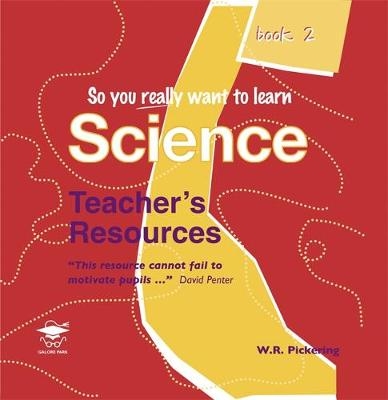
So You Really Want to Learn Science
Galore Park Publishing Ltd (Verlag)
978-1-902984-64-3 (ISBN)
- Keine Verlagsinformationen verfügbar
- Artikel merken
Designed to accompany So You Really Want To Learn Science Book 2, this CD contains an impressive amount of supplementary material in PDF format which can be printed and photocopied for use in the classroom. Featuring 80 experiments, 26 data handling exercises, 56 crosswords, 29 keyword jumbles and 19 internet projects, this resource will ensure that you have plenty of material to engage and challenge pupils of all abilities and help them achieve their best in science lessons! So You Really Want To Learn Science Book 2 Teacher's Resource Key Benefits: - Features an incredible amount of supplementary material for use with your whole class - ideal for classwork and prep - The huge amount of experiments, data handling exercises and key word jumbles will engage and challenge pupils of all abilities and ensure that you never run out of material for your lessons! - Material can be photocopied again and again so that you only need to invest in this resource once
Ron Pickering has published a number of very successful books covering the GCSE and A Level syllabus and has worked in both maintained and independent education for more than 20 years.
Pupil experiments and teacher demonstrations Worksheet 1 - Introduction + Chapter 11: Safety in chemistry Worksheet 2 - Introduction + Chapter 11: Assessing safety in science Worksheet 3 - Chapter 1: Using the microscope: Plant and human cells Worksheet 4 - Chapter 2: Food tests Worksheet 5 - Chapter 2: Testing for vitamin C Worksheet 6 - Chapter 2: The effect of amylase on starch Worksheet 7 - Chapter 2: Food must be digested to cross the gut wall Worksheet 8 - Chapter 3: What is bone made of? Worksheet 9 - Chapter 3: Making a model elbow Worksheet 10 - Chapter 5: Measuring lung volumes Worksheet 11 - Chapter 5: Oxygen in inspired and expired air Worksheet 12 - Chapter 5: Carbon dioxide in inspired and expired air Worksheet 13 - Chapter 5: Respiration circus Worksheet 14 - Chapter 5: Energy in food Worksheet 15 - Chapter 5: Energy content in food Worksheet 16 - Chapter 5: Smoking machine demonstration Worksheet 17 - Chapter 6: Heart rate and exercise Worksheet 18 - Chapter 6: How yeast causes bread to rise Worksheet 19 - Chapter 8: Human variation Worksheet 20 - Chapter 12: States of matter Worksheet 21 - Chapter 13: Heating substances Worksheet 22 - Chapter 13: Boling points Worksheet 23 - Chapter 13: Pure substance or mixture? Worksheet 24 - Chapter 13: Explaining solutions Worksheet 25 - Chapter 13: Rock Salt Worksheet 26 - Chapter 13: What happens to a solute when a solution is formed? Worksheet 27 - Chapter 13: Demonstrating distillation Worksheet 28 - Chapter 13: Chromatography Worksheet 29 - Chapter 13: Limits to solubility Worksheet 30 - Chapter 14: What are acids and alkalis? Worksheet 31 - Chapter 14: Indicators Worksheet 32 - Chapter 14: Other indicators Worksheet 33 - Chapter 15: How do compounds differ from elements? Worksheet 34 - Chapter 15: Modelling molecules Worksheet 35 - Chapter 15: Finding out about elements Worksheet 36 - Chapter 15: Particle models Worksheet 37 - Chapter 16: Changes of mass Worksheet 38 - Chapter 16: Burning Worksheet 39 - Chapters 15 & 16: pH values of three types of water Worksheet 40 - Chapter 16: Products of combustion Worksheet 41 - Chapter 16: Other chemical reactions Worksheet 42 - Chapter 16: Acid rain Worksheet 43 - Chapter 17: Metals and acids Worksheet 44 - Chapter 17: Metals and acids in detail Worksheet 45 - Chapter 17: Acids and metal carbonates Worksheet 46 - Chapter 17: More metal carbonates and acid reactions Worksheet 47 - Chapter 17: Magnesium and water Worksheet 48 - Chapter 17: Reactivity of metals with acid Worksheet 49 - Chapter 17: Predicting reactions of metals with oxygen Worksheet 50 - Chapter 17: Can metals displace each other? Worksheet 51 - Chapter 17: Assessment investigations Worksheet 52 - Chapter 18: Bunsen Burners Worksheet 53 - Chapter 19: Looking at energy transfers Worksheet 54 - Chapter 18: Heat transfer Worksheet 55 - Chapter 20: Making electrical circuits Worksheet 56 - Chapter 20: Circuits with resistors Worksheet 57 - Chapter 20: Circuits with switches Worksheet 58 - Chapter 20: Measuring current Worksheet 59 - Chapter 22: Magnets and electromagnets Worksheet 60 - Chapter 22: Making and using a paint gauge Worksheet 61 - Chapter 26: Reaction time graph Worksheet 62 - Chapter 26: Density Worksheet 63 - Chapter 26: Investigating floating Worksheet 64 - Chapter 26: Stretching materials Worksheet 65 - Chapter 27: Investigating friction Worksheet 66 - Chapter 27: Investigating moments Worksheet 67 - Chapter 28: Measuring reflection Worksheet 68 - Chapter 28: Paint colour Worksheet 69 - Chapter 28: Explaining dispersion Worksheet 70 - Chapter 28: The refraction of light Worksheet 71 - Chapter 29: Analysis of sound waves Worksheet 72 - Chapter 29: Measuring the speed of sound Data handling and interpretation Worksheet 1 - Introduction: Data interpretation - variables and fair tests Worksheet 2 - Introduction: Measuring in multiples Worksheet 3 - Chapter 2: The benefits of milk Worksheet 4 - Chapter 2: Enzymes and washing powders Worksheet 5 - Chapter 2: Chewing bread Worksheet 6 - Chapter 2: Energy needs at different ages Worksheet 7 - Chapter 2: Protein requirements Worksheet 8 - Chapter 2: Vitamins and minerals Worksheet 9 - Chapter 4 and 5: Smoking and the developing fetus Worksheet 10 - Chapter 4: Growth curves Worksheet 11 - Chapter 6: Pulse rate and exercise Worksheet 12 - Chapter 7: pH and plants Worksheet 13 - Chapter 8: Human variation Worksheet 14 - Chapter 12: Warming up Worksheet 15 - Chapter 12: Expansion of metals Worksheet 16 - Chapter 13: Temperature and solubility Worksheet 17 - Chapter 13: Testing tea Worksheet 18 - Chapter 14: Indigestion tablets Worksheet 19 - Chapter 14: Safety for the skin Worksheet 20 - Chapter 15: Compounds of magnesium Worksheet 21 - Chapter 17: Reacting metals Worksheet 22 - Chapter 18: Food and energy Worksheet 23 - Chapter 19: Generating electricity Worksheet 24 - Chapt
| Erscheint lt. Verlag | 29.9.2006 |
|---|---|
| Reihe/Serie | So You Really Want to Learn ; 2 |
| Zusatzinfo | col. |
| Sprache | englisch |
| Maße | 127 x 148 mm |
| Gewicht | 90 g |
| Themenwelt | Schulbuch / Wörterbuch |
| ISBN-10 | 1-902984-64-1 / 1902984641 |
| ISBN-13 | 978-1-902984-64-3 / 9781902984643 |
| Zustand | Neuware |
| Informationen gemäß Produktsicherheitsverordnung (GPSR) | |
| Haben Sie eine Frage zum Produkt? |
aus dem Bereich