


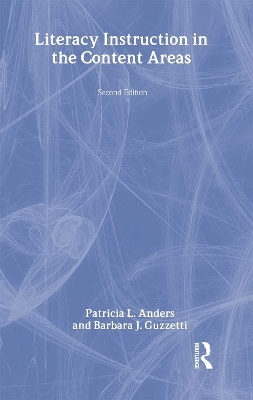
Literacy Instruction in the Content Areas
Seiten
2005
|
2nd edition
Routledge (Verlag)
978-0-8058-4339-2 (ISBN)
Routledge (Verlag)
978-0-8058-4339-2 (ISBN)
- Titel z.Zt. nicht lieferbar
- Versandkostenfrei
- Auch auf Rechnung
- Artikel merken
This second, updated and expanded edition is written for undergraduate, graduate, and in-service teachers who want to integrate literacy processes into their content area instruction.
Like its predecessor, Literacy Instruction in the Content Areas, Second Edition is written for undergraduate, graduate, and in-service teachers who want to integrate literacy processes into their content area instruction. In addition to extensive updating of earlier material, this new edition extends its coverage to include new chapters on adolescents' out-of-school literacy experiences and their in-school preferences, digital resources for content learning, and considerations for the reading specialist. In doing so, however, the authors have tried to maintain the brevity, stylistic clarity, and classroom focus of the earlier volume.
Key features of this important new book include:
*Teaching Flexibility. Although written with the needs of pre-service teachers in mind, theory and research are treated in sufficient depth to make the book suitable for graduate courses and for teacher study groups. It is also appropriate for secondary reading specialists or literacy coaches responsible for establishing or maintaining a school-wide literacy program.
*Changes in New Edition. All chapters have been reorganized and most of the text rewritten. In addition, new chapters not usually included in content area reading texts were added. These cover: 1) adolescents' out-of-school literacy experiences and in-school preferences; 2) digital resources for content learning; and 3) considerations for the reading specialist.
*Socio-Cultural Perspective. Like other volumes in the Literacy Teaching Series, the perspective of this one is socio-cultural and constructivist. It recognizes that classroom teaching and learning are closely intertwined with surrounding school and community cultures as well as the culture and language of the subject being studied. Likewise, literacy is not simply a matter of reading and writing but involves using multiple literacies to negotiate and construct meaning.
*Practical Orientation. Although supporting theory and research are included in all chapters, instructional strategies with illustrative examples from practicing teachers are included in most chapters. Each chapter concludes with "Application Activities" and "From Our Professional Library" references.
Like its predecessor, Literacy Instruction in the Content Areas, Second Edition is written for undergraduate, graduate, and in-service teachers who want to integrate literacy processes into their content area instruction. In addition to extensive updating of earlier material, this new edition extends its coverage to include new chapters on adolescents' out-of-school literacy experiences and their in-school preferences, digital resources for content learning, and considerations for the reading specialist. In doing so, however, the authors have tried to maintain the brevity, stylistic clarity, and classroom focus of the earlier volume.
Key features of this important new book include:
*Teaching Flexibility. Although written with the needs of pre-service teachers in mind, theory and research are treated in sufficient depth to make the book suitable for graduate courses and for teacher study groups. It is also appropriate for secondary reading specialists or literacy coaches responsible for establishing or maintaining a school-wide literacy program.
*Changes in New Edition. All chapters have been reorganized and most of the text rewritten. In addition, new chapters not usually included in content area reading texts were added. These cover: 1) adolescents' out-of-school literacy experiences and in-school preferences; 2) digital resources for content learning; and 3) considerations for the reading specialist.
*Socio-Cultural Perspective. Like other volumes in the Literacy Teaching Series, the perspective of this one is socio-cultural and constructivist. It recognizes that classroom teaching and learning are closely intertwined with surrounding school and community cultures as well as the culture and language of the subject being studied. Likewise, literacy is not simply a matter of reading and writing but involves using multiple literacies to negotiate and construct meaning.
*Practical Orientation. Although supporting theory and research are included in all chapters, instructional strategies with illustrative examples from practicing teachers are included in most chapters. Each chapter concludes with "Application Activities" and "From Our Professional Library" references.
Patricia L. Anders and Barbara J. Guzzetti
Contents: Preface. Knowing Today's Millennial Youth: Discovering Students' Literacies. Responses to Adolescent Learners: Literacy and Content Area Literacy--Past and Present. Literacy and the Teaching and Learning of Ideas. Analyzing, Selecting, and Planning to Use Print Resources. Digital Resources and Content Area Literacy. Possibilities for Literacy Instruction in the Content Areas. Content Area Literacy Assessment and Classroom Climate. Promising Principles and Practices for Adolescent Literacy Programs.
| Erscheint lt. Verlag | 6.7.2005 |
|---|---|
| Verlagsort | New York |
| Sprache | englisch |
| Maße | 152 x 229 mm |
| Gewicht | 589 g |
| Themenwelt | Schulbuch / Wörterbuch |
| Sozialwissenschaften ► Pädagogik ► Schulpädagogik / Sekundarstufe I+II | |
| ISBN-10 | 0-8058-4339-6 / 0805843396 |
| ISBN-13 | 978-0-8058-4339-2 / 9780805843392 |
| Zustand | Neuware |
| Informationen gemäß Produktsicherheitsverordnung (GPSR) | |
| Haben Sie eine Frage zum Produkt? |
Mehr entdecken
aus dem Bereich


aus dem Bereich
Buch | Softcover (2025)
Verlag an der Ruhr
CHF 33,55


