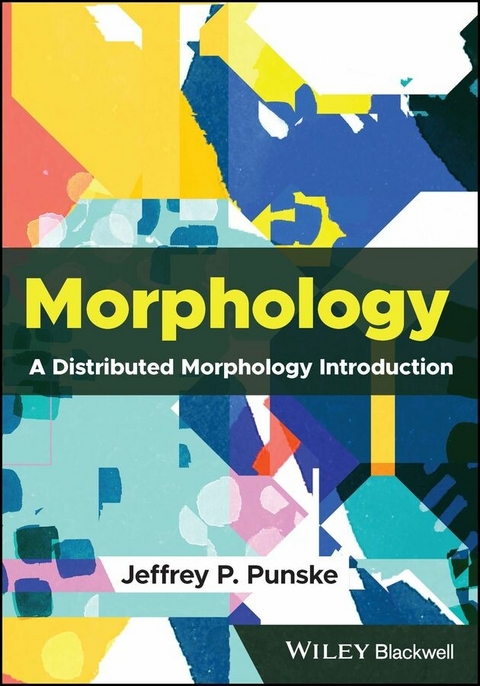
Morphology (eBook)
John Wiley & Sons (Verlag)
978-1-119-66781-0 (ISBN)
The first comprehensive morphology textbook written in the framework of Distributed Morphology, firmly grounded in cross-linguistic theory
Distributed Morphology is the theoretical framework that views morphology as syntactic, proposing that there is no divide between the construction of words and the construction of sentences. The first text of its kind, Morphology: A Distributed Morphology Introduction provides a thorough overview of Distributed Morphology using data and problem sets from a diverse selection of the world's languages. Divided into two parts, this valuable resource begins by describing the basics of morphology and then moves into an exploration of more advanced topics in morphology including morphosyntactic operations, cyclic derivation, the Mirror Principle, and non-compositional language. Each chapter includes a glossary of key terms, learning objectives, further readings, and illustrative examples to reinforce learning. Exercises and problem sets encourage students to develop their understanding and build confidence in the application of theory to practice. Through this valuable text, students will develop comprehension in morphological parsing and glossing, the concept of the lexicon, the different types of morphemes, the idea of paradigms, the basic practice of morphological analysis, and more.
Offering detailed yet accessible coverage of morphological theory from the perspective of Distributed Morphology, this textbook:
- Introduces the methodology used in morphology, the basic assumptions of Distributed Morphology, and key concepts from lexical grammatical approaches to language
- Covers essential phonology, feature interaction, paradigms as linguistic objects, core ideas of syntax and syntactic derivation, and derivation and inflection in Distributed Morphology
- Includes a Quick Reference Guide with glossing abbreviations from the Leipzig Glossing Rules, a full IPA chart with instructions, and charts of phonological features
- Provides access to a companion website containing solutions to problem sets and additional instructor resources
Morphology: A Distributed Morphology Introduction is the ideal textbook for advanced undergraduates and graduate students in morphology courses or with an interest in specializing in morphology. Offering students an unparalleled overview of this growing field of morphology, this text will ensure that developing morphologists are well-equipped to employ the latest methods in Distributed Morphology to their own research and study.
JEFFREY P. PUNSKE is an Associate Professor in the School of Languages and Linguistics and the Director of Undergraduate Studies in Linguistics at Southern Illinois University Carbondale, USA. He specializes in morphosyntax, especially in the framework of Distributed Morphology, and in linguistic pedagogy and public outreach through constructed languages. He has published in journals such as Lingua and Canadian Journal of Linguistics, and has presented on issues of language at workshops hosted by the European Space Agency and the National Space Society
The first comprehensive morphology textbook written in the framework of Distributed Morphology, firmly grounded in cross-linguistic theory Distributed Morphology is the theoretical framework that views morphology as syntactic, proposing that there is no divide between the construction of words and the construction of sentences. The first text of its kind, Morphology: A Distributed Morphology Introduction provides a thorough overview of Distributed Morphology using data and problem sets from a diverse selection of the world's languages. Divided into two parts, this valuable resource begins by describing the basics of morphology and then moves into an exploration of more advanced topics in morphology including morphosyntactic operations, cyclic derivation, the Mirror Principle, and non-compositional language. Each chapter includes a glossary of key terms, learning objectives, further readings, and illustrative examples to reinforce learning. Exercises and problem sets encourage students to develop their understanding and build confidence in the application of theory to practice. Through this valuable text, students will develop comprehension in morphological parsing and glossing, the concept of the lexicon, the different types of morphemes, the idea of paradigms, the basic practice of morphological analysis, and more. Offering detailed yet accessible coverage of morphological theory from the perspective of Distributed Morphology, this textbook: Introduces the methodology used in morphology, the basic assumptions of Distributed Morphology, and key concepts from lexical grammatical approaches to language Covers essential phonology, feature interaction, paradigms as linguistic objects, core ideas of syntax and syntactic derivation, and derivation and inflection in Distributed Morphology Includes a Quick Reference Guide with glossing abbreviations from the Leipzig Glossing Rules, a full IPA chart with instructions, and charts of phonological features Provides access to a companion website containing solutions to problem sets and additional instructor resources Morphology: A Distributed Morphology Introduction is the ideal textbook for advanced undergraduates and graduate students in morphology courses or with an interest in specializing in morphology. Offering students an unparalleled overview of this growing field of morphology, this text will ensure that developing morphologists are well-equipped to employ the latest methods in Distributed Morphology to their own research and study.
JEFFREY P. PUNSKE is an Associate Professor in the School of Languages and Linguistics and the Director of Undergraduate Studies in Linguistics at Southern Illinois University Carbondale, USA. He specializes in morphosyntax, especially in the framework of Distributed Morphology, and in linguistic pedagogy and public outreach through constructed languages. He has published in journals such as Lingua and Canadian Journal of Linguistics, and has presented on issues of language at workshops hosted by the European Space Agency and the National Space Society
chapter 1
Defining Morphology
Learning Objectives
Define what morphology is as a field.
Tackle the challenges of defining a “word.”
Learn the basics of the three‐line gloss.
Overview the Distributed Morphology framework.
0. PRELIMINARIES
Morphology, at its core, is the study of the word. Perhaps outside of a linguistics class, we rarely grapple with the question of “what is a word?” In a game of Scrabble or in another context where someone uses a term we are unfamiliar with, we may turn to one of our favorite dictionaries to confirm something’s wordhood. Even then, we recognize that the dictionary is slow to adapt to new usages and coinages – further, it does not always recognize what is basically productive about our linguistic system. For instance, if your boss instructed you to “recollate the files in the conference room,” you might grumble to yourself about the tediousness of the task. However, you probably would not point out that Merriam‐Webster Dictionary does not recognize “recollate” as a word of English – therefore the task makes no sense. You certainly would not point this out if you planned on keeping that job for any time.
Wordhood is not defined by whether or not the given item is listed in an official document. In our recollate case, we recognize that this is an English word, even if it is completely novel to us, because it follows predictable rules of English word formation: we combine two separated elements re‐ (a prefix meaning “do again”) with collate (a verb stem meaning “to put into order”). This prefix re‐ generally may occur with verbs and as speakers of English, we are aware of this and may use this to produce new and novel forms. Thus, our mental capacity for words may generate new forms and may do so far faster than any physical dictionary could keep up with. This mental capacity is part of our mental grammar. It is this grammar that we are studying throughout this book.
1. WORDHOOD
Fun Fact: While European writing traditions now involve spacing between words, this was not always the case. Early medieval and classical writing was done in a tradition known as scriptio continua. In this style of text, breaks were not found between words but instead where pauses would naturally be found, even within a word, when the text was being spoken.
Much as we must discard the idea that wordhood is associated with being listed in an official registry (a dictionary), we must consider and reject a few other common ideas about defining a word. In the first place, as readers of English, one common assumption about wordhood is that a word is a unit of language, which has spaces on both sides of it. This may be an adequate description of the general situation with English writing (though later in the book we will argue that complex terms with many spaces like pickle jar lid factory shift supervisor are, in fact, a single word). However, it certainly fails to account for spoken English, which does not put a pause between each word, let alone languages with other written traditions or the roughly 70% of languages that linguists estimate have no major written tradition.
Another common misconception is that there is a one‐to‐one correspondence between a word and a concept. We have already seen with our recollate example that words can be built of multiple concepts – in this case, our concepts “do again” and “put in order.” But perhaps a skeptic will object that re‐ is some form of lesser concept and that words are built solely out of a single core concept. There are many ways to meet this skeptic’s objection. First, we may look at the case of English compounds, which combine two otherwise independent words/concepts to form a single unit:
(1) blackbird
But, perhaps even more compelling, we may look to other languages of the world where a single word may express the equivalent of an English sentence. Such languages are known as polysynthetic, and we will look more at their properties throughout this book. An illustrative example is given below from the language Central Alaskan Yup’ik provided by first‐language speaker George Charles via Mithun (1999):
| (2) | kaipiallrulliniuk |
| kaig | ‐piar | ‐llru | ‐llni | ‐u | ‐k |
| be.hungry ‐really ‐PST ‐apparently ‐INDICATIVE ‐they.two |
| “the two of them were apparently really hungry” |
To be able to read and interpret all of the details of this example is not yet critical for us, though we will soon begin to cover the concept of glossing. What is critical about this example is that what would be a full sentence made up of independent words in other languages, such as English, is a single word in Central Alaskan Yup’ik. Further, this process of word building is fully productive in languages like Central Alaskan Yup’ik.
We will use the term productive throughout this text although there is not a precise definition for what it means. Generally, the term is used to describe morphological processes that are common in the language or morphological forms that occur regularly. We contrast it with nonproductive that describes morphological processes and forms that are found in a language but only rarely – perhaps due to historical change or language contact. For example, the English plural marker ‐s is productive because it is commonly found and applies to new words introduced to the language. The English plural marker ‐ren found in children is nonproductive as it is limited to one exceptional form.
What, then, makes a good definition for “word?” Haspelmath (2011) makes a compelling case that it may be impossible to generate an acceptable definition that will account for all languages. Nonetheless, we will continue to use this term “word” in an informal sense, but we will need to exercise caution making any formal reference to the concept of a word. What we should notice is that regardless of the status of the concept of “word,” languages build meaningful units out of other smaller meaningful units. Sometimes those units may stand on their own and be meaningful or usable as in the case of black and bird in blackbird, but in many cases, these units must combine with other units to be usable such as re‐ in recollate. These units, termed morphemes, are ultimately what this book is about. In many introductory textbooks, morphemes are defined as something like the “smallest unit of meaning.” Throughout this book, we will question and refine this definition. But, in a general sense (for now), a morpheme is the smallest of the units of meaning in language. An independent word containing no sub‐morphemes, such as bird, is itself a morpheme. Our goal is to understand the universal properties, distributions, and restrictions of morphemes. We will also study how they interact with other systems of grammar, such as phonology and syntax.
The study of morphology goes well beyond defining the concept of words. Our study will involve analyzing the internal components of words and how these components interact with other grammatical systems. It is our hope that by understanding morphology and its role in our broader linguistic systems we can better understand the nature of language itself.
2. DOING MORPHOLOGY
Linguists study morphology by breaking apart language (words, phrases, and sentences) into smaller component pieces: morphemes. Ultimately, this work is a form of scientific hypothesis building and is subject to the same scientific process as any other science.
We apply the scientific method in morphology in the following ways:
- Observe: Collect the relevant data from the target language.
- Hypothesize: Analyze, parse, and gloss the data.
- Predict: Make testable statements about the distribution and order of the morphemes you identified in your hypothesis.
- Test: Examine new data or contexts and determine how your statements behave.
A critical point is that just as there is no master list of words, there is no master list of morphemes. Doing morphology is a process of scientific discovery, which includes trial and error. Not every hypothesis will be correct. Sometimes, elements will appear to be morphemes when they are not or will appear to not be when they are. It is only through repeated observation and testing of our hypotheses that can we begin to be sure.
Morphology, like all scientific practice, is governed by the principle of simplicity of explanation, also known as Occam’s Razor. The basic idea is that if you have multiple viable competing solutions to the same problem, whichever requires the least amount of explanatory effort is most likely correct. In morphology, this typically means that we look to have fewer rules and constraints and we like to avoid having the same morpheme serving different...
| Erscheint lt. Verlag | 9.10.2023 |
|---|---|
| Sprache | englisch |
| Themenwelt | Schulbuch / Wörterbuch ► Wörterbuch / Fremdsprachen |
| Geisteswissenschaften ► Sprach- / Literaturwissenschaft ► Sprachwissenschaft | |
| Schlagworte | Distributed Morphology • distributed morphology framework • distributed morphology introduction • distributed morphology textbook • distributed morphology theory • Linguistics • Linguistik • morphological analysis textbook • Morphologie • Morphology • morphology introduction • morphology textbook • Sprachwissenschaften • Theoretical Linguistics • Theoretische Linguistik |
| ISBN-10 | 1-119-66781-X / 111966781X |
| ISBN-13 | 978-1-119-66781-0 / 9781119667810 |
| Informationen gemäß Produktsicherheitsverordnung (GPSR) | |
| Haben Sie eine Frage zum Produkt? |
 EPUB (Adobe DRM)
Kopierschutz: Adobe-DRM
Adobe-DRM ist ein Kopierschutz, der das eBook vor Mißbrauch schützen soll. Dabei wird das eBook bereits beim Download auf Ihre persönliche Adobe-ID autorisiert. Lesen können Sie das eBook dann nur auf den Geräten, welche ebenfalls auf Ihre Adobe-ID registriert sind.
Details zum Adobe-DRM
Dateiformat: EPUB (Electronic Publication)
EPUB ist ein offener Standard für eBooks und eignet sich besonders zur Darstellung von Belletristik und Sachbüchern. Der Fließtext wird dynamisch an die Display- und Schriftgröße angepasst. Auch für mobile Lesegeräte ist EPUB daher gut geeignet.
Systemvoraussetzungen:
PC/Mac: Mit einem PC oder Mac können Sie dieses eBook lesen. Sie benötigen eine
eReader: Dieses eBook kann mit (fast) allen eBook-Readern gelesen werden. Mit dem amazon-Kindle ist es aber nicht kompatibel.
Smartphone/Tablet: Egal ob Apple oder Android, dieses eBook können Sie lesen. Sie benötigen eine
Geräteliste und zusätzliche Hinweise
Buying eBooks from abroad
For tax law reasons we can sell eBooks just within Germany and Switzerland. Regrettably we cannot fulfill eBook-orders from other countries.
aus dem Bereich