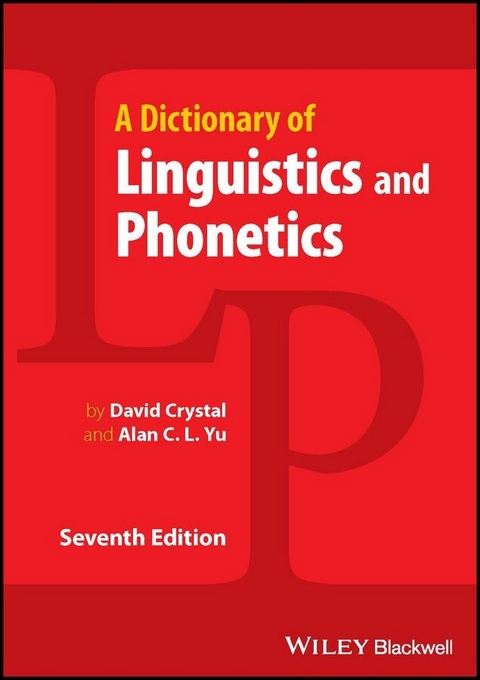
A Dictionary of Linguistics and Phonetics (eBook)
John Wiley & Sons (Verlag)
978-1-119-18459-1 (ISBN)
The fully updated new edition of the essential single-volume reference, covering the full fields of linguistics and phonetics
Now in its seventh edition, A Dictionary of Linguistics and Phonetics remains the definitive resource work for students of linguistics and phonetics. Originally created by David Crystal and revised for the new seventh edition with Alan C. L. Yu, this dictionary features a wealth of new entries by a team of experts in phonetics, phonology, syntax, semantics, sociolinguistics, and psycholinguistics. Throughout the text, most pre-existing entries have been updated to reflect the current body of knowledge in the areas of linguistics and phonetics.
Covering more than 5,100 terms, the new seventh edition reflects the latest state of the field and accounts for evolutions in research and theory since the publication of the prior edition. The entries provide clear and authoritative definitions of each term and are supported by additional information such as the historical context in which a term was used or the relationship between a term and others from associated fields. This useful work:
- Features new and updated entries reflecting the way established terms are now perceived in light of changes in the field
- Integrates ideas from the minimalist program, situating linguistic theory in the broader cognitive sciences
- Includes tables of abbreviations, symbols, and the International Phonetic Alphabet
- Offers unique insights into the historical development of linguistics
- Identifies major lexical variants as separate headwords, enabling readers to quickly find the location of a term
- Provides word-class identifiers and usage examples for single-word headwords, especially useful for non-native English speakers
A Dictionary of Linguistics and Phonetics, Seventh Edition is an invaluable reference work for professionals, students, and general readers alike, and remains an essential resource for anyone studying linguistics or phonetics at the university level.
David Crystal is Honorary Professor of Linguistics at the University of Bangor, formerly at the University of Reading, and a Fellow of the British Academy. He has been author, co-author, or editor of over 120 books, including several benchmark reference volumes such as The Cambridge Encyclopedia of Language (1987, 1997, 2010) and The New Penguin Encyclopedia (2003), and books that have spread awareness of linguistics to general readers, such as The Stories of English (2004).
Alan C. L. Yu is the William Colvin Professor of Linguistics and the College at the University of Chicago. His research focuses on language variation and change, particularly from an individual-difference perspective. He is the author of A Natural History of Infixation (2007), the editor of Origins of Sound Change: Approaches to Phonologization (2013), and co-editor of The Handbook of Phonological Theory, Second Edition (2011, Wiley Blackwell). He is co-General Editor of Laboratory Phonology and Associate Editor of the International Journal of American Linguistics.
David Crystal is Honorary Professor of Linguistics at the University of Bangor, formerly at the University of Reading, and a Fellow of the British Academy. He has been author, co-author, or editor of over 120 books, including several benchmark reference volumes such as The Cambridge Encyclopedia of Language (1987, 1997, 2010) and The New Penguin Encyclopedia (2003), and books that have spread awareness of linguistics to general readers, such as The Stories of English (2004). Alan C. L. Yu is the William Colvin Professor of Linguistics and the College at the University of Chicago. His research focuses on language variation and change, particularly from an individual-difference perspective. He is the author of A Natural History of Infixation (2007), the editor of Origins of Sound Change: Approaches to Phonologization (2013), and co-editor of The Handbook of Phonological Theory, Second Edition (2011, Wiley Blackwell). He is co-General Editor of Laboratory Phonology and Associate Editor of the International Journal of American Linguistics.
Preface to the Seventh Edition vi
Acknowledgements xi
List of Abbreviations xiii
List of Symbols xxii
The International Phonetic Alphabet xxvi
Alphabetical Entries 1
Preface to the Seventh Edition
This is the Preface used in earlier editions, with minor updating. For an account of the present jointly edited edition, see the Addendum below.
When I took the first survey of my undertaking, I found our speech copious without order, and energetick without rules: wherever I turned my view, there was perplexity to be disentangled, and confusion to be regulated; choice was to be made out of boundless variety, without any established principle of selection; adulterations were to be detected, without a settled test of purity; and modes of expression to be rejected or received, without the suffrages of any writers of classical reputation or acknowledged authority.
Samuel Johnson, ‘Preface’ to A Dictionary of the English Language
One sign of immaturity [in a science] is the endless flow of terminology. The critical reader begins to wonder if some strange naming taboo attaches to the terms that a linguist uses, whereby when he dies they must be buried with him.
Dwight Bolinger, Aspects of Language, p. 554
It is over forty years since the first edition of this book, and the plaint with which I began the preface to that edition remains as valid as ever. What is needed, I said then, is a comprehensive lexicographical survey, on historical principles, of twentieth-century terminology in linguistics and phonetics. And I continued, in that and the subsequent prefaces, in the following way.
We could use the techniques, well established, which have provided dictionaries of excellence, such as the Oxford English Dictionary. The painstaking scrutiny of texts from a range of contexts, the recording of new words and senses on slips, and the systematic correlation of these as a preliminary to representing patterns of usage: such steps are routine for major surveys of general vocabulary and could as readily be applied for a specialized vocabulary, such as the present undertaking. Needless to say, it would be a massive task – and one which, for linguistics and phonetics, has frequently been initiated, though without much progress. I am aware of several attempts to work along these lines, in Canada, Great Britain, Japan and the United States, sometimes by individuals, sometimes by committees. All seem to have foundered, presumably for a mixture of organizational and financial reasons. I tried to initiate such a project myself, twice, but failed both times, for the same reasons. The need for a proper linguistics dictionary is thus as urgent now as it ever was; but to be fulfilled it requires a combination of academic expertise, time, physical resources and finance which so far have proved impossible to attain.
But how to cope, in the meantime, with the apparently ‘endless flow of terminology’ which Bolinger, among many others, laments? And how to deal with the enquiries from the two kinds of consumer of linguistic and phonetic terms? For this surely is the peculiar difficulty which linguists have always had to face – that their subject, despite its relative immaturity, carries immense popular as well as academic appeal. Not only, therefore, is terminology a problem for the academic linguist and phonetician; these days, such people are far outnumbered by those who, for private or professional reasons, have developed more than an incidental interest in the subject. It is of little use intimating that the interest of the outside world is premature, as has sometimes been suggested. The interest exists, in a genuine, responsible and critical form, and requires a comparably responsible academic reaction. The present dictionary is, in the first instance, an attempt to meet that popular demand for information about linguistic terms, pending the fuller, academic evaluation of the subject’s terminology which one day may come.
The demand has come mainly from those for whom a conscious awareness of language is an integral part of the exercise of a profession, and upon whom the influence of linguistics has been making itself increasingly felt in recent years. This characterization includes two main groups: the range of teaching and remedial language professions, such as foreign-language teaching or speech and language therapy; and the range of academic fields which study language as part of their concerns, such as psychology, anthropology, sociology, literary criticism and philosophy. It also includes an increasing number of students of linguistics – especially those who are taking introductory courses in the subject at postgraduate or in-service levels. In addition, there are the many categories of first-year undergraduate students of linguistics and phonetics, and (especially since the early 1990s) a corresponding growth in the numbers studying the subject abroad. My aim, accordingly, is to provide a tool which will assist these groups in their initial coming to grips with linguistic terminology, and it is this which motivated the original title of the book in 1980: A First Dictionary of Linguistics and Phonetics. The publisher dropped the word First from later editions, on the grounds that it had little force, given that there was no ‘advanced’ dictionary for students to move on to; but, though my book has doubled in size during the intervening period, it still seems as far away from a comprehensive account as it did at the outset. Bolinger’s comment still very much obtains.
Coverage
Once a decision about readership had been made, the problem of selecting items and senses for inclusion simplified considerably. It is not the case that the whole of linguistic terminology, and all schools of thought, have proved equally attractive or useful to the above groups. Some terms have been used (and abused) far more than others. For example, COMPETENCE, LEXIS, GENERATE, STRUCTURALISM, MORPHOLOGY and PROSODY are a handful which turn up so often in a student’s early experience of the subject that their exclusion would have been unthinkable. The terminology of phonetics, also, is so pervasive that it is a priority for special attention. On the other hand, there are many highly specialized terms which are unlikely to cause any problems for my intended readership, as they will not encounter them in their initial contact with linguistic ideas. The detailed terminology of, say, glossematics or stratificational grammar has not made much of an impact on the general consciousness of the above groups. While I have included several of the more important theoretical terms from these less widely encountered approaches, therefore, I have not presented their terminology in any detail. Likewise, some linguistic theories and descriptions have achieved far greater popularity than others – generative grammar, in all its incarnations, most obviously, and (in Great Britain) Hallidayan linguistics and the Quirk reference grammar, for example.
The biases of this dictionary, I hope, will be seen to be those already present in the applied and introductory literature – with a certain amount of systematization and filling-out in places, to avoid gaps in the presentation of a topic; for example, whereas many introductory texts selectively illustrate DISTINCTIVE FEATURES, this topic has been systematically covered in the present book. I devote a great deal of space to the many ‘harmless-looking’ terms which are used by linguists, where an apparently everyday word has developed a special sense, often after years of linguistic debate, such as FORM, FUNCTION, FEATURE, ACCENT, WORD and SENTENCE. These are terms which, perhaps on account of their less technical appearance, cause especial difficulty at an introductory level. Particular attention is paid to them in this dictionary, therefore, alongside the more obvious technical terms, such as PHONEME, BILABIAL, ADJUNCTION and HYPONYMY.
Bearing in mind the background of my primary readership has helped to simplify the selection of material for inclusion in a second way: the focus was primarily on those terms and senses which have arisen because of the influence of twentieth-century linguistics and phonetics. This dictionary is therefore in contrast with several others, where the aim seems to have been to cover the whole field of language, languages and communication, as well as linguistics and phonetics. My attitude here is readily summarized: I do not include terms whose sense any good general dictionary would routinely handle, such as alphabet and aphorism. As terms, they owe nothing to the development of ideas in linguistics. Similarly, while such terms as runic and rhyme-scheme are more obviously technical, their special ranges of application derive from conceptual frameworks other than linguistics. I have therefore not attempted to take on board the huge terminological apparatus of classical rhetoric and literary criticism (in its focus on language), or the similarly vast terminology of speech and language disorders. Nor have I gone down the encyclopaedia road, adding names of people, languages and other ‘proper names’, apart from in the few cases where schools of thought have developed (CHOMSKYAN, BLOOMFIELDIAN, PRAGUE SCHOOL, etc.). Many of these terms form the subject-matter of my companion volume, The Penguin Dictionary of Language (1999), which is the second edition of a work that originally appeared as An Encyclopedic Dictionary of Language and Languages (Blackwell/Penguin, 1992).
In the first edition, to keep the focus sharp on the contemporary subject, I was quite rigorous about excluding several types of term, unless they had edged their way into modern linguistics: the terminology of traditional (pre-twentieth-century) language study,...
| Erscheint lt. Verlag | 19.9.2023 |
|---|---|
| Sprache | englisch |
| Themenwelt | Schulbuch / Wörterbuch ► Wörterbuch / Fremdsprachen |
| Geisteswissenschaften ► Sprach- / Literaturwissenschaft ► Sprachwissenschaft | |
| Schlagworte | English linguistics dictionary • Linguistics • linguistics definitions • linguistics reference • linguistics terms • Linguistik • Philosophie • Philosophy • Philosophy of Language • phonetics definitions • phonetics dictionary • phonetics reference • phonetics terms • Phonetik • semantics dictionary • sociolinguistics dictionary • Speech Science • Sprache • Sprachphilosophie • Sprachwissenschaften • Sprechwissenschaft • syntax dictionary |
| ISBN-10 | 1-119-18459-2 / 1119184592 |
| ISBN-13 | 978-1-119-18459-1 / 9781119184591 |
| Informationen gemäß Produktsicherheitsverordnung (GPSR) | |
| Haben Sie eine Frage zum Produkt? |
 EPUB (Adobe DRM)
Kopierschutz: Adobe-DRM
Adobe-DRM ist ein Kopierschutz, der das eBook vor Mißbrauch schützen soll. Dabei wird das eBook bereits beim Download auf Ihre persönliche Adobe-ID autorisiert. Lesen können Sie das eBook dann nur auf den Geräten, welche ebenfalls auf Ihre Adobe-ID registriert sind.
Details zum Adobe-DRM
Dateiformat: EPUB (Electronic Publication)
EPUB ist ein offener Standard für eBooks und eignet sich besonders zur Darstellung von Belletristik und Sachbüchern. Der Fließtext wird dynamisch an die Display- und Schriftgröße angepasst. Auch für mobile Lesegeräte ist EPUB daher gut geeignet.
Systemvoraussetzungen:
PC/Mac: Mit einem PC oder Mac können Sie dieses eBook lesen. Sie benötigen eine
eReader: Dieses eBook kann mit (fast) allen eBook-Readern gelesen werden. Mit dem amazon-Kindle ist es aber nicht kompatibel.
Smartphone/Tablet: Egal ob Apple oder Android, dieses eBook können Sie lesen. Sie benötigen eine
Geräteliste und zusätzliche Hinweise
Buying eBooks from abroad
For tax law reasons we can sell eBooks just within Germany and Switzerland. Regrettably we cannot fulfill eBook-orders from other countries.
aus dem Bereich