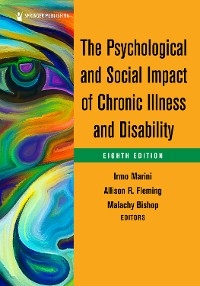
The Psychological and Social Impact of Chronic Illness and Disability (eBook)
548 Seiten
Springer Publishing Company (Verlag)
978-0-8261-5111-7 (ISBN)
List of Contributors
Foreword
Preface
Acknowledgments
PART I. HISTORICAL and Cultural PERSPECTIVES ON ILLNESS AND DISABILITY
Chapter 1. History of Treatment Toward Persons With Disabilities in America and Abroad
Chapter 2. Societal Attitudes and Myths about Disability: Improving Social Consciousness
Chapter 3. History of Treatment Toward Persons With Psychiatric Disabilities
Chapter 4. Disability Identity and Disability Culture
Chapter 5. Recognizing, Understanding, and Constructively Responding to Ableism
Chapter 6. The Evolution of Laws and Policies in the United States and Their Impact on Disabled People
PART II. THE PERSONAL IMPACT OF DISABILITY
Chapter 7. Psychosocial Adaptation to Chronic Illness and Disability (CID): A Primer for Counselors
Chapter 8. Theories of Adjustment and Adaptation to Disability
Chapter 9. Vulnerabilities, Abuse, and Psychosocial Disparities of Women With Disabilities
Chapter 10. Sexuality and Disability
Chapter 11. Ableist Microaggressions
Chapter 12. Quality of Life (QOL) and Psychosocial Adaptation to Chronic Illness and Disability
PART III. FAMILY ISSUES IN ILLNESS AND DISABILITY
Chapter 13. Family Adaptation Across Cultures Toward Loved Ones With Disability
Chapter 14. Giving Parents a Voice: Challenges Experienced by Parents of Children With Disabilities
Chapter 15. Psychosocial Counseling Aspects of Grief, Dying, and Death
Chapter 16. Psychosocial Issues for Family Caregivers
PART IV. SPECIFIC TRAUMAS AND STIGMATIZED POPULATIONS
Chapter 17. Living With Substance Use Disorder: From Stigma to Recovery
Chapter 18. Culturally Competent Service Provision: Considerations for Supporting Veterans and Family Reintegration
Chapter 19. Responding Well to Individuals Experiencing Abuse and Relationship Violence
Chapter 20. Immigrants, Refugees, and Asylum Seekers: The Psychosocial Cost of War on Civilians
Chapter 21. Key Concepts and Techniques for an Aging Population of Persons With Disabilities
PART V. NEW DIRECTIONS, ISSUES, AND PERSPECTIVES
Chapter 22. Interventions to Improve the Well-Being of People With Disabilities and Chronic Illness
Chapter 23. Users of Assistive Technology: The Human Component
Chapter 24. Religion and Disability
Chapter 25. Social Justice, Oppression, and Disability Counseling
Chapter 26. The Impact of Social-Media Influence on Mental Health
Chapter 27. Reflections and Considerations
APPENDIX A. PERSONAL PERSPECTIVES
Index
| Erscheint lt. Verlag | 15.9.2023 |
|---|---|
| Sprache | englisch |
| Themenwelt | Schulbuch / Wörterbuch ► Schulbuch / Allgemeinbildende Schulen |
| Medizin / Pharmazie ► Medizinische Fachgebiete | |
| Studium ► 1. Studienabschnitt (Vorklinik) ► Med. Psychologie / Soziologie | |
| Sozialwissenschaften ► Soziologie | |
| ISBN-10 | 0-8261-5111-6 / 0826151116 |
| ISBN-13 | 978-0-8261-5111-7 / 9780826151117 |
| Informationen gemäß Produktsicherheitsverordnung (GPSR) | |
| Haben Sie eine Frage zum Produkt? |
 EPUB (Adobe DRM)
Kopierschutz: Adobe-DRM
Adobe-DRM ist ein Kopierschutz, der das eBook vor Mißbrauch schützen soll. Dabei wird das eBook bereits beim Download auf Ihre persönliche Adobe-ID autorisiert. Lesen können Sie das eBook dann nur auf den Geräten, welche ebenfalls auf Ihre Adobe-ID registriert sind.
Details zum Adobe-DRM
Dateiformat: EPUB (Electronic Publication)
EPUB ist ein offener Standard für eBooks und eignet sich besonders zur Darstellung von Belletristik und Sachbüchern. Der Fließtext wird dynamisch an die Display- und Schriftgröße angepasst. Auch für mobile Lesegeräte ist EPUB daher gut geeignet.
Systemvoraussetzungen:
PC/Mac: Mit einem PC oder Mac können Sie dieses eBook lesen. Sie benötigen eine
eReader: Dieses eBook kann mit (fast) allen eBook-Readern gelesen werden. Mit dem amazon-Kindle ist es aber nicht kompatibel.
Smartphone/Tablet: Egal ob Apple oder Android, dieses eBook können Sie lesen. Sie benötigen eine
Geräteliste und zusätzliche Hinweise
Buying eBooks from abroad
For tax law reasons we can sell eBooks just within Germany and Switzerland. Regrettably we cannot fulfill eBook-orders from other countries.
aus dem Bereich