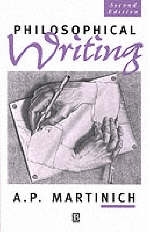
Philosophical Writing
Blackwell Publishers (Verlag)
978-0-631-20281-3 (ISBN)
- Titel erscheint in neuer Auflage
- Artikel merken
This is the substantially updated and revised edition of A. P. Martinich's best-selling text, Philosophical Writing: An Introduction. It's goal is to help those with little or no experience in philosophy to write successfully. By improving students' ability to present their knowledge and thoughts clearly, it helps them gain confidence in their essay-writing skills. This new edition includes three new sections on Contraries and Contradictions, Distinctions, and Definitions, as well as a glossary of those terms peculiar to philosophical prose (such as "obtain" and "straw man"). The second edition retains the highly acclaimed commentary on features of an essay, showing the evolution from draft stage to completion of a good paper, a crash course on logic, and a clear description of types of reasoning. It also discusses the special problem of being a student-author writing for a professor.
A.P. Martinich is the Roy Allison Vaughan Centennial Professor of Philosophy, History, and Government at the University of Texas at Austin. He is the author or editor of thirteen books, including Hobbes: A Biography (1999), The Philosophy of Language: 4th edition (2000), and A Companion to Analytic Philosophy (Blackwell, 2001).
Notes to the Second Edition. Introduction. Part I: Author and Audience. 1. The Professor as Audience. 2. The Student as Author. Part II: Logic and Argument for Writing. 3. What is a Good Argument? 4. Valid Arguments. 5. Cogent Arguments. 6. Consistency and Contradiction. 7. Contraries and Contradictions. 8. The Strength of a Proposition. Part III: The Structure of a Philosophical Essay. 9. An Outline of the Structure of a Philosophical Essay. 10. Anatomy of an Essay. Part IV: Composing. 11. How to Select an Essay Topic. 12. Techniques for Composing. 13. Outlining. 14. Successful Elaboration. 15. Conceptual Note Taking. 16. Research and Composing. 17. Polishing. 18. Evolution of an Essay. Part V: Tactics for Analytic Writing. 19. Definitions. 20. Distinctions. 21. Analysis. 22. Dilemmas. 23. Counterexamples. 24. Reductio ad Absurdum. 25. Dialectical Reasoning. Part VI: Some Constraints on Content. 26. The Pursuit of Truth. 27. The Use of Authority. 28. The Burden of Proof. Part VII: Some Goals of Form: 29. Coherence. 30. Clarity. 31. Conciseness. 32. Rigor. Part VIII: Problems with Introductions: 33. Slip Sliding Away. 34. The Tail Wagging the Dog. 35. The Running Start. Appendix A: "It's Sunday Night and I have an Essay Due Monday Morning." Appendix B: Glossary of Philosophical Terms. Index.
| Erscheint lt. Verlag | 29.11.1996 |
|---|---|
| Verlagsort | Oxford |
| Sprache | englisch |
| Maße | 216 x 140 mm |
| Gewicht | 273 g |
| Themenwelt | Schulbuch / Wörterbuch ► Wörterbuch / Fremdsprachen |
| Geisteswissenschaften ► Philosophie | |
| Geisteswissenschaften ► Sprach- / Literaturwissenschaft ► Literaturwissenschaft | |
| Geisteswissenschaften ► Sprach- / Literaturwissenschaft ► Sprachwissenschaft | |
| ISBN-10 | 0-631-20281-1 / 0631202811 |
| ISBN-13 | 978-0-631-20281-3 / 9780631202813 |
| Zustand | Neuware |
| Informationen gemäß Produktsicherheitsverordnung (GPSR) | |
| Haben Sie eine Frage zum Produkt? |
aus dem Bereich