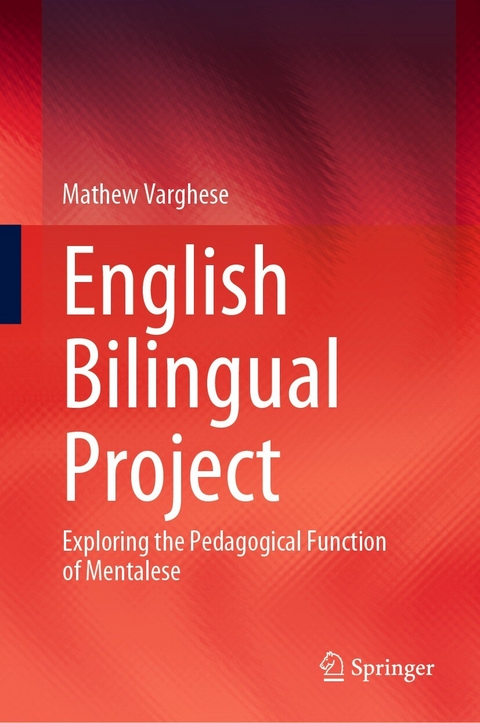
English Bilingual Project (eBook)
XXIX, 281 Seiten
Springer Nature Singapore (Verlag)
978-981-19-4778-0 (ISBN)
Today, English is the global lingua franca and competent English communication skills should be one of the rights of all educated individuals irrespective of any socio-cultural limits. By introducing a new method, this book focuses on helping any learner to get sufficient communication skills in English as much as in the native language. This method helps one to avoid translating from mother tongue to English. And by using the method of thinking in English, one could acquire the required English bilingual skills naturally. The method is founded on the philosophical idea of mentalese-mind language as the base language of thinking available for humans for constructing thoughts. The proposed English Bilingual Project (EBP) helps one to transfer thoughts from a structureless mentalese to the grammatical structure of any language English/Japanese/Chinese. The method described in this book works in two ways: one it helps one to intuitively understand the working of mentalese; the other is by practicing think in English with the mentalese, one could generate the bilingual brain. The main procedure for transferring thoughts from the mentalese to English is through writing one's thoughts. This helps one to think effectively in English like one's own mother tongue. This method works as a prime requirement model for one to generate multilingual skills. The book resourced the idea of mentalese from the classical philosophy, reflects it with the modern generative theories, links it with the studies in neuro-linguistic studies on bilingualism and the bilingual brain.
Mathew Varghese is a textual scholar who works on textual interpretations of classical Buddhist texts. He uses philosophical hermeneutics for to interpret Sanskrit Buddhist texts into English. He also works on bilingual communication. Here, the pedagogical function of mentalese is used for interpreting thought in more than two languages. He has published four books and several papers including works on bilingual communication, and also edits a newsletter, BilingualValue Bulletin since 2006. He teaches bilingual communication classes at Aoyama Gakuin University, Sophia University, Kanagawa University and Wako University in Tokyo, and also a research fellow at the Hajime Nakamura Eastern Institute, Tokyo.
Today, English is the global lingua franca and competent English communication skills should be one of the rights of all educated individuals irrespective of any socio-cultural limits. By introducing a new method, this book focuses on helping any learner to get sufficient communication skills in English as much as in the native language. This method helps one to avoid translating from mother tongue to English. And by using the method of thinking in English, one could acquire the required English bilingual skills naturally. The method is founded on the philosophical idea of mentalese-mind language as the base language of thinking available for humans for constructing thoughts. The proposed English Bilingual Project (EBP) helps one to transfer thoughts from a structureless mentalese to the grammatical structure of any language English/Japanese/Chinese. The method described in this book works in two ways: one it helps one to intuitively understand the working of mentalese; the other is by practicing think in English with the mentalese, one could generate the bilingual brain. The main procedure for transferring thoughts from the mentalese to English is through writing one's thoughts. This helps one to think effectively in English like one's own mother tongue. This method works as a prime requirement model for one to generate multilingual skills. The book resourced the idea of mentalese from the classical philosophy, reflects it with the modern generative theories, links it with the studies in neuro-linguistic studies on bilingualism and the bilingual brain.
| Erscheint lt. Verlag | 31.10.2022 |
|---|---|
| Zusatzinfo | XXIX, 281 p. 6 illus., 3 illus. in color. |
| Sprache | englisch |
| Themenwelt | Schulbuch / Wörterbuch ► Wörterbuch / Fremdsprachen |
| Geisteswissenschaften ► Philosophie ► Sprachphilosophie | |
| Geisteswissenschaften ► Sprach- / Literaturwissenschaft ► Sprachwissenschaft | |
| Sozialwissenschaften ► Pädagogik | |
| Schlagworte | bilingual brain • Bilingual Communication • Language Faculty • Mentalese—Mind Language • Philosophy of Languages • Thinking in English |
| ISBN-10 | 981-19-4778-3 / 9811947783 |
| ISBN-13 | 978-981-19-4778-0 / 9789811947780 |
| Informationen gemäß Produktsicherheitsverordnung (GPSR) | |
| Haben Sie eine Frage zum Produkt? |
 PDF (Wasserzeichen)
DRM: Digitales Wasserzeichen
Dieses eBook enthält ein digitales Wasserzeichen und ist damit für Sie personalisiert. Bei einer missbräuchlichen Weitergabe des eBooks an Dritte ist eine Rückverfolgung an die Quelle möglich.
Dateiformat: PDF (Portable Document Format)
Mit einem festen Seitenlayout eignet sich die PDF besonders für Fachbücher mit Spalten, Tabellen und Abbildungen. Eine PDF kann auf fast allen Geräten angezeigt werden, ist aber für kleine Displays (Smartphone, eReader) nur eingeschränkt geeignet.
Systemvoraussetzungen:
PC/Mac: Mit einem PC oder Mac können Sie dieses eBook lesen. Sie benötigen dafür einen PDF-Viewer - z.B. den Adobe Reader oder Adobe Digital Editions.
eReader: Dieses eBook kann mit (fast) allen eBook-Readern gelesen werden. Mit dem amazon-Kindle ist es aber nicht kompatibel.
Smartphone/Tablet: Egal ob Apple oder Android, dieses eBook können Sie lesen. Sie benötigen dafür einen PDF-Viewer - z.B. die kostenlose Adobe Digital Editions-App.
Buying eBooks from abroad
For tax law reasons we can sell eBooks just within Germany and Switzerland. Regrettably we cannot fulfill eBook-orders from other countries.
aus dem Bereich