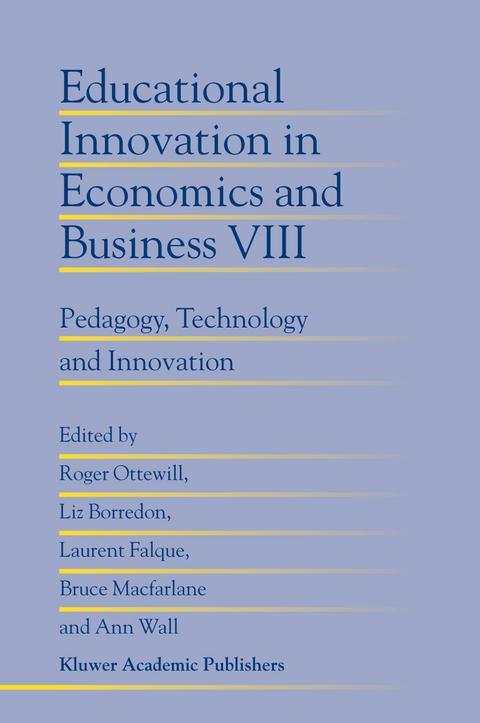
Educational Innovation in Economics and Business
Kluwer Academic Publishers (Verlag)
978-1-4020-1787-2 (ISBN)
I: The Business Context.- How E-Learning Businesses Meet Client and End User Needs: Analysing the Collaborative Contexts.- Business Process, Experience and Memory: Educational Approaches and Technology Tools for a Global Workforce.- II: Challenges for the Academy.- From High Level Clarity to Ground Level Confusion: Exactly Where do IT-Mediated Education Policies Fit?.- Moving a University Toward On-line Learning: Opportunities, Challenges, and Technologies.- Linking Pedagogical Innovation and Information Technology to Enhance Business Education.- The Experience of Self-Organized Learning Through the Use of Learning Plans for Knowledge Management.- III: Team and Collaborative Learning.- Using Student Consulting Team Assignments as a Vehicle to Teach a Systems Development Course.- Using Team Learning in the Classroom: Experiences and Lessons.- Using Teams in the Classroom: Meeting the Challenge of Evaluating Students’ Work.- International Management: Early Experience in Multicultural Virtual Team Interaction.- IV: Problem Based Learning.- PRAXIS: A Practice-Based Instructional System in the First Year of an Industrial Engineering Program.- Using the Web for Problem-Based Learning.- Effects of Problem-Based Learning in Business Education: A Comparison Between a PBL and a Conventional Educational Approach.- Learning about Teaching Information Systems in a Problem-Based Curriculum: An Exploratory Study of the Impact of Students’ Individual Differences on their Conception and Perception of Problem Tasks.- V: Distance and On Line Learning.- The Use of a Virtual Learning Environment to Support Learners on Work-Based Learning Programs.- Distance Learning: The Experience of Accounting at the University of Natal (Durban), South Africa.- Creating and Improving a “VirtualObject” Through Web-Mediated Discourse.- Testing Social Information Processing Theories in Distance Education.- VI: Specific Applications of Learning Technology.- Electronic Tutorial for Moral Reasoning in Business Education: A Technological Learning Tool to Facilitate Students’ Moral Reasoning.- The Five Key Benefits of On-line Final Examinations (with Three Free Bonus Benefits).- Assertion-Reason Assessment in Formative and Summative Tests: Results from Two Graduate Case Studies.- Exploring the Implications of Videoconferencing for Management Learning.
| Erscheint lt. Verlag | 31.12.2003 |
|---|---|
| Reihe/Serie | Educational Innovation in Economics and Business ; 8 |
| Zusatzinfo | 1686 Illustrations, black and white; XXIII, 401 p. 1686 illus. |
| Verlagsort | Dordrecht |
| Sprache | englisch |
| Maße | 155 x 235 mm |
| Themenwelt | Schulbuch / Wörterbuch ► Unterrichtsvorbereitung ► Unterrichts-Handreichungen |
| Geisteswissenschaften ► Psychologie ► Allgemeine Psychologie | |
| Geisteswissenschaften ► Psychologie ► Pädagogische Psychologie | |
| Sozialwissenschaften ► Pädagogik ► Allgemeines / Lexika | |
| Wirtschaft ► Betriebswirtschaft / Management ► Allgemeines / Lexika | |
| Wirtschaft ► Betriebswirtschaft / Management ► Personalwesen | |
| Wirtschaft ► Volkswirtschaftslehre | |
| ISBN-10 | 1-4020-1787-1 / 1402017871 |
| ISBN-13 | 978-1-4020-1787-2 / 9781402017872 |
| Zustand | Neuware |
| Informationen gemäß Produktsicherheitsverordnung (GPSR) | |
| Haben Sie eine Frage zum Produkt? |
aus dem Bereich