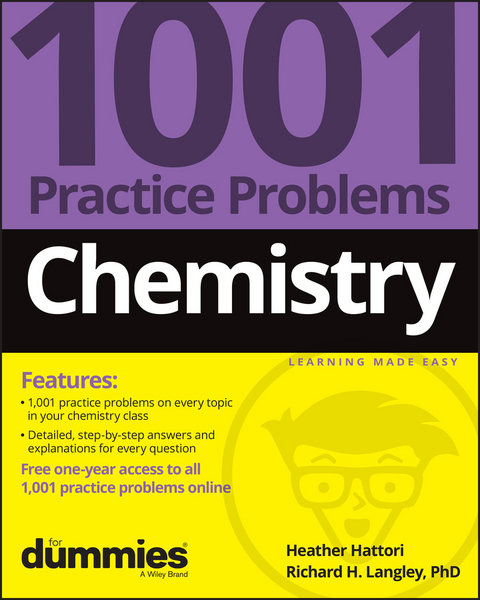
Chemistry: 1001 Practice Problems For Dummies (+ Free Online Practice) (eBook)
John Wiley & Sons (Verlag)
978-1-119-88355-5 (ISBN)
Practice your way to a better grade in your Chemistry class
Chemistry: 1001 Practice Problems For Dummies gives you 1,001 opportunities to practice solving problems on all the topics covered in your chemistry class-in the book and online! Get extra practice with tricky subjects, solidify what you've already learned, and get in-depth walk-throughs for every problem with this useful book. These practice problems and detailed answer explanations will catalyze the reactions in your brain, no matter what your skill level. Thanks to Dummies, you have a resource to help you put key concepts into practice.
- Work through multiple-choice practice problems on all Chemistry topics covered in class
- Step through detailed solutions to build your understanding
- Access practice questions online to study anywhere, any time
- Improve your grade and up your study game with practice, practice, practice
The material presented in Chemistry: 1001 Practice Problems For Dummies is an excellent resource for students, as well as parents and tutors looking to help supplement classroom instruction.
Chemistry: 1001 Practice Problems For Dummies (9781119883531) was previously published as 1,001 Chemistry Practice Problems For Dummies (9781118549322). While this version features a new Dummies cover and design, the content is the same as the prior release and should not be considered a new or updated product.
Heather Hattori has taught both high school and college level chemistry during her 30+ years in education.
Richard H. Langley, PhD, is on the faculty of Stephen F. Austin State University in Nacogdoches,Texas, where he teaches chemistry.
Heather Hattori has taught both high school and college level chemistry during her 30+ years in education. Richard H. Langley, PhD, is on the faculty of Stephen F. Austin State University in Nacogdoches,Texas, where he teaches chemistry.
Introduction 1
Part 1: The Questions 5
Chapter 1: Units and Unit Conversions 7
Chapter 2: Scientific Notation and Significant Figures 13
Chapter 3: Matter and Energy 19
Chapter 4: The Atom and Nuclear Chemistry 25
Chapter 5: Periodicity and the Periodic Table 33
Chapter 6: Ionic Bonding 39
Chapter 7: Covalent Bonding 47
Chapter 8: Molecular Geometry 53
Chapter 9: Chemical Reactions 61
Chapter 10: Molar Calculations 71
Chapter 11: Thermochemistry 83
Chapter 12: Gases 97
Chapter 13: Solutions (The Chemistry Kind) 107
Chapter 14: Acids and Bases 115
Chapter 15: Graphing Basics 125
Part 2: The Answers 131
Chapter 16: Answers and Explanations 133
Appendix: the Periodic Table of Elements 425
Index 427
Chapter 4
The Atom and Nuclear Chemistry
An atom consists of a nucleus surrounded by one or more electrons. Although the number of protons identifies the element, the electrons are the key to the chemistry. The arrangement of electrons in an atom influences the atom’s ability to gain, lose, or share electrons and therefore form compounds. Quantum numbers describe the arrangement of the electrons. Unstable atoms undergo nuclear decay to transform to stable atoms. Atoms may be broken apart by fission or joined by fusion.
The Problems You’ll Work On
In this chapter, you work with atoms and nuclear chemistry in the following ways:
- Counting subatomic particles
- Interpreting isotope notation
- Writing electron configurations
- Calculating average atomic mass and percent abundance
- Understanding nuclear decay and balancing nuclear equations
Note: For access to the periodic table, see the Appendix.
What to Watch Out For
Remember the following when working on atoms and nuclear chemistry:
- Note that unlike the atomic mass, the mass number is usually not found on the periodic table.
- Remember the maximum number of electrons possible in each subshell, and follow Hund’s rule and the Aufbau principle when filling orbitals. Know the rules for assigning the four quantum numbers.
- Know the common nuclear decay modes.
- Remember that balancing nuclear equations depends on both the mass numbers and the atomic numbers.
- Know how to calculate the half-life and how to use it.
Isotopes and Subatomic Particles
191–219 Answer the question on isotopes and subatomic particles.
191. How many protons are in an atom of sodium?
192. How many electrons are in an atom of bromine?
193. How many electrons are in an atom of nickel?
194. How many protons are in an atom of radon?
195. How many neutrons are in an atom of isotope potassium-40?
196. How is the atomic number related to the number of protons in an atom?
197. How is the mass number of an atom related to the number of neutrons?
198. How many protons, electrons, and neutrons are in an atom of isotope copper-63?
199. An atom has a mass number of 14 and 6 electrons. How many protons and neutrons does it have?
200. An atom has 40 electrons and 51 neutrons. What is its mass number, and how many protons does it have?
201. What does the top number in isotope notation represent?
202. What does the bottom number in isotope notation represent?
203. How many protons and neutrons are in ?
204. How many protons and neutrons are in ?
205. What is the isotope notation for an atom of carbon-12?
206. What is the isotope notation for an atom of chlorine-37?
207. What is the name of ?
208. How does an ion differ from an atom of the same element with regard to the numbers of subatomic particles?
209. When two atoms or ions have the same number of electrons, they’re said to be __________.
210. When an ion has a positive charge, how do the numbers of subatomic particles differ?
211. When an ion has a negative charge, how do the numbers of subatomic particles differ?
212. How many protons and electrons does have?
213. How many protons and electrons does have?
214. How many protons and electrons does have?
215. How many protons and electrons does have?
216. What is the isotope notation for an ion of silver-109 with a charge of positive 1?
217. What is the isotope notation for an ion of sulfur-34 with a charge of negative 2?
218. How many protons, neutrons, and electrons are in ?
219. How many protons, neutrons, and electrons are in ?
Electrons and Quantum Mechanics
220–234 Answer the questions on electrons and quantum mechanics.
220. What is the name of the premise that one electron fills each orbital in a subshell until all orbitals contain one electron and then electrons are added to fill in the second available spot in the subshell?
221. What rule or principle describes the order in which electrons fill orbitals?
222. What is the maximum number of electrons that can be in the f orbitals?
223. What is the maximum number of electrons that can be in the p orbitals?
224. What is the electron configuration of carbon?
225. What is the electron configuration of magnesium?
226. What is the electron configuration of argon?
227. What is the electron configuration of bromine?
228. What is the electron configuration of zirconium?
229. What is the expected electron configuration of plutonium?
230. Which quantum number describes the spin of the electron?
231. Which quantum number describes the average distance between the nucleus and the orbital?
232. Which quantum number describes how the various orbitals are oriented in space?
233. Which quantum number describes the shape of the orbital?
234. What are the possible values for the spin quantum number?
Average Atomic Mass
235–242 Answer the questions on average atomic mass.
235. The decimal numbers in the blocks of the periodic table represent the __________.
236. What is the average atomic mass of lithium that is 7.59% lithium-6 (mass of 6.0151 amu) and 92.41% lithium-7 (mass of 7.0160 amu)?
237. What is the average atomic mass of chlorine that is 75.78% chlorine-35 (mass of 34.96885 amu) and 24.22% chlorine-37 (mass of 36.9659 amu)?
238. What is the average atomic mass of magnesium, given the information in the following table?
| Isotope | Percent Abundance | Atomic Mass (amu) |
|---|
| 78.99 | 23.985 |
| 10.00 | 24.986 |
| 11.01 | 25.983 |
239. What is the average atomic mass of potassium, given the information in the following table?
| Isotope | Percent Abundance | Atomic Mass (amu) |
|---|
| 93.258 | 38.9637 |
| 0.01170 | 39.9640 |
| 6.7302 | 40.9618 |
240. What is the average atomic mass of iron, given the information in the following table?
| Isotope | Percent Abundance | Atomic Mass (amu) |
|---|
| 5.845 | 53.9396 |
| 91.754 | 55.9349 |
| 2.119 | 56.9354 |
| 0.282 | 57.9333 |
241. What is the average atomic mass of krypton, given the information in the following table?
| Isotope | Percent Abundance | Atomic Mass (amu) |
|---|
| 0.350 | 77.9204 |
| 2.28 | 79.9164 |
| 11.58 | 81.9135 |
| 11.49 | 82.9141 |
| 57.00 | 83.9115 |
| 17.30 | 85.9106 |
242. If the average atomic mass of boron is 10.81 amu, what is the percent abundance of boron-11 (mass of 11.009306 amu) if the only other isotope is boron-10 (mass of 10.012937 amu)?
Nuclear Reactions and Nuclear Decay
243–252 Answer...
| Erscheint lt. Verlag | 10.5.2022 |
|---|---|
| Sprache | englisch |
| Themenwelt | Sachbuch/Ratgeber ► Natur / Technik ► Naturwissenschaft |
| Schulbuch / Wörterbuch | |
| Naturwissenschaften ► Chemie ► Organische Chemie | |
| Sozialwissenschaften ► Pädagogik | |
| Schlagworte | answer explanations • ap chemistry • Basic chemistry • Chemie • Chemistry • Chemistry 1 • chemistry class • chemistry fd • chemistry for dummies • Chemistry practice • chemistry problems • CHEMISTRY REVIEW • chemistry study guide • chemistry supplement • Dummies guide to chemistry • Einführung in die Chemie • General K-12 School • High school chemistry • K-12 School • mcat • Naturwissenschaften • online chemistry practice • Preparatory / Introductory Chemistry • Science/Chemistry/K-12 |
| ISBN-10 | 1-119-88355-5 / 1119883555 |
| ISBN-13 | 978-1-119-88355-5 / 9781119883555 |
| Informationen gemäß Produktsicherheitsverordnung (GPSR) | |
| Haben Sie eine Frage zum Produkt? |
 EPUB (Adobe DRM)
Kopierschutz: Adobe-DRM
Adobe-DRM ist ein Kopierschutz, der das eBook vor Mißbrauch schützen soll. Dabei wird das eBook bereits beim Download auf Ihre persönliche Adobe-ID autorisiert. Lesen können Sie das eBook dann nur auf den Geräten, welche ebenfalls auf Ihre Adobe-ID registriert sind.
Details zum Adobe-DRM
Dateiformat: EPUB (Electronic Publication)
EPUB ist ein offener Standard für eBooks und eignet sich besonders zur Darstellung von Belletristik und Sachbüchern. Der Fließtext wird dynamisch an die Display- und Schriftgröße angepasst. Auch für mobile Lesegeräte ist EPUB daher gut geeignet.
Systemvoraussetzungen:
PC/Mac: Mit einem PC oder Mac können Sie dieses eBook lesen. Sie benötigen eine
eReader: Dieses eBook kann mit (fast) allen eBook-Readern gelesen werden. Mit dem amazon-Kindle ist es aber nicht kompatibel.
Smartphone/Tablet: Egal ob Apple oder Android, dieses eBook können Sie lesen. Sie benötigen eine
Geräteliste und zusätzliche Hinweise
Buying eBooks from abroad
For tax law reasons we can sell eBooks just within Germany and Switzerland. Regrettably we cannot fulfill eBook-orders from other countries.
aus dem Bereich