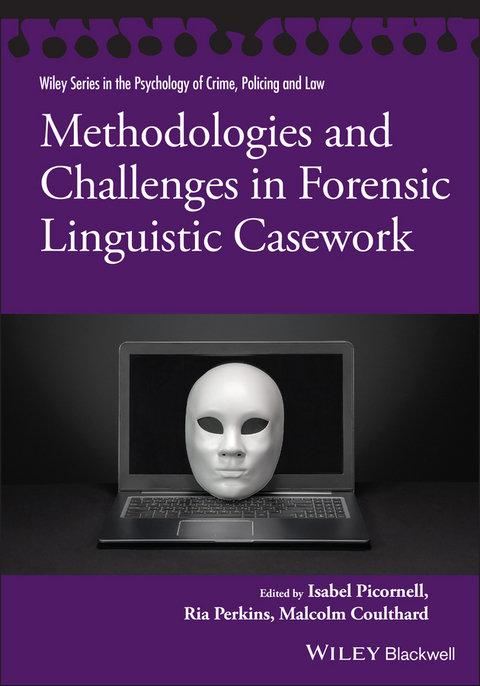
Methodologies and Challenges in Forensic Linguistic Casework (eBook)
John Wiley & Sons (Verlag)
978-1-119-61467-8 (ISBN)
Discover more about Forensic Linguistics, a fascinating cross-disciplinary field from an international team of renowned contributors
Methodologies and Challenges in Forensic Linguistic Casework provides an overview of the range of forensic linguistic casework typically found in investigative and judicial contexts. In these case studies, the authors demonstrate how linguistic theory is applied in real-life forensic situations and the constraints and challenges they have to deal with. Drawing on linguistic expertise from the USA and Europe involving casework in English, Spanish, Danish and Portuguese, our contributing practitioners exemplify the most common types of text analysis such as identifying faked texts, suspect profiling, analyzing texts whose authorship is questioned, and giving expert opinions on meaning and understanding.
Methodologies and Challenges in Forensic Linguistic Casework is designed for investigators and legal practitioners interested in the use of language analysis for investigative or evidentiary purposes, as well as for students and researchers wanting to understand how linguistic theory and analysis may be applied to solving real-life forensic problems using current best practice.
Isabel Picornell, PhD, is a Visiting Research Fellow at the Aston Institute for Forensic Linguistics, UK. She is a certified Fraud Examiner and runs a forensic linguistic consultancy. Her main research interest is authorship in deceptive contexts.
Ria Perkins, PhD, works as a civil servant for the Ministry of Defence, and is an Honorary Research Fellow at the Aston Institute for Forensic Linguistics in Birmingham, UK. Her casework specialty is authorship profiling, and her research interests include the language of persuasion and power, and Other Language Influence Detection (OLID).
Malcolm Coulthard, PhD, is Emeritus Professor of Forensic Linguistics at Aston University, UK, where he founded the Centre for Forensic Linguistics. He was Foundation President of the International Association of Forensic Linguists and Founding Editor of the International Journal of Speech Language and the Law and Language and Law - Linguaegem e Direito.
Methodologies and Challenges in Forensic Linguistic Casework Discover more about Forensic Linguistics, a fascinating cross-disciplinary field from an international team of renowned contributors Methodologies and Challenges in Forensic Linguistic Casework provides an overview of the range of forensic linguistic casework typically found in investigative and judicial contexts. In these case studies, the authors demonstrate how linguistic theory is applied in real-life forensic situations and the constraints and challenges they have to deal with. Drawing on linguistic expertise from the USA and Europe involving casework in English, Spanish, Danish and Portuguese, our contributing practitioners exemplify the most common types of text analysis such as identifying faked texts, suspect profiling, analyzing texts whose authorship is questioned, and giving expert opinions on meaning and understanding. Methodologies and Challenges in Forensic Linguistic Casework is designed for investigators and legal practitioners interested in the use of language analysis for investigative or evidentiary purposes, as well as for students and researchers wanting to understand how linguistic theory and analysis may be applied to solving real-life forensic problems using current best practice.
Isabel Picornell, PhD, is a Visiting Research Fellow at the Aston Institute for Forensic Linguistics, UK. She is a certified Fraud Examiner and runs a forensic linguistic consultancy. Her main research interest is authorship in deceptive contexts. Ria Perkins, PhD, works as a civil servant for the Ministry of Defence, and is an Honorary Research Fellow at the Aston Institute for Forensic Linguistics in Birmingham, UK. Her casework specialty is authorship profiling, and her research interests include the language of persuasion and power, and Other Language Influence Detection (OLID). Malcolm Coulthard, PhD, is Emeritus Professor of Forensic Linguistics at Aston University, UK, where he founded the Centre for Forensic Linguistics. He was Foundation President of the International Association of Forensic Linguists and Founding Editor of the International Journal of Speech Language and the Law and Language and Law - Linguaegem e Direito.
Series Preface viii
Acknowledgements x
About the Editors xi
1 Forensic Linguistic Casework 1
Isabel Picornell and Ria Perkins
Section 1
2 The Starbuck Case: Methods for Addressing Confirmation Bias in Forensic Authorship Analysis 13
Tim Grant and Jack Grieve
3 A Forensic Authorship Analysis of the Ayia Napa Rape Statement 29
Lisa Donlan and Andrea Nini
4 Linguistic Profiling: A Spanish Case Study 44
Sheila Queralt
5 Other Language Influence Detection: Profiling the Native Language of a Dark Web Pedophile 63
Ria Perkins
6 Forensic Plagiarism Detection and Analysis 77
Rui Sousa Silva
Section 2
7 Mourning the Slow Death of Miranda: California v. Ceja 95
Gerald R. McMenamin
8 Detecting Faked Texts 114
Isabel Picornell and Malcolm Coulthard
9 Joining ISIS? A Pragmatic Discourse Analysis of Chat Messages in a Counterterrorism Case 129
Tanya Karoli Christensen
10 "I Wanted to Leave A Long Time Ago": Casework in Suicide Letter Analysis: Methods Used and Lessons Learned 145
I. M. Nick
11 Casework in Forensic Linguistics: Looking Outward 162
Isabel Picornell
Index 170
1
Forensic Linguistic Casework
Isabel Picornell and Ria Perkins
INTRODUCTION AND CONTEXTS
Forensic linguistics has come a long way since the term was first used in Jan Svartvik’s publication The Evans Statement: A Case for Forensic Linguistics in 1968. Since then, an increasing body of research has contributed to the growth and professionalism of this multi- and cross-disciplinary field, with practitioners regularly undertaking forensic linguistic casework.
Forensic linguistics, broadly speaking, is the science of language analysis in a legal context and grounded in established linguistic theory, with practitioners applying linguistic knowledge and methodology to answering questions raised about the status, meaning, and authorship of the communication. Forensic linguistics can be seen as an area of applied linguistics in which techniques of linguistic analysis are applied to forensic situations and data. Linguistics involves the analysis of written texts or spoken interaction by describing and explaining the nature of the communication on a number of linguistic levels using a variety of interpretative tools, theories, and methods. Forensic linguistics essentially takes the linguist’s toolbox and applies it in forensic contexts, where text and speech samples are often unhelpfully short and few in number, in contrast to the large data collections traditionally used in academic research.
PURPOSE AND ORGANIZATION OF THIS BOOK
This book is aimed not only at students, academics, and professionals, but also at anyone interested in the interaction of language and the law and language as analysis for investigative purposes or evidence. Collectively, the chapters exemplify the state-of-the-art application of forensic linguistic analysis. The purpose is to illustrate the diversity of a field where forensic linguists may inform an investigation or a court-of-law and to examine how the professional quality of the linguist’s involvement, findings, and conclusions may be maintained.
Focusing on written (including electronic) communication, across a wide range of contexts, all chapters are authored by accomplished practitioners with consulting experience in their particular field. They discuss actual casework that they have undertaken, demonstrating their methodological choices and how they performed their analysis. The authors discuss and answer linguistic questions on issues as diverse as authorial ownership, communication in faked contexts, and how meaning is understood in today’s multisocial, multilingual society.
As discussed in more detail later in this chapter, this book sets out current “good practice” within the field of forensic linguistic casework. The choice of good practice rather than best practice is a conscious one to reflect the evolving nature of forensic linguistics, which is still a comparatively new field. Technological advances mean that the methodology, the data analyzed, and the contexts in which forensic linguists work are all constantly evolving. The book does not endorse any particular practitioners or promote any methodologies. Rather, it presents practices that demonstrate a high level of rigor and theoretical basis, that work well in the context in which they are applied, that have the potential for replication through their grounding in solid processes and methodologies, that are empirically supported by linguistic theory and research, and that are presented with consideration for their weaknesses and limitations.
The book is divided into two sections according to casework types: Section 1 deals with disputed and anonymous authorship analysis, while Section 2 addresses issues of meaning and interpretation.
Section 1: Anonymous and Disputed Authorship Analysis
This section’s five chapters present different forensic linguistic approaches to dealing with challenges posed by questioned authorship. Tim Grant and Jack Grieve open this section in Chapter 2 with an authorship verification analysis for a police investigation. The chapter raises issues associated with cognitive biases and discusses the strengths and weaknesses of stylistic and stylometric approaches in this closed-set authorship verification problem. In contrast, in Chapter 3 Lisa Donlan and Andrea Nini face an authorship issue that they address by using authorship profiling in a Cyprus-based court case. Here, the emphasis is not on comparing texts but on building a socio-demographic profile of its author to determine whether that profile matches that of its stated author.
While Donlan and Nini’s case involves English speakers, in Chapter 4 Sheila Queralt deals with a long-running Spanish-language police investigation, illustrating how forensic linguistic analysis is applied to a language other than English. Queralt demonstrates how mixed methods approaches involving linguistic profiling and stylometric and stylistic analyses can contribute positively when working alongside other forensic sciences. In Chapter 5, Ria Perkins undertakes Other Language Influence Detection (OLID), linguistic profiling intended to indicate the first language of an author based on how they write in a second language. The section ends with Chapter 6, in which Rui Sousa Silva addresses a different type of authorship problem: detecting and analyzing for plagiarism. Sousa Silva’s discussion around the different strategies that plagiarists employ to steal other people’s written productions extends to the non-English-speaking world and highlights the growing problem of translingual plagiarism.
Section 2: Meaning and Interpretation
These chapters are concerned with casework covering linguistic analysis of how language is produced and how we derive meaning from it. In Chapter 7, Gerald McMenamin provides a strong opening to this section on how immigrant and multilingual communities are denied their constitutional rights and due process because of their lack of understanding of the English language. In this American court case centering on the admissibility of evidence provided during police interviews, judges in the trial and appellate courts concluded that a Hispanic woman understood English sufficiently well to waive her Miranda rights to not self-incriminate, in spite of linguistic evidence to the contrary.
This is followed by Chapter 8 on linguistic “oddities,” in which Isabel Picornell and Malcolm Coulthard discuss how language design alerts linguists to the possibility that the context in which it has been produced has been faked. Coulthard addresses the linguistics of faked confessions, while Picornell demonstrates how being alert to linguistic red flags can identify falsified contexts that are not initially apparent.
From identifying language that is wrong for its context, we move to assessing purpose and the implicit meanings conveyed by an utterance. Deriving meaning from language in context is central to Tanya Karoli Christensen’s analysis in Chapter 9 of ISIS recruitment chat logs to assist the police in understanding what the individuals concerned were discussing.
Finally, I. M. Nick concludes with an analysis of the language of suicide. Chapter 10 demonstrates the increasing cross-disciplinary mix of linguistics and forensic behavioral sciences to create new areas of research—in this case, suicidology.
FORENSIC LINGUISTIC CASEWORK
Traditionally, forensics has been defined as relating to the legal (civil or criminal) field, or a legal context setting. This association can be seen with other fields that contain the term “forensic” in their name, such as forensic sciences or forensic psychology. The self-definitions of such fields virtually always highlight their application within legal settings. For example, the stated aim of the American Academy of Forensic Sciences is to “advance science and its application to the legal system” (American Academy of Forensic Sciences, n.d.); the British Academy of Forensic Sciences defines forensic science as “the application of science to the law, both civil and criminal” (British Academy of Forensic Sciences, n.d.).
The question arises as to whether it is the data, the analysis, or the application that makes a linguistic analysis forensic. Much valid work considered to be forensic linguistics would not immediately fall under the legal association of “forensic”. Areas of work such as understanding the language of mis- or disinformation or influence and radicalization for defense and security purposes do not have such a clear and direct legal association, yet they may easily be considered forensic.
In dictionaries, the word casework is normally associated with social work involving an individual’s personal history or circumstances (e.g., OED third edition, 2014). In the context of forensic linguistics, analysts also apply their skills, experience, and knowledge to direct considerations of a particular personal situation. However, rather than relating to information on the personal circumstances of a specific individual or group, it instead relates to language data, created by individuals or groups, that is examined in investigatory situations.
The requirement for forensic linguistic expertise is one that arguably evolved from necessity. Early work in forensic linguistics was exceedingly casework driven. Investigators and lawyers were encountering the need to analyze language as evidence or challenge linguistic perceptions and interpretation, and it was clear that analysis...
| Erscheint lt. Verlag | 6.4.2022 |
|---|---|
| Reihe/Serie | Wiley Series in Psychology of Crime, Policing and Law |
| Wiley Series in The Psychology of Crime, Policing and Law | Wiley Series in The Psychology of Crime, Policing and Law |
| Sprache | englisch |
| Themenwelt | Schulbuch / Wörterbuch ► Wörterbuch / Fremdsprachen |
| Geisteswissenschaften ► Sprach- / Literaturwissenschaft ► Sprachwissenschaft | |
| Recht / Steuern ► Allgemeines / Lexika | |
| Recht / Steuern ► EU / Internationales Recht | |
| Recht / Steuern ► Strafrecht ► Kriminologie | |
| Schlagworte | forensic linguistic methodologies • forensic linguistics case studies • forensic linguistics challenges • forensic linguistics manual • forensic linguistics reference • forensic linguistics solutions • Forensic linguistics textbook • Forensic Psychology • Forensische Psychologie • Linguistics • Psycholinguistics • Psycholinguistik • Psychologie • Psychology • Sprachwissenschaften |
| ISBN-10 | 1-119-61467-8 / 1119614678 |
| ISBN-13 | 978-1-119-61467-8 / 9781119614678 |
| Informationen gemäß Produktsicherheitsverordnung (GPSR) | |
| Haben Sie eine Frage zum Produkt? |
 EPUB (Adobe DRM)
Kopierschutz: Adobe-DRM
Adobe-DRM ist ein Kopierschutz, der das eBook vor Mißbrauch schützen soll. Dabei wird das eBook bereits beim Download auf Ihre persönliche Adobe-ID autorisiert. Lesen können Sie das eBook dann nur auf den Geräten, welche ebenfalls auf Ihre Adobe-ID registriert sind.
Details zum Adobe-DRM
Dateiformat: EPUB (Electronic Publication)
EPUB ist ein offener Standard für eBooks und eignet sich besonders zur Darstellung von Belletristik und Sachbüchern. Der Fließtext wird dynamisch an die Display- und Schriftgröße angepasst. Auch für mobile Lesegeräte ist EPUB daher gut geeignet.
Systemvoraussetzungen:
PC/Mac: Mit einem PC oder Mac können Sie dieses eBook lesen. Sie benötigen eine
eReader: Dieses eBook kann mit (fast) allen eBook-Readern gelesen werden. Mit dem amazon-Kindle ist es aber nicht kompatibel.
Smartphone/Tablet: Egal ob Apple oder Android, dieses eBook können Sie lesen. Sie benötigen eine
Geräteliste und zusätzliche Hinweise
Buying eBooks from abroad
For tax law reasons we can sell eBooks just within Germany and Switzerland. Regrettably we cannot fulfill eBook-orders from other countries.
aus dem Bereich