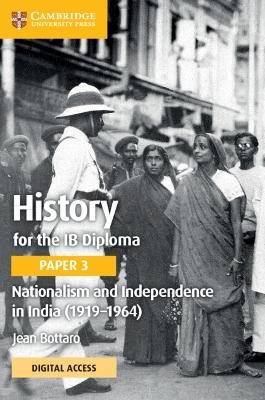
History for the IB Diploma Paper 3 Nationalism and Independence in India (1919–1964) Coursebook with Digital Access (2 Years)
Cambridge University Press
978-1-009-19012-1 (ISBN)
1. Introduction; Chapter 2. The origins of Indian nationalism and the impact of the First World War: 2.1. What were the origins of the nationalist movement in India?; 2.2. How did the First World War affect India?; 2.3. To what extent did the demands for Home Rule boost the nationalist movement?; Chapter 3. Political developments between 1919 and 1935: 3.1. To what extent was the Amritsar Massacre a turning point?; 3.2. How did the Government of India Act (1919) affect India?; 3.3. What was the significance of the Simon Commission?; 3.4. How effective were the Round Table Conferences?; 3.5. What were the responses to the Government of India Act, 1935?; Chapter 4. The role and importance of key groups and individuals: 4.1. What role did the Indian National Congress play in the nationalist movement?; 4.2. How important was the All-India Muslim League in the nationalist movement?; 4.3. Why was Gandhi so important to the nationalist movement?; 4.4. What was Nehru's contribution to the nationalist movement?; 4.5. How significant was Jinnah's role in the nationalist movement?; Chapter 5. The struggle for independence: 5.1. What was the Non-Cooperation movement?; 5.2. Why was the Salt March so significant?; 5.3. What happened during further Civil Disobedience campaigns?; 5.4. Why was the 'Quit India' campaign significant?; Chapter 6. The growth of Muslim separatism: 6.1. What was the background to the growth of Muslim separatism?; 6.2. When and how did the 'Two Nation' theory develop?; 6.3. How significant was the Lahore Resolution?; Chapter 7. The impact of the Second World War: 7.1. How did the Second World War affect India?; 7.2. What role did Subhas Chandra Bose play?; 7.3. Why did the Cripps Mission fail?; 7.4. How did the war affect British power in India?; 7.5. What was the situation in India after the war?; Chapter 8. Independence and partition: 8.1. What role did Mountbatten play?; 8.2. How did India achieve independence?; 8.3. What were the reasons for the partition of the South Asian subcontinent?; Chapter 9. Post-independence India: 9.1. What ethnic and religious conflicts did India face?; 9.2. How were the princely states incorporated?; 9.3. Why was there conflict with Pakistan over Kashmir?; 9.4. To what extent were Nehru's domestic policies successful?; Chapter 10. Exam practice; Further Reading; Index.
| Erscheint lt. Verlag | 31.1.2022 |
|---|---|
| Reihe/Serie | IB Diploma |
| Zusatzinfo | Worked examples or Exercises |
| Verlagsort | Cambridge |
| Sprache | englisch |
| Maße | 157 x 228 mm |
| Gewicht | 470 g |
| Themenwelt | Schulbuch / Wörterbuch |
| ISBN-10 | 1-009-19012-1 / 1009190121 |
| ISBN-13 | 978-1-009-19012-1 / 9781009190121 |
| Zustand | Neuware |
| Informationen gemäß Produktsicherheitsverordnung (GPSR) | |
| Haben Sie eine Frage zum Produkt? |
aus dem Bereich