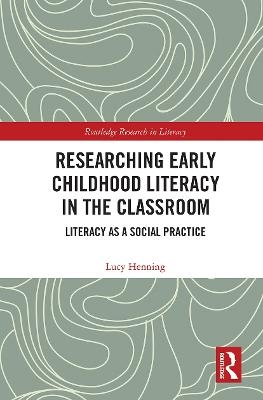
Researching Early Childhood Literacy in the Classroom
Routledge (Verlag)
9781032240084 (ISBN)
Researching Early Childhood Literacy in the Classroom argues that the lived experience of young children encountering formal schooled literacy curricula should be the foremost consideration in educational reforms intended to improve rates of literacy acquisition in schools. To make this argument, the author suspends traditional concerns with ‘learning’ and ‘progress’ to concentrate on ‘practice’ and ‘meaning’ in a careful analysis of key classroom incidents. The author concludes that such insights suggest a need for re-considering the assumptions upon which educational policy rests.
This book will be of great interest to graduate and postgraduate students, researchers, academics, and libraries in the fields of Literacy Studies, Teacher Education, Education Policy and Applied Linguistics.
Lucy Henning is Senior Lecturer in primary English at Roehampton University, UK.
List of Abbreviations
List of transcription conventions
Foreword
ACKNOWLEDGEMENTS
Introduction: Literacy, Schooling and Young Children
PART ONE: FRESH PERSPECTIVES ON FAMILIAR PHENOMENA
Chapter 1 Fresh Perspectives on Familiar Phenomena
Introduction
Section 1: Literacy in the social world
Section 2: Literacy in the institution of schooling
Section 3: Children’s interpretive reproduction of literacy in schools
Conclusion
Chapter 2: Researching Young Children’s in-school literacy practices
Introduction
Section 1: Policy priorities for researching early childhood literacy
Section 2: Ethnographic principles for researching early childhood literacy in classrooms
Section 3: Re-examining young children’s in-school literacy practices
Conclusion
PART TWO: AMBER CLASS CHILDREN PRACTISE LITERACY
Chapter 3: Jessica practises literacy with Donna
Introduction
Section 1: Normalising expectations for young children’s literacy practices.
Section 2: Interpretively reproducing literacy practices in the classroom.
Section 3: Interpretively Reproducing literacy skills and knowledge
Conclusion
Chapter 4: The importance of Amber Class’ children’s in-class peer culture
Introduction
Section 1: Producing peer culture literacy in social interaction
Section 2: Managing peer culture priorities: Peer to peer copying
Section 3: Managing peer culture and schooled literacy priorities
Conclusion
Chapter 5 Amber Class Children’s encounter with being grouped for teaching
Introduction
Section 1: Schooled literacy manages relative literacy expertise
Section 2: Peer culture interpretations of schooled groupings
Section 3: Sharing literacy expertise in the peer culture
Conclusion
PART THREE: DISCUSSION AND CONCLUSIONS
Discussion: Reflecting on young children, schooling and literacy
Conclusion
Appendix: My research project
REFERENCES
| Erscheinungsdatum | 14.12.2021 |
|---|---|
| Reihe/Serie | Routledge Research in Literacy |
| Zusatzinfo | 18 Illustrations, black and white |
| Verlagsort | London |
| Sprache | englisch |
| Maße | 152 x 229 mm |
| Gewicht | 276 g |
| Themenwelt | Schulbuch / Wörterbuch |
| Sozialwissenschaften ► Pädagogik ► Schulpädagogik / Grundschule | |
| Sozialwissenschaften ► Pädagogik ► Vorschulpädagogik | |
| ISBN-13 | 9781032240084 / 9781032240084 |
| Zustand | Neuware |
| Informationen gemäß Produktsicherheitsverordnung (GPSR) | |
| Haben Sie eine Frage zum Produkt? |
aus dem Bereich