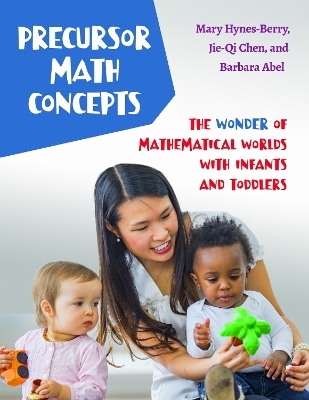
Precursor Math Concepts
Teachers' College Press (Verlag)
978-0-8077-6611-8 (ISBN)
This groundbreaking book looks at the development of mathematical thinking in infants and toddlers, with an emphasis on the earliest stage, from zero to three, when mathematical thinking and problem solving first emerge as natural instincts. The text explores the four precursor math concepts—Attribute, Comparison, Change, and Pattern—with an emphasis on how development occurs when it is nurtured by loving knowledgeable others. The authors call this the CAIR principle: Closely Attend & Intentionally Respond. Sharing their stories of working with a wide range of zero to three caregivers and educators, the authors stress the difference between arithmetic skills and their definition of mathematics as "a logical way of thinking that allows for increasing precision." Each user-friendly chapter includes suggestions for highly effective practices that are embedded into everyday interactions and routines. Early care providers can use this resource to develop young children's interest in mathematics, ensuring that they are ready for the big ideas they will encounter in preschool.Book Features:
Combines the most current research on infant and toddler cognitive development in relation to mathematical thinking.
Offers concrete ways to help caregivers and professionals draw out the math that is all around us.
Blends three domains of human development—social-emotional, physical, and cognitive.
Examines the What, Who, and How of each precursor concept, with authentic anecdotes and "What the Research Says" sections.
Mary Hynes-Berry is a bestselling author, professional developer, consultant, and a faculty member at Erikson Institute for Early Childhood. Jie-Qi Chen is a professor of early education at the Erikson Institute in Chicago and founder of the Institute's Early Math Collaborative. Barbara Abel is an experienced early childhood leader and clinical lecturer at the University of Illinois Chicago.
Contents
Preface v
Acknowledgments vii
1. The WHAT, WHO, and HOW of Mathematical Worlds of Infants and Toddlers 1
WHAT: Understanding the Concept and Practice of Precursor Mathematics 2
What the Research Says: The Brain Develops Significantly in the First Three Years 5
WHO: Infants and Toddlers and Their Conceptual Development 7
What the Research Says: The Critical Role of Nurturing 8
HOW: Closely Attend and Intentionally Respond—The CAIR Principle 11
Looking Back to Look Forward 14
2. The Precursor Math Concept of Attribute 15
WHAT: Where’s the Math in Attribute? 15
What the Research Says: Categories of Attribute 18
WHO: Infants and Toddlers Developing Understanding of Attribute 19
What the Research Says: Sensory Perceptions and Social-Emotional Responses 21
HOW: Using CAIR to Develop Understanding of the PMC of Attribute 22
Looking Back to Look Forward 27
YOUR TURN: Reflective Practice Review 28
3. The Precursor Math Concept of Comparison 30
WHAT: Where’s the Math in Comparison? 30
What the Research Says: Infants and Toddlers Are Born Mathematicians/ Statisticians 33
WHO: Infants and Toddlers Developing Understanding of Comparison 34
What the Research Says: Object Terms and Relational Terms 37
HOW: Using CAIR to Develop Understanding of the PMC of Comparison 38
Looking Back to Look Forward 44
YOUR TURN: Reflective Practice Review 44
4. The Precursor Math Concept of Change 46
WHAT: Where’s the Math in Change? 46
What the Research Says: Spatial Sense Is Where Math Begins 50
WHO: Infants and Toddlers Developing Understanding of Change 52
What the Research Says: It’s Not Surprising That Change Triggers Thinking 54
HOW: Using CAIR to Develop Understanding of the PMC of Change 55
Looking Back to Look Forward 59
YOUR TURN: Reflective Practice Review 60
5. The Precursor Math Concept of Pattern 62
WHAT: Where’s the Math in Pattern? 62
What the Research Says: Where Is the Pattern in the Number World? 66
WHO: Infants and Toddlers Developing Understanding of Pattern 68
What the Research Says: Where’s the Math in Music? 71
HOW: Using CAIR to Develop Understanding of the PMC of Pattern 72
Looking Back to Look Forward 75
YOUR TURN: Reflective Practice Review 76
6. Bringing It All Together 78
Bringing Together the Four Precursor Math Concepts—the WHAT 79
Bringing Together WHO and HOW 82
Bringing Together the WHAT, WHO, and HOW of Mathematical Thinking in Early Childhood 87
YOUR TURN: Bringing It All Together 90
References 93
Index 100
About the Authors 104
| Erscheinungsdatum | 01.12.2021 |
|---|---|
| Verlagsort | New York |
| Sprache | englisch |
| Maße | 217 x 279 mm |
| Gewicht | 288 g |
| Themenwelt | Schulbuch / Wörterbuch |
| Sozialwissenschaften ► Pädagogik ► Schulpädagogik / Grundschule | |
| Sozialwissenschaften ► Pädagogik ► Vorschulpädagogik | |
| ISBN-10 | 0-8077-6611-9 / 0807766119 |
| ISBN-13 | 978-0-8077-6611-8 / 9780807766118 |
| Zustand | Neuware |
| Informationen gemäß Produktsicherheitsverordnung (GPSR) | |
| Haben Sie eine Frage zum Produkt? |
aus dem Bereich