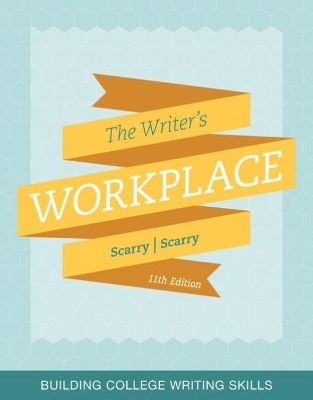
The Writer's Workplace (w/ MLA9E Update Card)
Wadsworth Publishing Co Inc
978-0-357-79271-1 (ISBN)
- Titel z.Zt. nicht lieferbar
- Versandkostenfrei
- Auch auf Rechnung
- Artikel merken
Sandra Scarry is the former Academic Coordinator of the COPE program (College Opportunity to Prepare for Employment) at The City University of New York. She came to that position after many years of classroom teaching in English and ESOL. She has published numerous textbooks in the areas of grammar and writing. John Scarry holds a Ph.D. from New York University and was the senior professor in the English Department of Hostos Community College, The City University of New York. He has been publishing writing textbooks for thirty-five years and his scholarly articles have appeared in many journals here and abroad.
Part I: AN INVITATION TO WRITING.
1. Gathering Ideas for Writing.
Overview of the Writing Process. Journal Writing. Entry from The Diary of Latoya Hunter. Focused Freewriting. Brainstorming, Clustering, and Outlining. Student Essay. Conducting Interviews and Surveys. Working Together: Taking a Survey.
2. Recognizing the Elements of Good Writing.
The Subject: What the Writing Is About. Purpose: The Writer's Intention. Audience: The Writer's Intended Readers. Voice: How the Writer's Attitude is Revealed. Unity: All Parts Relating to the Central Theme. Coherence: Clear and Logical Progression of Thought. Working Together: Knowing Your Audience.
Part II: CREATING EFFECTIVE SENTENCES.
3. Finding Subjects and Verbs in Simple Sentences.
What Is a Complete Sentence? How Do You Find the Subject of a Sentence? How Do You Find the Verb of a Sentence? How Do You Identify the Parts of Speech? Mastery and Editing Tests. Working Together: Crossword Puzzle.
4. Making Subjects and Verbs Agree.
What Is Subject-Verb Agreement? Subject-Verb Agreement with Personal Pronouns. Subject-Verb Agreement with the Verbs Do and Be. Subject-Verb Agreement with Hard-to-Find Subjects. Subject-Verb Agreement with Collective Nouns. Subject-Verb Agreement with Indefinite Pronouns. Subject-Verb Agreement with Compound Subjects. Subject-Verb Agreement with Unusual Nouns. Mastery and Editing Tests. Working Together: Focused Freewriting.
5. Understanding Fragments and Phrases.
What Is a Fragment? How Do You Correct a Fragment? What Is a Phrase and How Many Kinds of Phrases Are There? The Three Functions of the Present Participle. How Do You Make a Complete Sentence from a Fragment That Contains a Participle? Mastery and Editing Tests. Working Together: Examining an Advertisement for Fragments.
6. Combining Sentences Using Coordination.
What Is Coordination? First Option for Coordination: Using a Comma Plus a Coordinating Conjunction. Second Option for Coordination: Using a Semicolon, an Adverbial Conjunction, and a Comma. Third Option for Coordination: Using a Semicolon. Mastery and Editing Tests. Working Together: Causes and Effects.
7. Combining Sentences Using Subordination.
What Is Subordination? The Difference Between an Independent Clause and a Dependent Clause. Using Subordinating Conjunctions. Using Relative Pronouns. Mastery and Editing Tests. Working Together: Narrowing the Topic Through Group Discussion.
8. Correcting Fragments and Run-Ons.
What Is a Fragment? How Many Kinds of Fragments Are There? How Do You Make a Complete Sentence from a Fragment? What Is a Run-On? Mastery and Editing Tests. Working Together: Discussion and Summary.
9. Choosing Correct Pronouns.
Pronouns and Case. Pronoun-Antecedent Agreement. Mastery and Editing Tests. Working Together: Discussion and Summary.
10. Working with Adjectives, Adverbs, and Parallel Structure.
What Is the Difference Between an Adjective and an Adverb? Adjectives and Adverbs Used in Comparisons. The Most Commonly Confused Adjectives and Adverbs. Misplaced and Dangling Modifiers. Misplaced Modifiers. Dangling Modifiers. Avoiding the Double Negative with the Adverb not and other Negative Words. Parallel Structure: Making a Series of Words, Phrases, or Clauses Balanced Within the Sentence. Mastery and Editing Tests. Working Together: Preparing and Editing a Résumé.
11. Mastering Irregular Verb Forms.
What Are the Principal Parts of Irregular Verbs? Practicing Fifty Irregular Verbs. More Irregular Verbs. Mastery and Editing Tests. Working Together: Preparing for a Job Interview.
12. Using Verb Tenses Correctly.
How Many Verb Tenses Are There in English? How Do You Use The Present Perfect and the Past Perfect Tenses? What Is the Sequence of Tenses? Avoiding Unnecessary Shifts in Verb Tense. What Is the Difference Between the Passive Voice and the Active Voice? What Is the Subjunctive Mood? Knowing How to Use should/would, can/could, will/would, and used to/supposed to. Mastery and Editing Tests. Working Toget
| Erscheint lt. Verlag | 31.7.2021 |
|---|---|
| Zusatzinfo | Illustrations |
| Verlagsort | Belmont, CA |
| Sprache | englisch |
| Themenwelt | Schulbuch / Wörterbuch ► Wörterbuch / Fremdsprachen |
| Geisteswissenschaften ► Sprach- / Literaturwissenschaft ► Literaturwissenschaft | |
| Geisteswissenschaften ► Sprach- / Literaturwissenschaft ► Sprachwissenschaft | |
| Sozialwissenschaften ► Pädagogik ► Allgemeines / Lexika | |
| ISBN-10 | 0-357-79271-8 / 0357792718 |
| ISBN-13 | 978-0-357-79271-1 / 9780357792711 |
| Zustand | Neuware |
| Informationen gemäß Produktsicherheitsverordnung (GPSR) | |
| Haben Sie eine Frage zum Produkt? |
aus dem Bereich