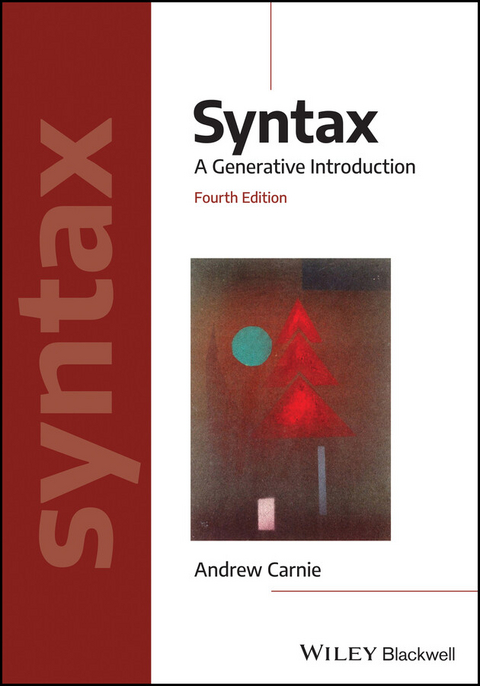
Syntax (eBook)
950 Seiten
John Wiley & Sons (Verlag)
978-1-119-56931-2 (ISBN)
The extensively updated fourth edition of the leading introductory textbook on theoretical syntax, including an all-new chapter and additional problem sets
Now in its fourth edition, Andrew Carnie's Syntax: A Generative Introduction remains the leading introduction to the rules, principles, and processes that determine the structure of sentences in language. Comprehensive yet accessible, the text provides a well-balanced, student-friendly introduction to syntactic theory. Topics include phrase structure, the lexicon, binding theory, case theory, movement, covert movement, locality conditions, ditransitives, verbal inflection and auxiliaries, ellipsis, control theory, non-configurational languages, and more. Students are provided with numerous exercises and pedagogical features designed to strengthen comprehension, review learning objectives, test knowledge, and highlight major issues in the field.
The fourth edition features revised material throughout, including a new section on Chomsky's Merge and additional problem sets in every chapter, while new examples throughout the text broaden the appeal and relatability of the text to a more diverse set of students. The optional The Syntax Workbook: A Companion to Carnie's Syntax has also been thoroughly revised and expanded to offer students the opportunity to practice the skills and concepts introduced in the primary text. This classic textbook:
- Presents authoritative and comprehensive coverage of basic, intermediate, and advanced topics
- Includes ample exercises and clear explanations using straightforward language
- Offers extensive online student and instructor resources, including problem sets, PowerPoint slides, an updated instructor's manual, author-created videos, online-only chapters, and other supplementary material
- Features a wealth of learning tools, including learning objectives, discussion questions, and problems of varying levels of difficulty
In the new fourth edition, Syntax: A Generative Introduction remains an essential textbook for beginning syntacticians, perfect for undergraduate and graduate course in linguistics, grammar, language, and second language teaching.
Available as a set with The Syntax Workbook: A Companion to Carnie's Syntax, 2nd Edition
Andrew Carnie is Vice Provost for Graduate Education, Dean of the Graduate College, and Professor of Linguistics at the University of Arizona, USA. He specializes in generative syntactic theory with an emphasis on constituency, VSO languages, copular constructions, and the Celtic Languages. He is the author of numerous publications, including Constituent Structure, Modern Syntax, and The Syntax Workbook: A Companion to Carnie's Syntax, and is the co-editor of The Routledge Handbook of Syntax.
Andrew Carnie is Vice Provost for Graduate Education, Dean of the Graduate College, and Professor of Linguistics at the University of Arizona, USA. He specializes in generative syntactic theory with an emphasis on constituency, VSO languages, copular constructions, and the Celtic Languages. He is the author of numerous publications, including Constituent Structure, Modern Syntax, and The Syntax Workbook: A Companion to Carnie's Syntax, and is the co-editor of The Routledge Handbook of Syntax.
"One noticeable quality that sets the work apart from other textbooks is its implicit tracing of the evolution of generative theory." - LINGUIST List 33.1498
Preface and Acknowledgments
Almost every preface to every syntax textbook out there starts out by telling the reader how different this book is from every other syntax textbook. On one hand, this is often the truth: each author shows their own particular spin or emphasis. This is certainly true of this textbook. For example, you’ll be hard-pressed to find another textbook on Principles and Parameters syntax that uses as many Irish examples as this one does.. On the other hand, let’s face facts. The basic material to be covered in an introductory textbook doesn’t really vary much. One linguist may prefer a little more on binding theory, and a little less on control, etc. In this text, I’ve attempted to provide a relatively balanced presentation of most of the major issues and I’ve tried to do this in a student-friendly way. I’ve occasionally abstracted away from some of the thornier controversies, when I felt they weren’t crucial to a student understanding the basics. This may make the professional syntactician feel that I’ve cut corners or laid out too rosy a picture. I did this on purpose, however, to give students a chance to absorb the fundamentals before challenging the issues. This was a deliberate pedagogical choice. I’m well aware that sometimes I’ve glossed over controversies, but I think a student has to learn the basics of how the system works before they can seriously critique and evaluate the model. This is a textbook, not a scholarly tome, so its aim is to reach as many students as possible. The style is deliberately low-key and friendly. This doesn’t mean I don’t want the students to challenge the material I’ve presented here. Throughout the book, you’ll find grey “textboxes” that contain issues for further discussion or interesting tidbits. Many of the problem sets also invite the student to challenge the black and white presentation I’ve given in the text. I encourage instructors to assign these, and students to do them, as they form an important part of the textbook. Instructors may note that if a favorite topic is not dealt with in the body of the text, a problem set may very well treat the question.
A quick word on the level of this textbook: This book is intended as an introduction to syntactic theory. It takes the student through most of the major issues in Principles and Parameters, from tree drawing to constraints on movement. While this book is written as an introduction, some students have reported it to be challenging. I use this text in my upper-division undergraduate introduction to syntax course with success, but I can certainly see it being used in more advanced classes. I hope instructors will flesh out the book, and walk their students through some of the thornier issues.
This textbook has grown out of my lecture notes for my own classes. Needless to say, the form and shape of these notes have been influenced in terms of choice of material and presentation by the textbooks my own students have used. While the book you are reading is entirely my fault, it does owe a particular intellectual debt to the following three textbooks, which I have used in teaching at various times:
- Cowper, Elizabeth (1992) A Concise Introduction to Syntactic Theory: The Government and Binding Approach. Chicago: Chicago University Press.
- Haegeman, Liliane (1994) Introduction to Government and Binding Theory (2nd edition). Oxford: Blackwell.
- Radford, Andrew (1988) Transformational Grammar: A First Course. Cambridge: Cambridge University Press.
I’d like to thank the authors of these books for breaking ground in presenting a complicated and integrated theory to the beginner. Writing this book has given me new appreciation for the difficulty of this task and their presentation of the material has undoubtedly influenced mine.
Sadly, during the final stages of putting the first edition of this text together, my dissertation director, teacher, mentor, and academic hero, Ken Hale, passed away after a long illness. Ken always pushed the idea that theoretical syntax is best informed by cross- linguistic research, while at the same time the accurate documentation of languages requires a sophisticated understanding of grammatical theory. These were important lessons that I learned from Ken and I hope students will glean the significance of both by reading this text. While I was writing this book (and much other work) Ken gave me many comments and his unfettered support. He was a great man and I will miss him terribly.
It’s hard to believe that I began writing the first drafts of this book twenty two years ago, and now we’re going into the 4th edition. A whole generation of syntacticians began their careers with this book and I’m utterly humbled that it has been so useful to people. I hope this new edition, and the 2nd edition of the accompanying workbook will continue to guide people into the world of syntax. The 4th edition has some important changes from the 3rd. I brought back affix lowering for those who loved it. That’s now at the end of chapter 7. But I’ve also kept the selection-based analysis of English Auxiliaries in chapter 9. Instructors can safely do one, the other, or both. I’ve changed the names of some of the functional categories to reflect current practice. There’s a new, albeit cursory, chapter on Merge at the end. There’s new exercises and problem sets in every chapter both in the main book and in the workbook.
Perhaps the most important change to the book is more subtle and may not be initially apparent. While example sentences are just examples and aren’t meant to make profound statement with their content, I’ve learned through the years that they can impact people nonetheless by perpetuating cultural bias. The subconscious messages example sentences can send cannot help but impact readers. Macaulay and Brice (1997) and Pabst et al (2018) have shown that syntax textbooks and journals often have example sentences that show bias towards male actors and female patients. In reviewing the example sentences in the third edition, I discovered that not only was there a gender bias in the examples, but there was an unconscious bias towards white anglophone names and a failure to represent ethnic, racial, sexuality, and gender diversity. So I made a conscious effort to address those biases. Honestly, I probably haven’t entirely succeeded but I hope the book is now a little more welcoming and will encourage more women, more gender-diverse people, more people of color, more indigenous people and generally broader range of students to seriously consider syntactic theory as their life’s work.
I hope that instructors and students will find these revisions helpful. I have attempted where possible to take into account all the many comments and suggestions I received from people using the previous editions, although of course, in order to maintain consistency, I was unable to implement them all.
Acknowledgments
I’d like to thank the many people who taught me syntax through the years: Barb Brunson, Noam Chomsky, Elizabeth Cowper, Ken Hale, Alec Marantz, Diane Massam, Jim McCloskey, Shigeru Miyagawa, and David Pesetsky. A number of people have read through this book or the previous editions and have given me helpful comments; others have helped on smaller issues but have had no less of an impact on the work and still others have contributed problem sets or editorial advice. This long list includes: Dong- Hwan An, David Adger, William Alexander, Dean Allemang, Gabriel Amores, Diana Archangeli, Ash Asudeh, Dali Balti, Brett Baker, Uldis Balodis, Mark Baltin, Luis Barragan, Andy Barss, Michael Bauer, Dane Bell, Emily Bender, Abbas Benmamoun, Jeff Berry, Tom Bever, Bronwyn Bjorkman, Laura Blumenthal, Claire Bowern, Joan Bresnan, Aaron Broadwell, Dirk Bury, Ivano Caponigo, Roy Chan, Ronald Charles, Danny Chen, Deborah Chen-Pichler, Jaehoon Choi, Barbara Citko, Ian Clayton, Peter Cole, Chris Collins, Jennifer Columbus, Richard Compton, Andrew Comrie, Robert Coren, Dick Demers, Lorenzo Demery, Sheila Dooley, Rebecca Drinkall, Joe Dupris, Yehuda Falk, Muriel Fisher, Megan Figueroa, Sandiway Fong, Leslie Ford, Amy Fountain, Stefan Frisch, Alexandra Galani, Andrew Garrett, Jila Ghomeshi, David Gil, Carrie Gillion, Erin Good-Ament, Anthony Green, Andrea Haber, Paul Hagstrom, Ken Hale, John Halle, Mike Hammond, Daniel Harbour, Jack Hardy, Heidi Harley, Josh Harrison, Rachel Hayes-Harb, David Heap, Bernhard Heigl, One-Soon Her, Caroline Heycock, Nicky Hoover, Stephan Hurtubise, John Ivens, Eloise Jelinek, Ling Jiang, Alana Johns, Mark Johnson, Hyun Kyoung Jung, Arsalan Kahnemuyipour, Dalina Kallulli, Simin Karimi, Dan Karvonen, Andreas Kathol, Chris Kennedy, Greg Key, Amy LaCross, Erwin Lares, Richard Larson, Péter Lazar, Carlos Gelormini Lezama, Jeff Lidz, Anne Lobeck, Leila Lomashivili, Pen Long, Sarah Longstaff, Alicia Lopez, Ahmad Reza Lotfi, Ricardo Mairal, Joan Maling, Jack Martin, Diane Massam, Jeffrey Maxwell, Martha McGinnis-Archibald, Nathan McWhorter, Dave Medeiros, Jason Merchant, Mirjana Miskovic-Lukovic, Tel Monks, Kumiko Murasugi, Alan Munn, MaryLou Myers, Jian Gang Ngui, Chris Nicholas, Janet Nicol, Jon Nissenbaum, Peter Norquest, Diane Ohala, Kazutoshi Ohno, Heidi Orcutt-Gachiri, Hiroyuki Oshita, Panayiotis Pappas, Jaime Parchment, Hyeson Park, Barbara Partee, Matt Pearson, David Pesetsky, Colin Phillips, Massimo Piatelli- Palmarini, Carl Pollard, Bill Poser, Kristen Pruett, Jeff Punske, Mike Putnam, Sevren Quijada, Eric Randall, Janet Randall, Marlita Reddy-Hjelmfelt, Jodi Reich, Norvin...
| Erscheint lt. Verlag | 5.3.2021 |
|---|---|
| Reihe/Serie | Introducing Linguistics |
| Introducing Linguistics | Introducing Linguistics |
| Sprache | englisch |
| Themenwelt | Schulbuch / Wörterbuch ► Lektüren / Interpretationen |
| Schulbuch / Wörterbuch ► Wörterbuch / Fremdsprachen | |
| Geisteswissenschaften ► Sprach- / Literaturwissenschaft ► Sprachwissenschaft | |
| Schlagworte | Chomsky merge • college syntax course • generative syntactic theory • generative syntax textbook • Linguistics • linguistics textbook • Linguistik • Sprachwissenschaften • syntactic theory textbook • Syntax • syntax exercises • syntax intro • syntax problems • Syntax textbook • syntax workbook • Theoretical Linguistics • Theoretical Syntax • Theoretische Linguistik |
| ISBN-10 | 1-119-56931-1 / 1119569311 |
| ISBN-13 | 978-1-119-56931-2 / 9781119569312 |
| Informationen gemäß Produktsicherheitsverordnung (GPSR) | |
| Haben Sie eine Frage zum Produkt? |
 EPUB (Adobe DRM)
Kopierschutz: Adobe-DRM
Adobe-DRM ist ein Kopierschutz, der das eBook vor Mißbrauch schützen soll. Dabei wird das eBook bereits beim Download auf Ihre persönliche Adobe-ID autorisiert. Lesen können Sie das eBook dann nur auf den Geräten, welche ebenfalls auf Ihre Adobe-ID registriert sind.
Details zum Adobe-DRM
Dateiformat: EPUB (Electronic Publication)
EPUB ist ein offener Standard für eBooks und eignet sich besonders zur Darstellung von Belletristik und Sachbüchern. Der Fließtext wird dynamisch an die Display- und Schriftgröße angepasst. Auch für mobile Lesegeräte ist EPUB daher gut geeignet.
Systemvoraussetzungen:
PC/Mac: Mit einem PC oder Mac können Sie dieses eBook lesen. Sie benötigen eine
eReader: Dieses eBook kann mit (fast) allen eBook-Readern gelesen werden. Mit dem amazon-Kindle ist es aber nicht kompatibel.
Smartphone/Tablet: Egal ob Apple oder Android, dieses eBook können Sie lesen. Sie benötigen eine
Geräteliste und zusätzliche Hinweise
Buying eBooks from abroad
For tax law reasons we can sell eBooks just within Germany and Switzerland. Regrettably we cannot fulfill eBook-orders from other countries.
aus dem Bereich