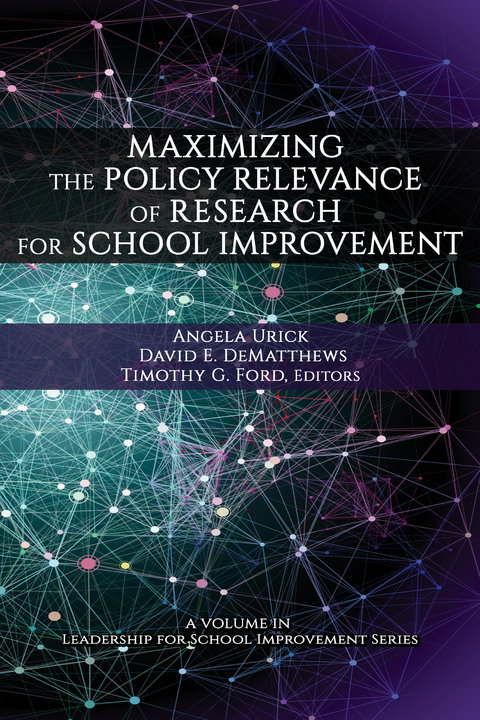
This book is primarily for education researchers, faculty, and advanced graduate students seeking to improve the visibility and impact of their research on school improvement, particularly in the realm of educational policy and policy making. While this book is a volume in the book series for the American Educational Research Association Special Interest Group, Leadership for School Improvement, the importance and usefulness of the topics covered span education research more broadly. Further, the content of this book serves as a comprehensive guide for how education researchers, in general, can better situate their work to influence policy. The book is intended to be utilized by university scholars, graduate students in research or policy courses, post-doctoral fellows, as well as research associates or directors in various organizations relevant to education such as research consulting groups, non-profits which serve education causes, teacher unions, state agencies or state-level educator organizations/associations, and think tanks. Emerging or established researchers in any of these organizations who want to increase the relevance, significance and dissemination of their work into education policy will hopefully find this book useful.
Education policy and policy making is shaped through the activities of a complex network of educators, educational leaders, researchers, community members, as well as government and non-government officials and organizations. Educational researchers are a critical player in this complex network and their investigations of various educational phenomena can answer questions relevant to the design and implementation of education policy for school improvement. Educational research, however, often has limited influence in larger policy conversations and decisions (Orland, 2009), and this is due to many factors. Educational researchers can provide an evidence-based starting place for discussions about school improvement with the complex network of stakeholders engaged in policy development and implementation, but they must be more intentionally and systematically thoughtful about the connections of their work to policy and policy making. Furthermore, researchers can increase the relevance of their work for policy through the careful design and framing of research in collaboration with end-users, and an awareness of its implications. In so doing, researchers can spur the interest and dissemination of their findings to wider audiences. This book offers resources for education researchers, faculty, and advanced graduate students interested in maximizing the relevance of their research on policy for school improvement. In achieving this purpose, the book is organized into three sections: 1) A primer for education policy making in the United States; 2) Designing research to maximize education policy relevance; and 3) Engaging users of research to communicate its relevance to policymakers.This book is primarily for education researchers, faculty, and advanced graduate students seeking to improve the visibility and impact of their research on school improvement, particularly in the realm of educational policy and policy making. While this book is a volume in the book series for the American Educational Research Association Special Interest Group, Leadership for School Improvement, the importance and usefulness of the topics covered span education research more broadly. Further, the content of this book serves as a comprehensive guide for how education researchers, in general, can better situate their work to influence policy. The book is intended to be utilized by university scholars, graduate students in research or policy courses, post-doctoral fellows, as well as research associates or directors in various organizations relevant to education such as research consulting groups, non-profits which serve education causes, teacher unions, state agencies or state-level educator organizations/associations, and think tanks. Emerging or established researchers in any of these organizations who want to increase the relevance, significance and dissemination of their work into education policy will hopefully find this book useful.
| Erscheint lt. Verlag | 1.1.2021 |
|---|---|
| Sprache | englisch |
| Themenwelt | Schulbuch / Wörterbuch ► Lexikon / Chroniken |
| Sozialwissenschaften ► Pädagogik | |
| Sozialwissenschaften ► Politik / Verwaltung | |
| ISBN-10 | 1-64802-249-9 / 1648022499 |
| ISBN-13 | 978-1-64802-249-4 / 9781648022494 |
| Informationen gemäß Produktsicherheitsverordnung (GPSR) | |
| Haben Sie eine Frage zum Produkt? |
 PDF (Adobe DRM)
Größe: 36,1 MB
Kopierschutz: Adobe-DRM
Adobe-DRM ist ein Kopierschutz, der das eBook vor Mißbrauch schützen soll. Dabei wird das eBook bereits beim Download auf Ihre persönliche Adobe-ID autorisiert. Lesen können Sie das eBook dann nur auf den Geräten, welche ebenfalls auf Ihre Adobe-ID registriert sind.
Details zum Adobe-DRM
Dateiformat: PDF (Portable Document Format)
Mit einem festen Seitenlayout eignet sich die PDF besonders für Fachbücher mit Spalten, Tabellen und Abbildungen. Eine PDF kann auf fast allen Geräten angezeigt werden, ist aber für kleine Displays (Smartphone, eReader) nur eingeschränkt geeignet.
Systemvoraussetzungen:
PC/Mac: Mit einem PC oder Mac können Sie dieses eBook lesen. Sie benötigen eine
eReader: Dieses eBook kann mit (fast) allen eBook-Readern gelesen werden. Mit dem amazon-Kindle ist es aber nicht kompatibel.
Smartphone/Tablet: Egal ob Apple oder Android, dieses eBook können Sie lesen. Sie benötigen eine
Geräteliste und zusätzliche Hinweise
Buying eBooks from abroad
For tax law reasons we can sell eBooks just within Germany and Switzerland. Regrettably we cannot fulfill eBook-orders from other countries.
 EPUB (Adobe DRM)
Kopierschutz: Adobe-DRM
Adobe-DRM ist ein Kopierschutz, der das eBook vor Mißbrauch schützen soll. Dabei wird das eBook bereits beim Download auf Ihre persönliche Adobe-ID autorisiert. Lesen können Sie das eBook dann nur auf den Geräten, welche ebenfalls auf Ihre Adobe-ID registriert sind.
Details zum Adobe-DRM
Dateiformat: EPUB (Electronic Publication)
EPUB ist ein offener Standard für eBooks und eignet sich besonders zur Darstellung von Belletristik und Sachbüchern. Der Fließtext wird dynamisch an die Display- und Schriftgröße angepasst. Auch für mobile Lesegeräte ist EPUB daher gut geeignet.
Systemvoraussetzungen:
PC/Mac: Mit einem PC oder Mac können Sie dieses eBook lesen. Sie benötigen eine
eReader: Dieses eBook kann mit (fast) allen eBook-Readern gelesen werden. Mit dem amazon-Kindle ist es aber nicht kompatibel.
Smartphone/Tablet: Egal ob Apple oder Android, dieses eBook können Sie lesen. Sie benötigen eine
Geräteliste und zusätzliche Hinweise
Buying eBooks from abroad
For tax law reasons we can sell eBooks just within Germany and Switzerland. Regrettably we cannot fulfill eBook-orders from other countries.
aus dem Bereich