


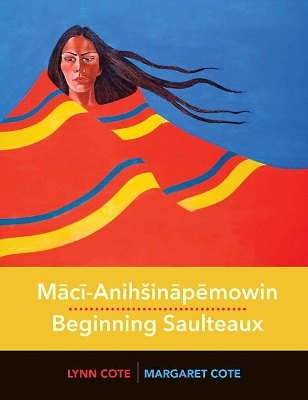
Maci-Anihšinapemowin / Beginning Saulteaux
University of Regina Press (Verlag)
978-0-88977-757-6 (ISBN)
Mācī-Anihināpēmowin / Beginning Saulteaux is an introductory look at one of the most widely spoken of all North American Indigenous languages, regionally known as Saulteaux, Ojibway, Ottawa (Odawa), Chippewa, and Algonquian. In an easy-to-use and easy-to-read series of lessons, both designed for self-study or for use in the classroom, Beginning Saulteaux will guide beginners through the language's grammatical structures and spelling systems, as well as everyday terms and phrases. The book grounds the language in both traditional and contemporary contexts, and sheds light on the Saulteaux world view. For example, there is no word for good-bye in the language, so upon parting people will usually say Kika-wāpamin mīnawā, meaning "I'll see you again." The third in our Indigenous Languages for Beginners series, Beginning Saulteaux is an invaluable resource produced in consultation with Elders, Language Keepers, and community members, and continues our commitment to revitalizing Indigenous languages.
Margaret Cote has had a distinguished career in education, including many years at First Nations University of Canada. She is the author of numerous publications, including Nēnapohš Legends and children's books aimed at preserving and teaching the Saulteaux language. Margaret lives in Regina, SK. Lynn Cote is a faculty member with the Department of Indigenous Languages, Arts and Cultures at First Nations University of Canada, teaching the Saulteaux language, linguistics, and stories. She lives in Regina, SK.
Acknowledgements
Introduction
About the Saulteaux Language
First Nations Languages Spoken in Saskatchewan
First Nations in Saskatchewan
Notes and Suggestions for the Student
Chapter 1
Objectives
Saulteaux Spelling and Sounds
The Orthography
The Phonology
Vowels
Consonants
Pronunciation
Grammatical Terms
Abbreviations
Chapter 2
Objectives, Dialogues, and Vocabulary
Minimal Pairs and Near-Minimal Pairs
Greetings and Polite Responses
Chapter 3
Objectives, Dialogues, and Vocabulary
Akintāhsowinan (Numbers)
Adding and Subtracting Numbers in Saulteaux
Šōniyā (Money)
Adding and Subtracting Money in Saulteaux
Chapter 4
Objectives, Dialogues, and Vocabulary
Introduction to Nouns
Gender Classification
Animate Nouns
Inanimate Nouns
Pluralization
Animate Noun Plural Suffixes
Inanimate Noun Plural Suffixes
Chapter 5
Objectives, Dialogues, and Vocabulary
Pre-nouns
Pronouns
Demonstrative Pronouns
Singular Forms
Plural Forms
Other Demonstrative Pronouns
Interrogative Pronouns
Personal Pronouns
Emphatic Personal Pronouns
Chapter 6
Objectives, Dialogues, and Vocabulary
Diminutive Nouns
Locative Nouns
Pejorative Nouns
Compound Nouns
Building Suffix
Chapter 7
Objectives, Dialogues, and Vocabulary
Possessive Nouns
Animate Noun Forms
Animate Noun Obviation
Animate Obviative Demonstrative Forms
Inanimate Noun Forms
Inanimate Noun Obviation
Dependent Nouns
Kinship Terms
Anatomical Terms
Chapter 8
Objectives, Dialogues, and Vocabulary
Introduction to Verbs
Verb Mode, Tense, and Aspect
Mode
Tense and Aspect
Conjugating Verbs
Chapter 9
Objectives, Dialogues, and Vocabulary
Introduction to Particles and Pre-verbs
Particles
Pre-verbs
Chapter 10
Objectives, Dialogues, and Vocabulary
Inanimate Intransitive Verbs (V-II)
Indicative Mode—Present Tense
Weather Words
Days of the Week
Divisions of the Day
Time
Seasons
Colours
Indicative Mode—Past Tense and Future Definite Tense
Past Tense
Future Definite Tense
Pre-verb Order
Particles
Polarity or Yes/No Questions
Negative Indicative Mode
Chapter 11
Objectives, Dialogues, and Vocabulary
Inanimate Intransitive Verbs (V-II), continued
Subjunctive Mode
Weather Words—Subjunctive Mode
Supplementary Questions
Negative Subjunctive Mode
Chapter 12
Objectives, Dialogues, and Vocabulary
Animate Intransitive Verbs (V-AI)
Imperative and Negative Imperative Modes
Delayed Imperative
Indicative Mode
Tense and Aspect
Polarity or Yes/No Questions
Negative Indicative Mode
Chapter 13
Objectives, Dialogues, and Vocabulary
Animate Intransitive Verbs (V-AI), continued
Subjunctive Mode
Initial Change
Tense and Aspect
Negative Subjunctive Mode
Chapter 14
Objectives, Dialogues, and Vocabulary
Introduction to Transitive Verbs
Transitive Animate Verbs (V-TA)
Imperative and Negative Imperative Modes
Indicative Mode
Tense and Aspect
Negative Indicative Mode
Chapter 15
Objectives, Dialogues, and Vocabulary
Transitive Animate Verbs (V-TA), continued
Subjunctive Mode
Negative Subjunctive Mode
Chapter 16
Objectives, Dialogues, and Vocabulary
Transitive Inanimate Verbs (V-TI)
Imperative and Negative Imperative Modes
Indicative Mode
Tense and Aspect
Negative Indicative Mode
Chapter 17
Objectives, Dialogues, and Vocabulary
Transitive Inanimate Verbs (V-TI), continued
Subjunctive Mode
Tense and Aspect
Negative Subjunctive Mode
Exercises
Verb Conjugation Patterns (V-AI, V-TA, V-TI)
Animate Intransitive Verbs
Imperative and Negative Imperative Mode
Indicative Mode
Negative Indicative Mode
Subjunctive Mode
Negative Subjunctive Mode
Transitive Animate Verbs
Imperative and Negative Imperative Mode
Indicative Mode
Negative Indicative Mode
Subjunctive Mode
Negative Subjunctive Mode
Transitive Inanimate Verbs
Imperative and Negative Imperative Mode
Indicative Mode
Negative Indicative Mode
Subjunctive Mode
Negative Subjunctive Mode
Vocabulary List
| Erscheinungsdatum | 18.01.2021 |
|---|---|
| Verlagsort | Regina |
| Sprache | englisch |
| Maße | 216 x 280 mm |
| Gewicht | 760 g |
| Themenwelt | Schulbuch / Wörterbuch ► Wörterbuch / Fremdsprachen |
| Geisteswissenschaften ► Sprach- / Literaturwissenschaft ► Sprachwissenschaft | |
| Sozialwissenschaften ► Ethnologie | |
| Sozialwissenschaften ► Soziologie | |
| ISBN-10 | 0-88977-757-8 / 0889777578 |
| ISBN-13 | 978-0-88977-757-6 / 9780889777576 |
| Zustand | Neuware |
| Informationen gemäß Produktsicherheitsverordnung (GPSR) | |
| Haben Sie eine Frage zum Produkt? |
aus dem Bereich


