


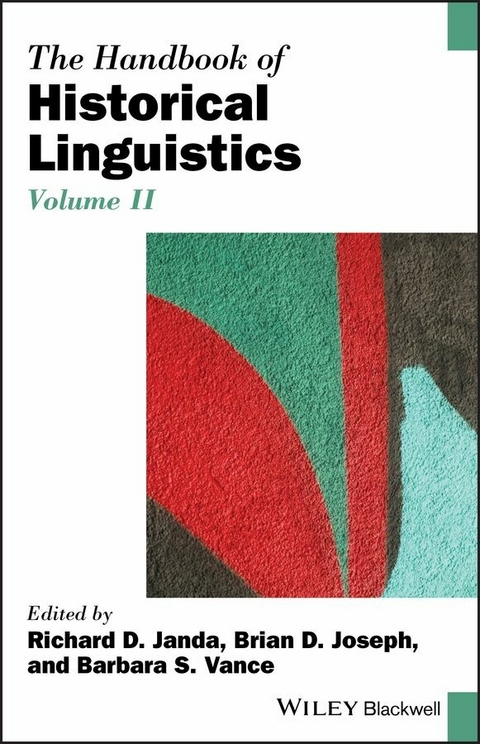
The Handbook of Historical Linguistics, Volume II (eBook)
John Wiley & Sons (Verlag)
978-1-118-73226-7 (ISBN)
An entirely new follow-up volume providing a detailed account of numerous additional issues, methods, and results that characterize current work in historical linguistics.
This brand-new, second volume of The Handbook of Historical Linguistics is a complement to the well-established first volume first published in 2003. It includes extended content allowing uniquely comprehensive coverage of the study of language(s) over time. Though it adds fresh perspectives on several topics previously treated in the first volume, this Handbook focuses on extensions of diachronic linguistics beyond those key issues.
This Handbook provides readers with studies of language change whose perspectives range from comparisons of large open vs. small closed corpora, via creolistics and linguistic contact in general, to obsolescence and endangerment of languages. Written by leading scholars in their respective fields, new chapters are offered on matters such as the origin of language, evidence from language for reconstructing human prehistory, invocations of language present in studies of language past, benefits of linguistic fieldwork for historical investigation, ways in which not only biological evolution but also field biology can serve as heuristics for research into the rise and spread of linguistic innovations, and more. Moreover, it:
- offers novel and broadened content complementing the earlier volume so as to provide the fullest available overview of a wholly engrossing field
- includes 23 all-new contributed chapters, treating some familiar themes from fresh perspectives but mostly covering entirely new topics
- features expanded discussion of material from language families other than Indo-European
- provides a multiplicity of views from numerous specialists in linguistic diachrony.
The Handbook of Historical Linguistics, Volume II is an ideal book for undergraduate and graduate students in linguistics, researchers and professional linguists, as well as all those interested in the history of particular languages and the history of language more generally.
Richard D. Janda is currently Visiting Scholar in French and Italian at Indiana University Bloomington, USA, but his teaching spans 11 universities in 9 US states. He is author or editor of over 75 publications, including The Handbook of Historical Linguistics (Wiley Blackwell, 2003).
Brian D. Joseph is Distinguished University Professor of Linguistics and The Kenneth E. Naylor Professor of South Slavic Linguistics at The Ohio State University, USA. He has written and edited numerous books and published over 280 articles. He served as editor of the journal Language from 2002 - 2009, and is currently co-editor of the Journal of Greek Linguistics.
Barbara S. Vance is Associate Professor of Linguistics and Associate Professor of French Linguistics at Indiana University Bloomington, USA. She is the author of Syntactic Change in Medieval French (1997) and is a specialist in the historical syntax of French and Occitan.
An entirely new follow-up volume providing a detailed account of numerous additional issues, methods, and results that characterize current work in historical linguistics. This brand-new, second volume of The Handbook of Historical Linguistics is a complement to the well-established first volume first published in 2003. It includes extended content allowing uniquely comprehensive coverage of the study of language(s) over time. Though it adds fresh perspectives on several topics previously treated in the first volume, this Handbook focuses on extensions of diachronic linguistics beyond those key issues. This Handbook provides readers with studies of language change whose perspectives range from comparisons of large open vs. small closed corpora, via creolistics and linguistic contact in general, to obsolescence and endangerment of languages. Written by leading scholars in their respective fields, new chapters are offered on matters such as the origin of language, evidence from language for reconstructing human prehistory, invocations of language present in studies of language past, benefits of linguistic fieldwork for historical investigation, ways in which not only biological evolution but also field biology can serve as heuristics for research into the rise and spread of linguistic innovations, and more. Moreover, it: offers novel and broadened content complementing the earlier volume so as to provide the fullest available overview of a wholly engrossing field includes 23 all-new contributed chapters, treating some familiar themes from fresh perspectives but mostly covering entirely new topics features expanded discussion of material from language families other than Indo-European provides a multiplicity of views from numerous specialists in linguistic diachrony. The Handbook of Historical Linguistics, Volume II is an ideal book for undergraduate and graduate students in linguistics, researchers and professional linguists, as well as all those interested in the history of particular languages and the history of language more generally.
Richard D. Janda is currently Visiting Scholar in French and Italian at Indiana University Bloomington, USA, but his teaching spans 11 universities in 9 US states. He is author or editor of over 75 publications, including The Handbook of Historical Linguistics (Wiley Blackwell, 2003). Brian D. Joseph is Distinguished University Professor of Linguistics and The Kenneth E. Naylor Professor of South Slavic Linguistics at The Ohio State University, USA. He has written and edited numerous books and published over 280 articles. He served as editor of the journal Language from 2002 - 2009, and is currently co-editor of the Journal of Greek Linguistics. Barbara S. Vance is Associate Professor of Linguistics and Associate Professor of French Linguistics at Indiana University Bloomington, USA. She is the author of Syntactic Change in Medieval French (1997) and is a specialist in the historical syntax of French and Occitan.
| Erscheint lt. Verlag | 15.9.2020 |
|---|---|
| Reihe/Serie | Blackwell Handbooks in Linguistics |
| Blackwell Handbooks in Linguistics | Blackwell Handbooks in Linguistics |
| Sprache | englisch |
| Themenwelt | Schulbuch / Wörterbuch ► Wörterbuch / Fremdsprachen |
| Geisteswissenschaften ► Sprach- / Literaturwissenschaft ► Sprachwissenschaft | |
| Schlagworte | Analogy • Communication • Diachrony • Dialect • Dialectology • etymology • Evolutionary Linguistics • grammar • Historical Linguistics • Historische Linguistik • language • Lexicon • Linguistics • Literacy • phonetics • sound study • Sprachwissenschaften • Syntax • tonogenesis • Translation • word origins |
| ISBN-10 | 1-118-73226-X / 111873226X |
| ISBN-13 | 978-1-118-73226-7 / 9781118732267 |
| Informationen gemäß Produktsicherheitsverordnung (GPSR) | |
| Haben Sie eine Frage zum Produkt? |
 PDF (Adobe DRM)
Kopierschutz: Adobe-DRM
Adobe-DRM ist ein Kopierschutz, der das eBook vor Mißbrauch schützen soll. Dabei wird das eBook bereits beim Download auf Ihre persönliche Adobe-ID autorisiert. Lesen können Sie das eBook dann nur auf den Geräten, welche ebenfalls auf Ihre Adobe-ID registriert sind.
Details zum Adobe-DRM
Dateiformat: PDF (Portable Document Format)
Mit einem festen Seitenlayout eignet sich die PDF besonders für Fachbücher mit Spalten, Tabellen und Abbildungen. Eine PDF kann auf fast allen Geräten angezeigt werden, ist aber für kleine Displays (Smartphone, eReader) nur eingeschränkt geeignet.
Systemvoraussetzungen:
PC/Mac: Mit einem PC oder Mac können Sie dieses eBook lesen. Sie benötigen eine
eReader: Dieses eBook kann mit (fast) allen eBook-Readern gelesen werden. Mit dem amazon-Kindle ist es aber nicht kompatibel.
Smartphone/Tablet: Egal ob Apple oder Android, dieses eBook können Sie lesen. Sie benötigen eine
Geräteliste und zusätzliche Hinweise
Buying eBooks from abroad
For tax law reasons we can sell eBooks just within Germany and Switzerland. Regrettably we cannot fulfill eBook-orders from other countries.
aus dem Bereich


