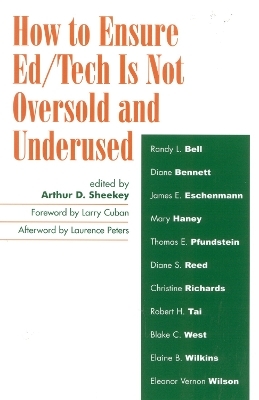
How to Ensure Ed/Tech Is Not Oversold and Underused
Rowman & Littlefield Education (Verlag)
978-0-8108-4620-3 (ISBN)
Recent claims by researchers and critics suggest that the demand for increasing the number of computers and telecommunications networks to schools and classrooms is coming from the nation's political and business sectors, and not from teachers and school practitioners. This book was written in response to these claims and suggests that answers to questions about how to successfully integrate and use technology can be found in programs that are currently underway. The recommendation to educational policymakers: create the conditions that encourage and support teachers to adapt technologies and other tools in ways that respond to the unique needs of their communities, school requirements, and students' learning styles.
The contributing authors describe the condition of their school or system and each identified the following:
· Goals and objectives
· Benefits to student learning and engagement
· Favorable and/or unfavorable conditions that influence effectiveness
· How technology and telecommunications can transform the delivery of education
· The resources involved and how they are changing the way teachers, students, and their families are benefiting
· The conditions necessary
Will be of interest among a wide group of stakeholders in the field of education including state and local educational administrators and others involved in adapting and using learning technologies and telecommunications services to improve and extend the quality of K-12 education throughout the nation.
Arthur D. Sheekey was a COMSI Fellow at the Office of Science and Technology Policy and at the FCC, Senior Associate at tile American Association for Higher Education, Senior Fellow at the Consortium of Universities of the Washington Area, and Resident Scholar at Stanford University's Graduate School of Education. He is a guest lecturer at the University of St. Thomas in St. Paul, Minnesota. He taught high school and junior high school science for five years in New Jersey.
Chapter 1 Acknowledgments
Chapter 2 Foreword
Chapter 3 Introduction
Chapter 4 1 Beyond Comprehension: Elementary Education and Generative Technology
Chapter 5 2 Transforming Science Instruction with Technology
Chapter 6 3 The Impact of technology on rural Schools with State Leadership
Chapter 7 4 Building a Community of Lifelong Learners
Chapter 8 5 Building a Bridge to Effective Use of Technology
Chapter 9 6 The Use of Technology That Affects How Teachers Teach and Students Learn
Chapter 10 7 Ensuring the Impact of Technology on Schools and School-Age Children
Chapter 11 8 The Impact of Technology Integration and Support from Coaches
Chapter 12 9 Using Technology to Engage Students for Multiple Learning Experiences
Chapter 13 Afterword
Chapter 14 Index
Chapter 15 About the Contributors
| Erscheint lt. Verlag | 4.5.2003 |
|---|---|
| Sprache | englisch |
| Maße | 146 x 230 mm |
| Gewicht | 268 g |
| Themenwelt | Schulbuch / Wörterbuch ► Unterrichtsvorbereitung ► Unterrichts-Handreichungen |
| Sozialwissenschaften ► Pädagogik | |
| ISBN-10 | 0-8108-4620-9 / 0810846209 |
| ISBN-13 | 978-0-8108-4620-3 / 9780810846203 |
| Zustand | Neuware |
| Informationen gemäß Produktsicherheitsverordnung (GPSR) | |
| Haben Sie eine Frage zum Produkt? |
aus dem Bereich