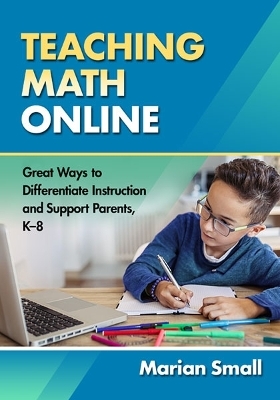
Teaching Math Online
Teachers' College Press (Verlag)
978-0-8077-6490-9 (ISBN)
- Titel z.Zt. nicht lieferbar
- Portofrei ab CHF 40
- Auch auf Rechnung
- Artikel merken
Learn how to provide rich, online mathematics instruction that optimizes the limited time you have with students, while doing it in a way that does not overwhelm parents. This practical resource: highlights the value of open questions for differentiating instruction in the K–8 virtual environment; shows teachers how to adapt the materials that they are already using; illustrates how students can incorporate items from their home environment into math lessons; demonstrates how to build and maintain community with students online; explores the logistics of independent meetings with students and parents; provides samples and directions for creating tools like number lines and manipulatives at home; and much more. Featuring professional developer Marian Small’s special brand of lucid explanation of difficult concepts, engaging teaching examples, troubleshooting tips, and formative assessments, Teaching Math Online is a must-have for anyone teaching math either wholly online or in blended classrooms.
Book Features:
Provides immediate assistance for teachers with little or no experience teaching math online.
Offers specific suggestions for supporting parents in their new role as the link between teacher and student.
Addresses both logistical and pedagogical issues important to successful online learning.
Provides online problem visuals for teachers to use with students.
Includes reproducibles for creating math manipulatives and tools.
Discusses distanced formative assessment.
Includes access to exemplar videos for communicating with parents, and for providing students with spoken instruction that they can save and replay.
Marian Small is an international professional developer and conference speaker. A former dean of education and professor of mathematics education, she is widely known for her bestselling books and her in-district work with educators. Visit her website at www.onetwoinfinity.ca for in-person and online professional development.
Contents
Introduction 1
1 Principles to Consider When Teaching Online 3
What Math Teaching Must Focus On 3
Creating Warmth 3
Creating Interactivity and Engagement 4
Providing Clarity and Structure 5
Attending to Individual Differences 6
2 Differentiation Instruction Using Open Questions and Parallel Tasks 7
The Value of Open Questions in an Online Environment 7
The Value of Parallel Tasks in an Online Environment 9
The Value of Rich Math Conversation: Unexpected Benefits of an Online Environment 10
The Importance of Being Intentional in an Online Environment 11
3 Logistics 12
Preparing Students for Working at a Distance 12
Connectivity Issues 12
Building Online Communities 13
Collecting Work From Students 15
Providing Feedback and Formative Assessment 16
Involving Parents Without Overwhelming Them 16
Dealing With Manipulatives When Teaching Virtually 18
4 Adapting Questions From Good Questions for the Online Environment 20
Grades K–2 20
Grades 3–5 27
Grades 6–8 33
Summary 40
5 New Open Questions for the Online Environment 41
Grades K–2 41
Grades 3–5 47
Grades 6–8 51
Summary 54
6 Conclusion 55
Resources 56
References 56
Online Resources 56
Videos 57
Math Tools 57
Appendix A: Scripts for Example Videos 58
Learning About Math Tools 59
Using a 100-Chart (Grades 1 and 2) 59
Using Number Lines (Grades 2 and 3) 60
Using Pattern Blocks (Grades 3 and 4) 61
Using Base Ten Blocks (Grades 4 and 5) 62
Using Double Number Lines (Grades 6 and 7) 63
Using Probing Questions 64
234 Question (Grades K–2) 64
What Does Division Look Like? (Grades 3–5) 66
Circles, Squares, and Crosses (Grades 6–8) 67
Appendix B: Templates for Manipulatives 69
10-Frames 70
100-Chart 71
Number Paths 72
Number Lines 73
Pattern Blocks 74
Dot Paper 76
Base Ten Blocks 77
Grid Paper 78
Fraction Strips 79
10 × 10 Grid 80
Double Number Lines 81
About the Author 82
| Erscheinungsdatum | 19.10.2020 |
|---|---|
| Verlagsort | New York |
| Sprache | englisch |
| Maße | 171 x 249 mm |
| Gewicht | 175 g |
| Themenwelt | Schulbuch / Wörterbuch ► Unterrichtsvorbereitung ► Unterrichts-Handreichungen |
| Sozialwissenschaften ► Pädagogik ► Schulpädagogik / Grundschule | |
| ISBN-10 | 0-8077-6490-6 / 0807764906 |
| ISBN-13 | 978-0-8077-6490-9 / 9780807764909 |
| Zustand | Neuware |
| Informationen gemäß Produktsicherheitsverordnung (GPSR) | |
| Haben Sie eine Frage zum Produkt? |
aus dem Bereich