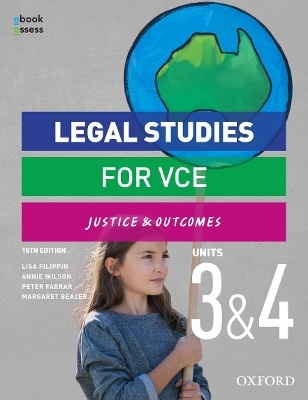
Legal Studies for VCE Units 3 & 4 Student book + obook assess
OUP Australia and New Zealand
9780190326302 (ISBN)
- Titel ist leider vergriffen;
keine Neuauflage - Artikel merken
Lisa Filippin is an experienced solicitor, teacher, assessor and examiner. She is currently a practising solicitor, working predominantly in the areas of commercial litigation and insolvency. Prior to working as a solicitor, Lisa taught at Melbourne Girls Grammar in the areas of Legal Studies and Business Management and was also the Year 10 Coordinator. Lisa has held several roles involving exam development, assessment and curriculum development, and was involved in the re-accreditation of the VCE Legal Studies course in 2009–2010 and 2016–17. Annie Wilson is an experienced VCE Legal Studies and Commerce teacher who has been passionately teaching and developing curriculum materials for over 30 years. She is the author of numerous textbooks and has prepared a range of teaching and learning resources for various publishers and subject associations including the Victorian Commercial Teachers Association (VCTA). Annie is currently teaching at Camberwell Girls Grammar School and is actively involved in providing professional development to VCE Legal Studies teachers and student revision lectures. Peter Farrar has taught VCE Legal Studies for over 25 years. He is passionate about learning and teaching and is highly skilled at developing a range of learning materials to meet the needs of a diverse range of students. During his career, he has authored over 20 books and also served in numerous senior leadership roles. Peter is actively involved with the VCTA, and has been a regular presenter at Comview since 1992. He currently teaches at Star of the Sea College. Margaret Beazer has been involved with Legal Studies in Victoria for many years. She has been writing Legal Studies text books since 1990 and ran her own publishing business for many years. Prior to publishing and authoring, Margaret taught Legal Studies at Monash High School and Trinity Grammar School; worked in curriculum development for the then Board of Studies; and was the Legal Studies State Reviewer for over 20 years. Josie Gray has 30 years’ experience in the planning and delivery of both academic and vocational education and training programs. She has taught business and law-related subjects to both school-age and adult learners. Josie taught VCE Legal Studies for many years before working as an Assistant Principal in the Victorian government school sector for 10 years, and as an educator in the Vocational Education and Training sector delivering law-related units. She is currently employed in the Victorian public sector where she designs, delivers and provides advice on professional development programs in education.
Chapter 1: Legal toolkit1.1 Understanding the VCE Legal Studies course 1.2 Setting yourself up for success in VCE Legal Studies 1.3 Tips for success on assessment tasks 1.4 Mastering legal citation 1.5 Careers in the lawChapter 2: Introduction to Unit 32.1 An overview of the Australian legal system 2.2 Criminal law and civil law 2.3 The meaning of the rule of lawChapter 3: Introduction to the Victorian criminal justice system3.1 Introduction to the criminal justice system 3.2 The principles of justice 3.3 Key concepts in the Victorian criminal justice system 3.4 The rights of the accused 3.5 The rights of the victims Chapter 3 reviewChapter 4: Determining a criminal case4.1 The role of Victorian Legal Aid in assisting an accused 4.2 The role of community legal centres in assisting an accused 4.3 The purposes of committal proceedings 4.4 Pleas negotiations 4.5 Sentence negotiations 4.6 The reasons for a Victorian court hierarchy 4.7 The responsibilities of the judge and jury in a criminal trial 4.8 The responsibilities of the parties and legal practitioners in a criminal trial 4.9 The purposes of sanctions 4.10 Types of sanctions – fees 4.11 Types of sanctions – imprisonment 4.12 Sentencing factors Chapter 4 reviewChapter 5: Reforming the criminal justice system5.1 Costs factors 5.2 Time factors 5.3 Cultural factors 5.4 Recent reforms 5.5 Recommended reforms Chapter 5 reviewChapter 6: Introduction to the Victorian civil justice system6.1 Introduction to the civil justice system 6.2 The principles of justice 6.3 Key concepts in the Victorian civil justice system 6.4 Relevant factors when initiating a civil claim – negotiation and costs Chapter 6 reviewChapter 7: Resolving a civil dispute7.1 Consumer Affairs Victoria 7.2 The Victorian Civil and Administrative Tribunal 7.3 The purposes of civil pre-trial procedures 7.4 The reasons for a Victorian court hierarchy 7.5 The responsibilities of the parties and legal practitioners in a civil trial 7.6 The responsibilities of the parties and legal practitioners in a civil trial 7.7 Judicial powers of case management 7.8 Courts as dispute resolution bodies 7.9 Methods used to resolve civil disputes – mediation and conciliation 7.10 Methods used to resolve civil disputes – arbitration 7.11 Remedies Chapter 7 reviewChapter 8: Reforming the civil justice system8.1 Costs factors 8.2 Time factors 8.3 Accessibility factors 8.4 Recent reforms 8.5 Recommended reforms Chapter 8 reviewChapter 9: Introduction to Unit 49.1 The historical development of the British parliament 9.2 The federation of Australia 9.3 Parliaments in Australia 9.4 The meaning of the rule of lawChapter 10: The people and the Constitution10.1 Introduction to the Australian Constitution 10.2 The role of the Commonwealth parliament in law-making in law-making 10.3 The role of the Victorian parliament in law-making 10.4 The role of the Crown in law-making 10.5 The division of constitutional law-making powers 10.6 Section 109 of the Australian Constitution Chapter 10 reviewChapter 11: Checks on Parliament in law-making11.1 Introduction to the checks on Parliament in law-making 11.2 The bicameral structure of the Commonwealth parliament 11.3 The speration of exclusive, legislative and judicial powers 11.4 The express protection of rights 11.5 The role of the high Court in interpreting the Australian Constitution 11.6 The requirement for a double majority in a referendum Chapter 11 reviewChapter 12: Changing and protecting the constitution12.1 High Court cases and sections 7 and 24 of the Constitution 12.2 Protecting the Australian Constitution – the 1999 Referendum 12.3 Protecting the Australian Constitution – the 1967 Referendum 12.4 The High Court and the division of law-making powers 12.5 Interpretation of the external affairs power Chapter 12 reviewChapter 13: The Parliament13.1 The roles of the houses of parliament 13.2 The representative nature of parliament 13.3 Political pressures 13.4 Restrictions on law-making powers Chapter 13 reviewChapter 14: The courts14.1 Introduction to the courts 14.2 The roles of the courts in law-making 14.3 Statutory interpretation 14.4 Factors that affect the ability of the courts to make law – the doctrine of precedent 14.5 Factors that affect the ability of the courts to make law – judicial conservatism 14.6 Factors that affect the ability of the courts to make law – judicial activism 14.7 Factors that affect the ability of the courts to make law – cost and time bringing a case to court 14.8 Factors that affect the ability of the courts to make law – the requirement of standing 14.9 The relationship between courts and parliament in law-making Chapter 14 reviewChapter 15: Rights15.1 Reasons for law reform 15.2 Individuals influencing law reform through petitions 15.3 Individuals influencing law reform through demonstrations 15.4 Individuals influencing law reform through the courts 15.5 The role of the media in law reform 15.6 The Victorian Law Reform Commission 15.7 Parliamentary committees 15.8 Royal commissions 15.9 The ability of parliament and the courts to respond to the need for law reform
| Erscheint lt. Verlag | 17.12.2020 |
|---|---|
| Reihe/Serie | Oxford VCE Legal Studies |
| Verlagsort | Melbourne |
| Sprache | englisch |
| Gewicht | 1460 g |
| Themenwelt | Schulbuch / Wörterbuch |
| Recht / Steuern ► EU / Internationales Recht | |
| ISBN-13 | 9780190326302 / 9780190326302 |
| Zustand | Neuware |
| Informationen gemäß Produktsicherheitsverordnung (GPSR) | |
| Haben Sie eine Frage zum Produkt? |
aus dem Bereich