Creating spaces of risk taking, and consistent mutual, critical engagement are challenging at a moment in history where neoliberal forces impact so many realms of formal teaching and learning. Within this context, the divide between what educators, be they in a classroom or a community, imagine as possible and their ability to implement these kinds of pedagogical possibilities is an urgent conundrum worth exploring. We must consider how to address these disconnects; advocating and envisioning a more holistic, healthy, forward thinking model of teaching and learning. How do we create cultures of engaged inquiry, framed in vulnerability, where educators and students are compelled to ask questions just beyond their grasp? How can we all be better equipped to ask and answer big, beautiful, bold, even uncomfortable questions that fuel the heart of inquiry and perhaps, just maybe, lead to a more peaceful and just world?
A collection of reflections, case studies, and research focused on the pedagogy of vulnerability is a starting point for this work. The book itself is meant to be an example of pedagogical vulnerability, wherein the authors work to explicate the most intimate and delicate aspects of the varied pedagogical journeys, understandings rooted in vulnerability, and those of their students, colleagues, clients, even adversaries. It is a work that “holds space.
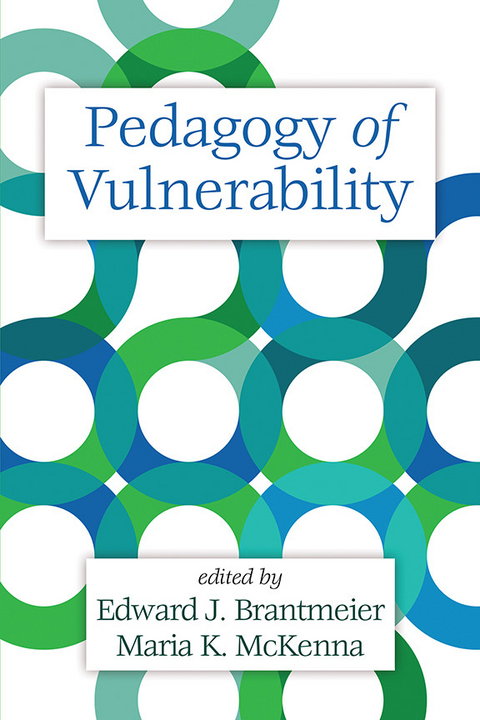
The purpose of this text is to elicit discussion, reflection, and action specific to pedagogy within education, especially higher education, and circles of experiential learning, community organizing, conflict resolution and youth empowerment work. Vulnerability itself is not a new term within education; however the pedagogical imperatives of vulnerability are both undertheorized in educational discourse and underexplored in practice. This work builds on that of Edward Brantmeier in Re-Envisioning Higher Education: Embodied Pathways to Wisdom and Transformation (Lin, Oxford, & Brantmeier, 2013). In his chapter, "e;Pedagogy of vulnerability: Definitions, assumptions, and application,"e; he outlines a set of assumptions about the term, clarifying for his readers the complicated, risky, reciprocal, and purposeful nature of vulnerability, particularly within educational settings.Creating spaces of risk taking, and consistent mutual, critical engagement are challenging at a moment in history where neoliberal forces impact so many realms of formal teaching and learning. Within this context, the divide between what educators, be they in a classroom or a community, imagine as possible and their ability to implement these kinds of pedagogical possibilities is an urgent conundrum worth exploring. We must consider how to address these disconnects; advocating and envisioning a more holistic, healthy, forward thinking model of teaching and learning. How do we create cultures of engaged inquiry, framed in vulnerability, where educators and students are compelled to ask questions just beyond their grasp? How can we all be better equipped to ask and answer big, beautiful, bold, even uncomfortable questions that fuel the heart of inquiry and perhaps, just maybe, lead to a more peaceful and just world?A collection of reflections, case studies, and research focused on the pedagogy of vulnerability is a starting point for this work. The book itself is meant to be an example of pedagogical vulnerability, wherein the authors work to explicate the most intimate and delicate aspects of the varied pedagogical journeys, understandings rooted in vulnerability, and those of their students, colleagues, clients, even adversaries. It is a work that "e;holds space."e;
| Erscheint lt. Verlag | 1.3.2020 |
|---|---|
| Sprache | englisch |
| Themenwelt | Schulbuch / Wörterbuch ► Lexikon / Chroniken |
| Geisteswissenschaften ► Psychologie ► Allgemeine Psychologie | |
| Geisteswissenschaften ► Psychologie ► Pädagogische Psychologie | |
| Sozialwissenschaften ► Pädagogik ► Allgemeines / Lexika | |
| Sozialwissenschaften ► Pädagogik ► Bildungstheorie | |
| Sozialwissenschaften ► Pädagogik ► Didaktik | |
| Sozialwissenschaften ► Politik / Verwaltung | |
| ISBN-10 | 1-64802-027-5 / 1648020275 |
| ISBN-13 | 978-1-64802-027-8 / 9781648020278 |
| Informationen gemäß Produktsicherheitsverordnung (GPSR) | |
| Haben Sie eine Frage zum Produkt? |
 PDF (Adobe DRM)
Größe: 1,1 MB
Kopierschutz: Adobe-DRM
Adobe-DRM ist ein Kopierschutz, der das eBook vor Mißbrauch schützen soll. Dabei wird das eBook bereits beim Download auf Ihre persönliche Adobe-ID autorisiert. Lesen können Sie das eBook dann nur auf den Geräten, welche ebenfalls auf Ihre Adobe-ID registriert sind.
Details zum Adobe-DRM
Dateiformat: PDF (Portable Document Format)
Mit einem festen Seitenlayout eignet sich die PDF besonders für Fachbücher mit Spalten, Tabellen und Abbildungen. Eine PDF kann auf fast allen Geräten angezeigt werden, ist aber für kleine Displays (Smartphone, eReader) nur eingeschränkt geeignet.
Systemvoraussetzungen:
PC/Mac: Mit einem PC oder Mac können Sie dieses eBook lesen. Sie benötigen eine
eReader: Dieses eBook kann mit (fast) allen eBook-Readern gelesen werden. Mit dem amazon-Kindle ist es aber nicht kompatibel.
Smartphone/Tablet: Egal ob Apple oder Android, dieses eBook können Sie lesen. Sie benötigen eine
Geräteliste und zusätzliche Hinweise
Buying eBooks from abroad
For tax law reasons we can sell eBooks just within Germany and Switzerland. Regrettably we cannot fulfill eBook-orders from other countries.
 EPUB (Adobe DRM)
Kopierschutz: Adobe-DRM
Adobe-DRM ist ein Kopierschutz, der das eBook vor Mißbrauch schützen soll. Dabei wird das eBook bereits beim Download auf Ihre persönliche Adobe-ID autorisiert. Lesen können Sie das eBook dann nur auf den Geräten, welche ebenfalls auf Ihre Adobe-ID registriert sind.
Details zum Adobe-DRM
Dateiformat: EPUB (Electronic Publication)
EPUB ist ein offener Standard für eBooks und eignet sich besonders zur Darstellung von Belletristik und Sachbüchern. Der Fließtext wird dynamisch an die Display- und Schriftgröße angepasst. Auch für mobile Lesegeräte ist EPUB daher gut geeignet.
Systemvoraussetzungen:
PC/Mac: Mit einem PC oder Mac können Sie dieses eBook lesen. Sie benötigen eine
eReader: Dieses eBook kann mit (fast) allen eBook-Readern gelesen werden. Mit dem amazon-Kindle ist es aber nicht kompatibel.
Smartphone/Tablet: Egal ob Apple oder Android, dieses eBook können Sie lesen. Sie benötigen eine
Geräteliste und zusätzliche Hinweise
Buying eBooks from abroad
For tax law reasons we can sell eBooks just within Germany and Switzerland. Regrettably we cannot fulfill eBook-orders from other countries.
aus dem Bereich