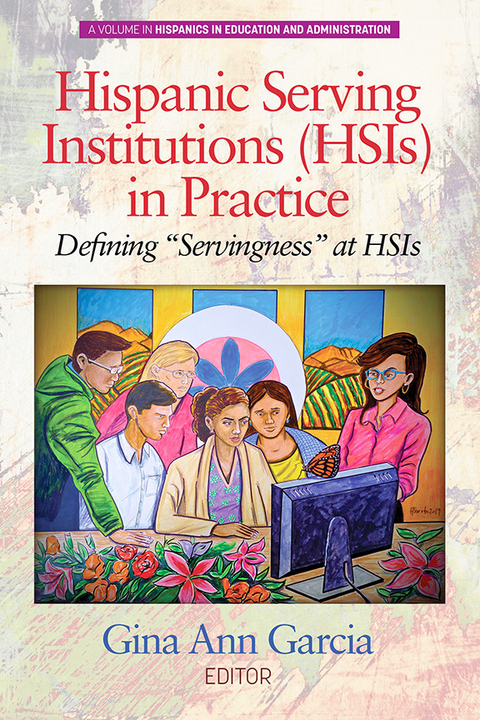
This edited book, Hispanic Serving Institutions (HSIs) in Practice: Defining “Servingness” at HSIs, fills an important gap in the literature. It features the stories of faculty, staff, and administrators who are defining “servingness” in practice at HSIs. Servingness is conceptualized as the ability of HSIs to enroll and educate Latinx students through a culturally enhancing approach that centers Latinx ways of knowing and being, with the goal of providing transformative experiences that lead to both academic and non-academic outcomes. In this book, practitioners tell their stories of success in defining servingness at HSIs. Specifically, they provide empirical and practical evidence of the results and outcomes of federally funded HSI grants, including those funded by Department of Education Title III and V grants.
This edited book is ideal for higher education practitioners and scholars searching for best practices for HSIs in the United States. Administrators at HSIs, including presidents, provosts, deans, and boards of trustees, will find the book useful as they seek out ways to effectively serve Latinx and other minoritized students. Faculty who teach in higher education graduate programs can use the book to highlight practitioner engaged scholarship. Legislators and policy advocates, who fight for funding and support for HSIs at the federal level, can use the book to inform and shape a research-based Latinx educational policy agenda.
The book is essential as it provides a framework that simplifies the complex phenomenon known as servingness. As HSIs become more significant in the U.S. higher education landscape, books that provide empirically based, practical examples of servingness are necessary.
As the general population of Latinxs in the United States burgeons, so does the population of college-going Latinx students. With more Latinxs entering college, the number of Hispanic Serving Institutions (HSIs), which are not-for-profit, degree granting postsecondary institutions that enroll at least 25% Latinxs, also grows, with 523 institutions now meeting the enrollment threshold to become HSIs. But as they increase in number, the question remains: What does it mean to serve Latinx students?This edited book, Hispanic Serving Institutions (HSIs) in Practice: Defining 'Servingness' at HSIs, fills an important gap in the literature. It features the stories of faculty, staff, and administrators who are defining 'servingness' in practice at HSIs. Servingness is conceptualized as the ability of HSIs to enroll and educate Latinx students through a culturally enhancing approach that centers Latinx ways of knowing and being, with the goal of providing transformative experiences that lead to both academic and non-academic outcomes. In this book, practitioners tell their stories of success in defining servingness at HSIs. Specifically, they provide empirical and practical evidence of the results and outcomes of federally funded HSI grants, including those funded by Department of Education Title III and V grants.This edited book is ideal for higher education practitioners and scholars searching for best practices for HSIs in the United States. Administrators at HSIs, including presidents, provosts, deans, and boards of trustees, will find the book useful as they seek out ways to effectively serve Latinx and other minoritized students. Faculty who teach in higher education graduate programs can use the book to highlight practitioner engaged scholarship. Legislators and policy advocates, who fight for funding and support for HSIs at the federal level, can use the book to inform and shape a research-based Latinx educational policy agenda.The book is essential as it provides a framework that simplifies the complex phenomenon known as servingness. As HSIs become more significant in the U.S. higher education landscape, books that provide empirically based, practical examples of servingness are necessary.
| Erscheint lt. Verlag | 5.3.2020 |
|---|---|
| Sprache | englisch |
| Themenwelt | Schulbuch / Wörterbuch ► Lexikon / Chroniken |
| Sozialwissenschaften ► Ethnologie | |
| Sozialwissenschaften ► Pädagogik ► Erwachsenenbildung | |
| Sozialwissenschaften ► Politik / Verwaltung | |
| Sozialwissenschaften ► Soziologie | |
| ISBN-10 | 1-64802-018-6 / 1648020186 |
| ISBN-13 | 978-1-64802-018-6 / 9781648020186 |
| Informationen gemäß Produktsicherheitsverordnung (GPSR) | |
| Haben Sie eine Frage zum Produkt? |
 PDF (Adobe DRM)
Größe: 5,6 MB
Kopierschutz: Adobe-DRM
Adobe-DRM ist ein Kopierschutz, der das eBook vor Mißbrauch schützen soll. Dabei wird das eBook bereits beim Download auf Ihre persönliche Adobe-ID autorisiert. Lesen können Sie das eBook dann nur auf den Geräten, welche ebenfalls auf Ihre Adobe-ID registriert sind.
Details zum Adobe-DRM
Dateiformat: PDF (Portable Document Format)
Mit einem festen Seitenlayout eignet sich die PDF besonders für Fachbücher mit Spalten, Tabellen und Abbildungen. Eine PDF kann auf fast allen Geräten angezeigt werden, ist aber für kleine Displays (Smartphone, eReader) nur eingeschränkt geeignet.
Systemvoraussetzungen:
PC/Mac: Mit einem PC oder Mac können Sie dieses eBook lesen. Sie benötigen eine
eReader: Dieses eBook kann mit (fast) allen eBook-Readern gelesen werden. Mit dem amazon-Kindle ist es aber nicht kompatibel.
Smartphone/Tablet: Egal ob Apple oder Android, dieses eBook können Sie lesen. Sie benötigen eine
Geräteliste und zusätzliche Hinweise
Buying eBooks from abroad
For tax law reasons we can sell eBooks just within Germany and Switzerland. Regrettably we cannot fulfill eBook-orders from other countries.
 EPUB (Adobe DRM)
Kopierschutz: Adobe-DRM
Adobe-DRM ist ein Kopierschutz, der das eBook vor Mißbrauch schützen soll. Dabei wird das eBook bereits beim Download auf Ihre persönliche Adobe-ID autorisiert. Lesen können Sie das eBook dann nur auf den Geräten, welche ebenfalls auf Ihre Adobe-ID registriert sind.
Details zum Adobe-DRM
Dateiformat: EPUB (Electronic Publication)
EPUB ist ein offener Standard für eBooks und eignet sich besonders zur Darstellung von Belletristik und Sachbüchern. Der Fließtext wird dynamisch an die Display- und Schriftgröße angepasst. Auch für mobile Lesegeräte ist EPUB daher gut geeignet.
Systemvoraussetzungen:
PC/Mac: Mit einem PC oder Mac können Sie dieses eBook lesen. Sie benötigen eine
eReader: Dieses eBook kann mit (fast) allen eBook-Readern gelesen werden. Mit dem amazon-Kindle ist es aber nicht kompatibel.
Smartphone/Tablet: Egal ob Apple oder Android, dieses eBook können Sie lesen. Sie benötigen eine
Geräteliste und zusätzliche Hinweise
Buying eBooks from abroad
For tax law reasons we can sell eBooks just within Germany and Switzerland. Regrettably we cannot fulfill eBook-orders from other countries.
aus dem Bereich