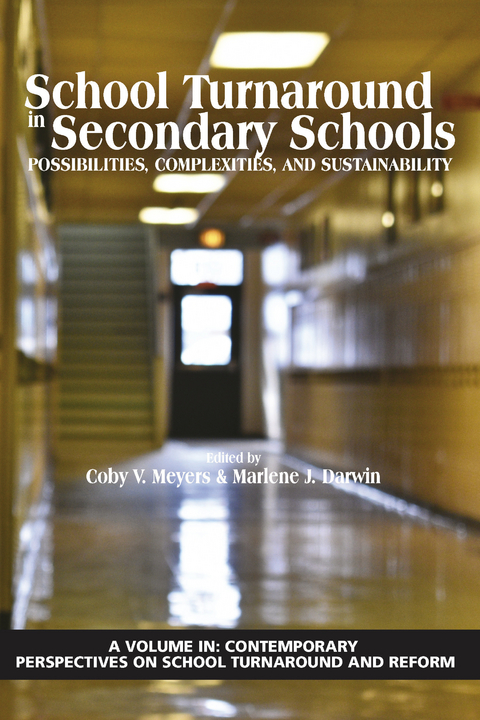
In this edited volume, researchers and scholars consider the doubly perplexing challenge of school turnaround or the rapid improvement of the lowest-performing secondary schools. Although there is some evidence that school turnaround policy can impact student achievement scores, research across international contexts seldom identifies schools that substantially changed student learning trajectories and sustained them. Separately, many societies have found improving secondary schools a relatively intractable problem for multiple reasons, including school size and complexity, the micropolitics of teaching and leading within them, and cumulative widening student achievement gaps. In combination, there are almost no examples of low-performing secondary schools turning around.
The chapters in this book begin to offer some hope about how policymakers, practitioners, and researchers might begin to reconceptualize how they engage in and undertake the work of rapidly improving low-performing secondary schools. The authors provide theoretical and conceptual advancements, offer lessons learned from both successful and unsuccessful initiatives, and address practical issues with potentially accessible ways forward.
In the continuing quest to turnaround the lowest performing schools, rapid and sustainable reform, or school turnaround, seems most elusive for secondary schools. Secondary schools are rife with challenges due to their wide-ranging mission and organizational complexity. With the continued emphasis on college and career readiness and the vast learning possibilities enhanced by technology, our third book in this series, Contemporary Perspectives on School Turnaround and Reform, focuses on rapid school turnaround and reform in secondary schools.In this edited volume, researchers and scholars consider the doubly perplexing challenge of school turnaround or the rapid improvement of the lowest-performing secondary schools. Although there is some evidence that school turnaround policy can impact student achievement scores, research across international contexts seldom identifies schools that substantially changed student learning trajectories and sustained them. Separately, many societies have found improving secondary schools a relatively intractable problem for multiple reasons, including school size and complexity, the micropolitics of teaching and leading within them, and cumulative widening student achievement gaps. In combination, there are almost no examples of low-performing secondary schools turning around.The chapters in this book begin to offer some hope about how policymakers, practitioners, and researchers might begin to reconceptualize how they engage in and undertake the work of rapidly improving low-performing secondary schools. The authors provide theoretical and conceptual advancements, offer lessons learned from both successful and unsuccessful initiatives, and address practical issues with potentially accessible ways forward.
| Erscheint lt. Verlag | 1.12.2019 |
|---|---|
| Sprache | englisch |
| Themenwelt | Schulbuch / Wörterbuch ► Lexikon / Chroniken |
| Sozialwissenschaften ► Pädagogik ► Allgemeines / Lexika | |
| Sozialwissenschaften ► Pädagogik ► Bildungstheorie | |
| Sozialwissenschaften ► Pädagogik ► Schulpädagogik / Sekundarstufe I+II | |
| Sozialwissenschaften ► Politik / Verwaltung | |
| ISBN-10 | 1-64113-875-0 / 1641138750 |
| ISBN-13 | 978-1-64113-875-8 / 9781641138758 |
| Informationen gemäß Produktsicherheitsverordnung (GPSR) | |
| Haben Sie eine Frage zum Produkt? |
 PDF (Adobe DRM)
Größe: 2,7 MB
Kopierschutz: Adobe-DRM
Adobe-DRM ist ein Kopierschutz, der das eBook vor Mißbrauch schützen soll. Dabei wird das eBook bereits beim Download auf Ihre persönliche Adobe-ID autorisiert. Lesen können Sie das eBook dann nur auf den Geräten, welche ebenfalls auf Ihre Adobe-ID registriert sind.
Details zum Adobe-DRM
Dateiformat: PDF (Portable Document Format)
Mit einem festen Seitenlayout eignet sich die PDF besonders für Fachbücher mit Spalten, Tabellen und Abbildungen. Eine PDF kann auf fast allen Geräten angezeigt werden, ist aber für kleine Displays (Smartphone, eReader) nur eingeschränkt geeignet.
Systemvoraussetzungen:
PC/Mac: Mit einem PC oder Mac können Sie dieses eBook lesen. Sie benötigen eine
eReader: Dieses eBook kann mit (fast) allen eBook-Readern gelesen werden. Mit dem amazon-Kindle ist es aber nicht kompatibel.
Smartphone/Tablet: Egal ob Apple oder Android, dieses eBook können Sie lesen. Sie benötigen eine
Geräteliste und zusätzliche Hinweise
Buying eBooks from abroad
For tax law reasons we can sell eBooks just within Germany and Switzerland. Regrettably we cannot fulfill eBook-orders from other countries.
 EPUB (Adobe DRM)
Kopierschutz: Adobe-DRM
Adobe-DRM ist ein Kopierschutz, der das eBook vor Mißbrauch schützen soll. Dabei wird das eBook bereits beim Download auf Ihre persönliche Adobe-ID autorisiert. Lesen können Sie das eBook dann nur auf den Geräten, welche ebenfalls auf Ihre Adobe-ID registriert sind.
Details zum Adobe-DRM
Dateiformat: EPUB (Electronic Publication)
EPUB ist ein offener Standard für eBooks und eignet sich besonders zur Darstellung von Belletristik und Sachbüchern. Der Fließtext wird dynamisch an die Display- und Schriftgröße angepasst. Auch für mobile Lesegeräte ist EPUB daher gut geeignet.
Systemvoraussetzungen:
PC/Mac: Mit einem PC oder Mac können Sie dieses eBook lesen. Sie benötigen eine
eReader: Dieses eBook kann mit (fast) allen eBook-Readern gelesen werden. Mit dem amazon-Kindle ist es aber nicht kompatibel.
Smartphone/Tablet: Egal ob Apple oder Android, dieses eBook können Sie lesen. Sie benötigen eine
Geräteliste und zusätzliche Hinweise
Buying eBooks from abroad
For tax law reasons we can sell eBooks just within Germany and Switzerland. Regrettably we cannot fulfill eBook-orders from other countries.
aus dem Bereich