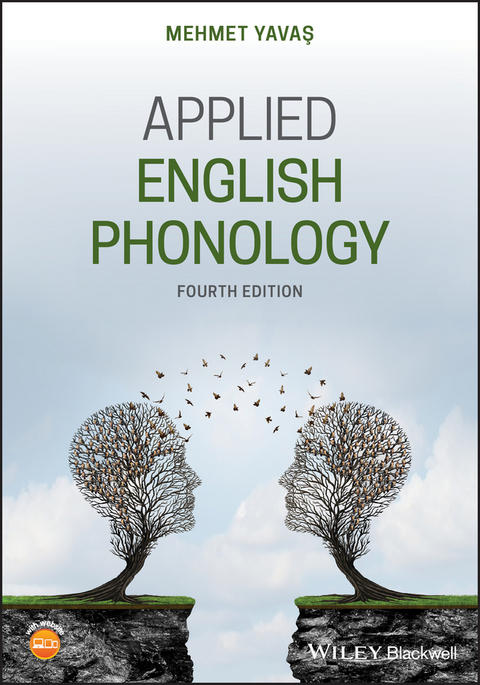
Applied English Phonology (eBook)
John Wiley & Sons (Verlag)
978-1-119-55748-7 (ISBN)
The new edition of the leading textbook for English applied phonetics and phonology
A leading textbook for English Phonetics and Phonology, the fourth edition of Applied English Phonology is an accessible, authoritative introduction to the English sound system. Providing clear explanations and numerous illustrative examples, this new edition has been fully updated with the latest research and references. Detailed discussions of fundamental concepts of applied English phonology cover phonetic elements, phonemics, English consonants and vowels, stress and intonation, structural factors in second language phonology, and much more.
Designed for students and professionals in both theoretical and applied linguistics, education, and communication sciences and disorders, this textbook contains new material throughout, including a new chapter introducing typical phonological development, patterns of simplification, and disordered phonology. Expanded sections explore topics such as contracted forms, issues in consonant and vowel transcription conventions, and regional dialects of American English. The essential introduction to phonetics and phonology, this textbook:
- Presents new and revised exercises, references, and recommended readings
- Covers developmental disorders relevant to the field of speech pathology
- Includes end-of-chapter passages that help students check their phonetic transcriptions
- Features an enhanced companion website which contains instructor resources and sound files for transcription exercises
Written by an internationally recognized scholar and educator, Applied English Phonology, Fourth Edition is essential reading for anyone in applied phonetics and phonology courses, as well as students and practitioners in areas of language and linguistics, TESOL, and communication sciences and disorders.
MEHMET YAVA? Is Professor of Linguistics at Florida International University, USA. He has published numerous articles and books on applied phonology. Among those are Romance-Germanic Bilingual Phonology (2017) Unusual Productions in Phonology: Universals and Language-Specific Considerations (2015), Phonology: Development and Disorders (1998), First and Second Language Phonology (1994), Phonological Disorders in Children (1991) and Avaliacao fonologica da crianca (1990), a phonological assessment procedure for Brazilian Portuguese.
The new edition of the leading textbook for English applied phonetics and phonology A leading textbook for English Phonetics and Phonology, the fourth edition of Applied English Phonology is an accessible, authoritative introduction to the English sound system. Providing clear explanations and numerous illustrative examples, this new edition has been fully updated with the latest research and references. Detailed discussions of fundamental concepts of applied English phonology cover phonetic elements, phonemics, English consonants and vowels, stress and intonation, structural factors in second language phonology, and much more. Designed for students and professionals in both theoretical and applied linguistics, education, and communication sciences and disorders, this textbook contains new material throughout, including a new chapter introducing typical phonological development, patterns of simplification, and disordered phonology. Expanded sections explore topics such as contracted forms, issues in consonant and vowel transcription conventions, and regional dialects of American English. The essential introduction to phonetics and phonology, this textbook: Presents new and revised exercises, references, and recommended readings Covers developmental disorders relevant to the field of speech pathology Includes end-of-chapter passages that help students check their phonetic transcriptions Features an enhanced companion website which contains instructor resources and sound files for transcription exercises Written by an internationally recognized scholar and educator, Applied English Phonology, Fourth Edition is essential reading for anyone in applied phonetics and phonology courses, as well as students and practitioners in areas of language and linguistics, TESOL, and communication sciences and disorders.
MEHMET YAVAS Is Professor of Linguistics at Florida International University, USA. He has published numerous articles and books on applied phonology. Among those are Romance-Germanic Bilingual Phonology (2017) Unusual Productions in Phonology: Universals and Language-Specific Considerations (2015), Phonology: Development and Disorders (1998), First and Second Language Phonology (1994), Phonological Disorders in Children (1991) and Avaliacao fonologica da crianca (1990), a phonological assessment procedure for Brazilian Portuguese.
"The fourth edition of Applied English Phonology continues to be a must-read for linguistics students, language practitioners (including ESL teachers and speech pathologists), and researchers in English phonology. Written in accessible language (like its predecessors), this new edition provides an in-depth (yet succinct) and up-to-date introduction to the phonological system of English, emphasizing the application of relevant concepts in the field to a variety of disciplines and professions. Applied English Phonology has been required reading in my phonology classes for over a decade!"
--Walcir Cardoso, Concordia University, Canada
"This comprehensive book on English phonology for applied linguistic audiences is notable for its extensive coverage. Not only are readers provided with in-depth information on phonological concepts such as segments, syllables, and stress, but they are also given a substantive introduction to phonetics, first and second language acquisition, and the relationship between spelling and phonemes. The main concepts are further enhanced by discussions of sounds produced in other languages and sociophonetic information about other varieties of English. Yava? also makes special effort to demonstrate how this material is relevant to applied and clinical concerns. The breadth and inclusivity of the topics covered in this book as they relate to applied English phonology makes it stand out."
--Lisa Davidson, New York University, USA
1
Phonetics
1.1 Introduction
Our aim in this book is to study the sound patterns of English. The understanding of phonological patterns cannot be done without the raw material: phonetics. In order to be able to come up with reliable phonological descriptions, we need to have accurate phonetic data. Thus, students and professionals who deal with the patterns of spoken language in various groups of speakers (linguists, speech therapists, and language teachers) need a basic knowledge of phonetics.
Phonetics, which may be described as the study of the sounds of human language, can be approached from three different perspectives. Articulatory phonetics deals with the physiological mechanisms of speech production. Acoustic phonetics studies the physical properties of sound waves in the message. Auditory phonetics is concerned with the perception of speech by the hearer. The coverage in this book will be limited to the first two of these approaches. The exclusion of auditory phonetics is basically due to the practical concerns of the primary readership as well as the little information available about the workings of the brain and speech perception. In this chapter, we will look at the basics of speech production. Acoustic properties, in a limited form of spectrographic analysis and waveform analysis, will be the subject of Chapter 5.
1.2 Phonetic Transcription
Because we are constantly involved with reading and writing in our daily lives, we tend to be influenced by the orthography when making judgments about the sounds of words. After all, from kindergarten on, the written language has been an integral part of our lives. Thus, it is very common to think that the number of orthographic letters in a word is an accurate reflection of the number of sounds. Indeed, this is the case for many words. If we look at the words pan, form, print, and spirit, for example, we can see the match in the number of letters (graphemes) with the number of sounds: three, four, five, and six, respectively. However, this match in number of graphemes and sounds is violated in so many other words. For example, both should and choose have six graphemes but only three sounds. Awesome has seven graphemes and four sounds, while knowledge has nine graphemes and five sounds. This list of non‐matches can easily be extended to thousands of other words. These violations, which may be due to “silent letters” or a sound being represented by a combination of letters, are not the only problems with respect to the inadequacies of orthography in its ability to represent the spoken language. Problems exist even if the number of letters and sounds match. We can outline the discrepancies that exist between the spelling and sounds in the following:
- The same sound is represented by different letters. In words such as each, bleed, either, achieve, scene, busy, we have the same vowel sound represented by different letters, which are underlined. This is not unique to vowels and can be verified with consonants, as in shop, ocean, machine, sure, conscience, mission, nation.
- The same letter may represent different sounds. The letter a in words such as gate, any, father, above, tall stands for different sounds. To give an example of a consonantal letter for the same phenomenon, we can look at the letter s, which stands for different sounds in each of the following: sugar, vision, sale, resume.
- One sound is represented by a combination of letters. The underlined portions in each of the following words represent a single sound: thin, rough, attempt, pharmacy.
- A single letter may represent more than one sound. This can be seen in the x of exit, the u of union, and the h of human.
One or more of the above are responsible for the discrepancies between spelling and sounds, and may result in multiple homophones such as rite, right, write, and wright. The lack of consistent relationships between letters and sounds is quite expected if we consider that the English alphabet tries to cope with more than 40 sounds with its limited 26 letters. Since letters can only tell us about spelling and cannot be used as reliable tools for pronunciation, the first rule in studying phonetics and phonology is to ignore spelling and focus only on the sounds of utterances.
To avoid the ambiguities created by the regular orthography and achieve a system that can represent sounds unambiguously, professionals who deal with language use a phonetic alphabet that is guided by the principle of a consistent one‐to‐one relationship between each phonetic symbol and the sound it represents. Over time, several phonetic alphabets have been devised. Probably, the most widespread is the one known as the International Phonetic Alphabet (IPA), which was developed in 1888, and has been revised since then. One may encounter some modifications of some symbols in books written by American scholars. In this book, we will basically follow the IPA usage while pointing out common alternatives that are frequently found in the literature. First, we will present the symbols that are relevant to American English (see Table 1.1) and later in the chapter we will add some non‐English sounds that are found in languages that our readership is likely to come in contact with. The dialectal variations, since they are examined in detail in Chapters 3 and 4, will not be dealt with here.
Table 1.1 English consonant and vowel symbols with key words.
| Phonetic symbol | Word positions |
| Initial | Medial | Final |
| Consonants |
| p | pack | super | map |
| b | bed | rubber | rob |
| t | tea | attack | great |
| d | date | adore | good |
| k | catch | picking | look |
| g | gate | doggy | bag |
| f | fat | coffee | loaf |
| v | very | moving | dove |
| θ | thin | ruthless | death |
| ð | they | mother | breathe |
| s | sad | sister | bus |
| z | zoom | raisin | buzz |
| ʃ (š) | shine | machine | cash |
| ʒ (ž) | — | vision | massage |
| h | head | behind | — |
| t∫ (č) | chair | teacher | which |
| dʒ (ǰ) | jump | larger | huge |
| m | remind | room |
| n | nest | tenor | bean |
| ŋ | — | anger | king |
| j (y) | yard | beyond | soy |
| w | way | rewind | low |
| (r, ɻ) | rain | boring | four |
| l | light | bullet |
| Vowels and diphthongs |
| i (ij, iy) | ease | feet | bee |
| ɪ | it | sit | — |
| e (ej, ei, ey) | eight | bake | say |
| ε | edge | red | — |
| æ | anger | nap | — |
| ʌ | oven | love | — |
| ə | above | often | Tampa |
| ɑ | arch | father | spa |
| ɔ | all | hall | saw |
| o (ow,... |
| Erscheint lt. Verlag | 10.3.2020 |
|---|---|
| Sprache | englisch |
| Themenwelt | Schulbuch / Wörterbuch ► Wörterbuch / Fremdsprachen |
| Geisteswissenschaften ► Sprach- / Literaturwissenschaft ► Sprachwissenschaft | |
| Sozialwissenschaften ► Pädagogik ► Bildungstheorie | |
| Schlagworte | Angewandte Linguistik • applied English phonology introduction • applied English phonology textbook • Applied Linguistics • Bildungswesen • Education • ELL textbook • English linguistics textbook • English phonetics • English phonetics transcription • English second language phonology • Language Teaching • Lehrpläne / Sprachen • Linguistics • <p>English phonology • Phonologie • Phonology • Sprachwissenschaften • TESOL textbook</p> |
| ISBN-10 | 1-119-55748-8 / 1119557488 |
| ISBN-13 | 978-1-119-55748-7 / 9781119557487 |
| Informationen gemäß Produktsicherheitsverordnung (GPSR) | |
| Haben Sie eine Frage zum Produkt? |
 EPUB (Adobe DRM)
Kopierschutz: Adobe-DRM
Adobe-DRM ist ein Kopierschutz, der das eBook vor Mißbrauch schützen soll. Dabei wird das eBook bereits beim Download auf Ihre persönliche Adobe-ID autorisiert. Lesen können Sie das eBook dann nur auf den Geräten, welche ebenfalls auf Ihre Adobe-ID registriert sind.
Details zum Adobe-DRM
Dateiformat: EPUB (Electronic Publication)
EPUB ist ein offener Standard für eBooks und eignet sich besonders zur Darstellung von Belletristik und Sachbüchern. Der Fließtext wird dynamisch an die Display- und Schriftgröße angepasst. Auch für mobile Lesegeräte ist EPUB daher gut geeignet.
Systemvoraussetzungen:
PC/Mac: Mit einem PC oder Mac können Sie dieses eBook lesen. Sie benötigen eine
eReader: Dieses eBook kann mit (fast) allen eBook-Readern gelesen werden. Mit dem amazon-Kindle ist es aber nicht kompatibel.
Smartphone/Tablet: Egal ob Apple oder Android, dieses eBook können Sie lesen. Sie benötigen eine
Geräteliste und zusätzliche Hinweise
Buying eBooks from abroad
For tax law reasons we can sell eBooks just within Germany and Switzerland. Regrettably we cannot fulfill eBook-orders from other countries.
aus dem Bereich