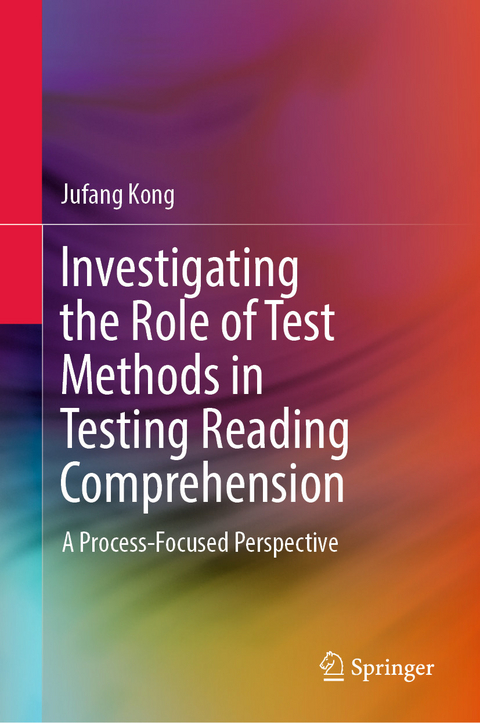
Investigating the Role of Test Methods in Testing Reading Comprehension (eBook)
XIV, 212 Seiten
Springer Singapore (Verlag)
978-981-13-7021-2 (ISBN)
Dr. Jufang Kong is a lecturer and Dean of the Teaching Research section of the College of Foreign Languages at Zhejiang Normal University, China. She holds a PhD in Language Testing and Assessment from Shanghai International Studies University and was a visiting student at the School of Education, University of Leicester, during her PhD studies. Her research interests include assessing reading skills, language test validation and assessing young language learners. In 2017, she received approval for the Ministry of Education Humanities and Social Sciences Project.
This book explores the construct of reading comprehension by means of two main test methods. Research methods like the think aloud protocol and eye tracking are employed to tap into test-takers' cognitive processes while engaged in input text meaning building, and in test tasks. The book is the first systematic attempt to explore test-takers' cognitive processes through the control of test methods, and presents findings in visualized form including processing route maps and eye fixation heat maps. It offers readers essential support with "e;digging into"e; and analyzing data that has to date remained difficult to access.
Dr. Jufang Kong is a lecturer and Dean of the Teaching Research section of the College of Foreign Languages at Zhejiang Normal University, China. She holds a PhD in Language Testing and Assessment from Shanghai International Studies University and was a visiting student at the School of Education, University of Leicester, during her PhD studies. Her research interests include assessing reading skills, language test validation and assessing young language learners. In 2017, she received approval for the Ministry of Education Humanities and Social Sciences Project.
Part OneChapter One Introduction1.1 Research Background1.2 Research Focus1.3 Book Structure1.4 SummaryChapter Two Theories of Reading Comprehension2.1 Nature of Reading Comprehension2.1.1 Psycholinguistic Perspective of Reading Comprehension2.1.2 Cognitive Perspective of Reading Comprehension2.1.3 Processing Patterns of Reading Comprehension2.1.3.1 Bottom-up Processing2.1.3.2 Top-down Processing2.1.3.3 Interactive Processing2.2 Factors Involved in Reading Comprehension2.2.1 Reader2.2.2 Text2.2.3 Interaction2.2.3.1 Purpose of Reading Comprehension2.2.3.2 Skills2.2.3.3 Strategies and Metacognitive Strategies2.3 Khalifa and Weir’ Model of Reading Comprehension2.4 SummaryChapter Three Construct and Validity3.1 Construct3.1.1 A Trait Theorist View3.1.2 A Behaviourist View3.1.3 An Interactionalist View3.2 Validity3.3 Validation3.3.1 Messick’s Validation Framework3.3.2 Kane’s Interpretive Argument Framework3.3.3 Bachman and Palmer’s AUA Framework3.3.4 Campbell and Fiske’s MTMM Approach 3.4 A Process-focused Construct Validation Framework3.5 SummaryChapter Four Test Method and Response Format4.1 Test Method4.2 Response Format4.2.1 Response Formats Most Commonly Used in Reading Comprehension Tests4.2.1.1 MCQ Format4.2.1.2 SAQ Format4.2.2 Response Format Effect(s) on Test takers’ Reading Comprehension Per-formances4.3 SummaryChapter Five Methodology5.1 Quantitative Approach5.2 Qualitative Approach5.3 Mixed Methods Approach5.4 A Qualitative Dominant Mixed Methods Approach5.5 SummaryPart TwoChapter Six Quantitative Strand6.1 Research Design6.1.1 Research Procedures6.1.2 Participants6.1.3 Research Instruments6.2 Findings6.2.1 Descriptive Statistics6.2.1.1 Item Statistics6.2.1.2 Passage Statistics6.2.1.3 Total Score Statistics6.2.2 Inferential Statistics6.2.2.1 Paired-sample T-test6.2.2.2 MTMM CFA6.2.3 Summary of Findings 6.3 SummaryChapter Seven Employing Think Aloud Protocols (TAPs) to Explore Test takers’ Cognitive Processes7.1 TAPs Paradigm7.1.1 Rationale and Concerns of TAPs7.1.2 TAPs in Reading Research7.1.3 TAPs in Language Testing and Assessment7.2 Research Design7.2.1 Research Procedures7.2.1.1 Pilot Study7.2.1.2 Formal Data Collection7.2.1.3 TAPs Data Transcription and Coding7.2.1.4 Cognitive Process Route Map7.3 Findings7.3.1 Test Level Analysis7.3.2 Question Type Level Analysis7.3.2.1 Question Type 1 TAPs Data Analysis7.3.2.2 Question Type 2 TAPs Data Analysis7.3.2.3 Question Type 3 TAPs Data Analysis7.3.2.4 Question Type 4 TAPs Data Analysis7.3.2.5 Question Type 5 TAPs Data Analysis7.4 Summary of Findings7.5 SummaryChapter Eight Employing Eye Tracking to Explore Test takers’ Cognitive Processes8.1 ET Paradigm8.1.1 Rationale and Concerns of ET8.1.2 ET in Reading Research8.1.3 ET in Language Testing and Assessment8.2 Research Design8.2.1 Research Procedures8.2.1.1 Research Instruments8.2.1.2 Pilot Study8.2.1.3 Participants8.2.1.4 Formal Data Collection8.3 Findings8.3.1 Test Level Analysis8.3.2 Question Type Level Analysis8.3.2.1 Question Type 1 ET Data Analysis8.3.2.2 Question Type 2 ET Data Analysis8.3.2.3 Question Type 3 ET Data Analysis8.3.2.4 Question Type 4 ET Data Analysis8.3.2.5 Question Type 5 ET Data Analysis8.4 Summary of the Findings8.5 SummaryChapter Nine Conclusion and Future Directions9.1 Major Findings9.2 Implications9.2.1 Test Validation9.2.2 Construct of Reading Comprehension Competence9.2.3 Reading Comprehension Test Development9.2.4 TAPs in Research on Cognitive Processing9.2.5 ET in Research on Language Testing and Assessment9.3 Limitations9.4 Future Directions9.5 Summary
| Erscheint lt. Verlag | 27.3.2019 |
|---|---|
| Zusatzinfo | XIV, 212 p. 60 illus., 16 illus. in color. |
| Verlagsort | Singapore |
| Sprache | englisch |
| Themenwelt | Schulbuch / Wörterbuch ► Wörterbuch / Fremdsprachen |
| Geisteswissenschaften ► Sprach- / Literaturwissenschaft ► Sprachwissenschaft | |
| Sozialwissenschaften ► Pädagogik ► Bildungstheorie | |
| Sozialwissenschaften ► Pädagogik ► Schulpädagogik / Grundschule | |
| Schlagworte | Applied Linguistics • Language testing • Reading Comprehension • test method • Test-Takers’ Cognitive Processes |
| ISBN-10 | 981-13-7021-4 / 9811370214 |
| ISBN-13 | 978-981-13-7021-2 / 9789811370212 |
| Informationen gemäß Produktsicherheitsverordnung (GPSR) | |
| Haben Sie eine Frage zum Produkt? |
 PDF (Wasserzeichen)
DRM: Digitales Wasserzeichen
Dieses eBook enthält ein digitales Wasserzeichen und ist damit für Sie personalisiert. Bei einer missbräuchlichen Weitergabe des eBooks an Dritte ist eine Rückverfolgung an die Quelle möglich.
Dateiformat: PDF (Portable Document Format)
Mit einem festen Seitenlayout eignet sich die PDF besonders für Fachbücher mit Spalten, Tabellen und Abbildungen. Eine PDF kann auf fast allen Geräten angezeigt werden, ist aber für kleine Displays (Smartphone, eReader) nur eingeschränkt geeignet.
Systemvoraussetzungen:
PC/Mac: Mit einem PC oder Mac können Sie dieses eBook lesen. Sie benötigen dafür einen PDF-Viewer - z.B. den Adobe Reader oder Adobe Digital Editions.
eReader: Dieses eBook kann mit (fast) allen eBook-Readern gelesen werden. Mit dem amazon-Kindle ist es aber nicht kompatibel.
Smartphone/Tablet: Egal ob Apple oder Android, dieses eBook können Sie lesen. Sie benötigen dafür einen PDF-Viewer - z.B. die kostenlose Adobe Digital Editions-App.
Buying eBooks from abroad
For tax law reasons we can sell eBooks just within Germany and Switzerland. Regrettably we cannot fulfill eBook-orders from other countries.
aus dem Bereich