


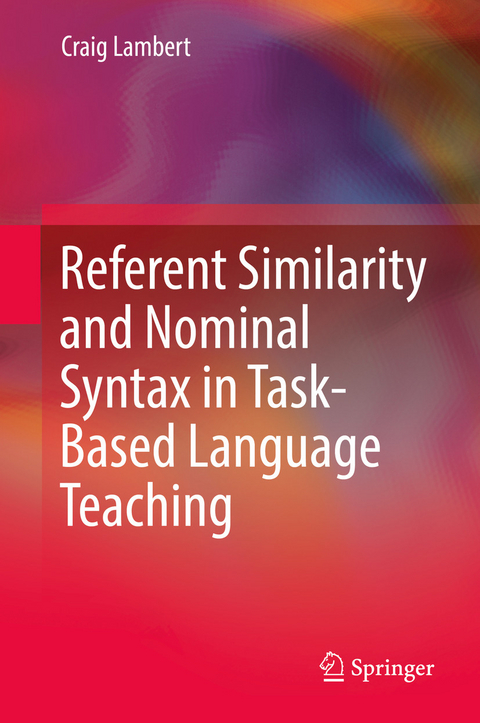
Referent Similarity and Nominal Syntax in Task-Based Language Teaching (eBook)
XIV, 154 Seiten
Springer Singapore (Verlag)
9789811330896 (ISBN)
Craig Lambert is an Associate Professor of Applied Linguistics and TESOL at Curtin University in Perth, Australia. He has taught in post-graduate TESOL programs at Anaheim University in the United States and at Lancaster University in the United Kingdom, and has more than 20 years of hands-on teaching experience in Japan, where he worked as an English teacher, course coordinator and teacher trainer. His research on second language speech processing, syntactic development, task-based learning and learner engagement has been published internationally.
This volume addresses an important gap in the literature on task design and second language use. Building on insights from over 50 years of research on the relationship between task demands and language use, it examines how referent similarity relates to developmentally-relevant variation in the use of nominal structures, comparative structures and abstract lexis among first and second language speakers of English. In addition to providing an empirical basis for future research on tasks, it shares both theoretical and practical information on task design, which will greatly benefit curriculum and material developers.
Craig Lambert is an Associate Professor of Applied Linguistics and TESOL at Curtin University in Perth, Australia. He has taught in post-graduate TESOL programs at Anaheim University in the United States and at Lancaster University in the United Kingdom, and has more than 20 years of hands-on teaching experience in Japan, where he worked as an English teacher, course coordinator and teacher trainer. His research on second language speech processing, syntactic development, task-based learning and learner engagement has been published internationally.
AcknowledgmentsTable of ContentsList of TablesChapter 1. Introduction1.1.Tasks in Language Teaching and Research1.2.Task-Based Language Teaching (TBLT)1.3.Task Learning versus Language Learning1.4. Referent Similarity and TBLT1.5. Overview of the BookChapter 2. L2 Performance and Incidental SLA2.1. Language Development from a Usage-Based Perspective2.2. Frequency Effects2.2.1. Cue Strength2.2.2. Prototype Effects2.2.3. Chunking2.3. Syntactic Priming2.4. Transferability2.5. First and Second Language Acquisition2.6. SummaryChapter 3. Referential Communication and L2 Production3.1. Referential Communication Tasks3.2. Communicative Demands3.3. Contextual Constraints3.4. Discourse Demands3.5. Limitations of Tasks in Instructed SLA3.6. Proficiency and L2 Performance3.7. SummaryChapter 4. Tasks in L2 Syllabus Design4.1. Attention4.1.1. Detection4.1.2. Awareness4.1.3. The Output Hypothesis4.1.4. Resources Pools4.1.5. Selection (Saliency, Effort, Expectancy & Value)4.2. Speech Production4.3. Cognitive Processes in SLA4.3.1. Analysis4.3.2. Control4.4. Cognitive Models of Task-Based L2 Instruction4.4.1. The Limited Attention Capacity Hypothesis4.4.2. The Cognition Hypothesis4.5. SummaryChapter 5. Referent Similarity5.1. Referent Identification5.1.1. Frequency5.1.2. Comparison5.2. The Number of Elements5.3. The Similarity between Elements5.4. The Present Study5.5. SummaryChapter 6. Referent Similarity and L2 Production6.1. Noun Phrase Complexity 6.2. Comparative Structures6.3. Relative Clause Structures6.4. Lexical Abstractness6.5. SummaryChapter 7. Methods7.1. Purpose of the Study7.2. Design7.3. Participants7.3.1. Native Speakers of English7.3.2. Non-Native Speakers of English7.4. Materials7.5. Procedures7.6. Analysis7.6.1. Transcription7.6.2. Noun Phrase Coding7.6.3. Comparative Structures7.6.4. Relative Clause Types7.6.5. Statistical Analyses7.7. SummaryChapter 8. Results8.1. Preliminary Data Screening8.1.1. Descriptive Statistics for Similarity Effect on NP Complexity8.1.2. Descriptive Statistics for Referent Effect on NP Complexity8.1.3. Descriptive Statistics for Proficiency Effect on NP Complexity8.2. Three-Way MANOVA on Noun Phrase Complexity8.2.1. Referent Similarity Effects on Noun Phrase Complexity8.2.2. Referent Effects on Noun Phrase Complexity8.2.3. Proficiency Effects on Noun Phrase Complexity8.2.4. Interactions between Factors on Noun Phrase Complexity8.2.5. Summary of Noun Phrase Complexity Results8.3. Two-Way ANOVA for Use of Comparative Structures8.3.1. Referent Similarity Effects on the Use of Comparative Structures8.3.2. Referent Effects on the Use of Comparative Structures8.3.3. Proficiency Effects on the Use of Comparative Structures8.3.4. Summary of Results for Comparative Structures8.4. Non-Parametric Tests for Use of Relative Clause Structures8.4.1. Referent Similarity Effects on the Use of Relative Clauses8.4.2. Referent Effects on the Use of Relative Clauses8.4.3. Proficiency Effects on the Use of Relative Clauses8.4.4. Summary of Findings for the Use of Relative Clauses8.5. SummaryChapter 9. Referent Similarity and TBLT9.1. Implications for Theory and Research on TBLT9.1.1 Referent Similarity and the Use of English Nominal Structures9.1.2 Referent Effects9.1.3 Proficiency Effects9.2. Implications for Task-Based Pedagogy and Materials Design9.2.1. Designing Pedagogic Tasks Based on Referential Similarity9.2.2. Formatting Tasks for Different Instructional Purposes9.2.3. Referential Similarity Tasks and Language Assessment9.3. Final ThoughtsReferencesAppendix 1. Materials for the StudyAppendix 2. Noun Phrase Coding ManualAppendix 3. Full Descriptive Statistics for NP Complexity
| Erscheint lt. Verlag | 7.12.2018 |
|---|---|
| Zusatzinfo | XIV, 154 p. 26 illus. |
| Verlagsort | Singapore |
| Sprache | englisch |
| Themenwelt | Schulbuch / Wörterbuch ► Wörterbuch / Fremdsprachen |
| Geisteswissenschaften ► Sprach- / Literaturwissenschaft ► Sprachwissenschaft | |
| Sozialwissenschaften ► Pädagogik | |
| Schlagworte | Abstract Lexis • Comparative Structures • literary diction • syntactic complexity • Task-based Language Teaching (TBLT) • Task Sequencing |
| ISBN-13 | 9789811330896 / 9789811330896 |
| Informationen gemäß Produktsicherheitsverordnung (GPSR) | |
| Haben Sie eine Frage zum Produkt? |
 PDF (Wasserzeichen)
DRM: Digitales Wasserzeichen
Dieses eBook enthält ein digitales Wasserzeichen und ist damit für Sie personalisiert. Bei einer missbräuchlichen Weitergabe des eBooks an Dritte ist eine Rückverfolgung an die Quelle möglich.
Dateiformat: PDF (Portable Document Format)
Mit einem festen Seitenlayout eignet sich die PDF besonders für Fachbücher mit Spalten, Tabellen und Abbildungen. Eine PDF kann auf fast allen Geräten angezeigt werden, ist aber für kleine Displays (Smartphone, eReader) nur eingeschränkt geeignet.
Systemvoraussetzungen:
PC/Mac: Mit einem PC oder Mac können Sie dieses eBook lesen. Sie benötigen dafür einen PDF-Viewer - z.B. den Adobe Reader oder Adobe Digital Editions.
eReader: Dieses eBook kann mit (fast) allen eBook-Readern gelesen werden. Mit dem amazon-Kindle ist es aber nicht kompatibel.
Smartphone/Tablet: Egal ob Apple oder Android, dieses eBook können Sie lesen. Sie benötigen dafür einen PDF-Viewer - z.B. die kostenlose Adobe Digital Editions-App.
Buying eBooks from abroad
For tax law reasons we can sell eBooks just within Germany and Switzerland. Regrettably we cannot fulfill eBook-orders from other countries.
aus dem Bereich


