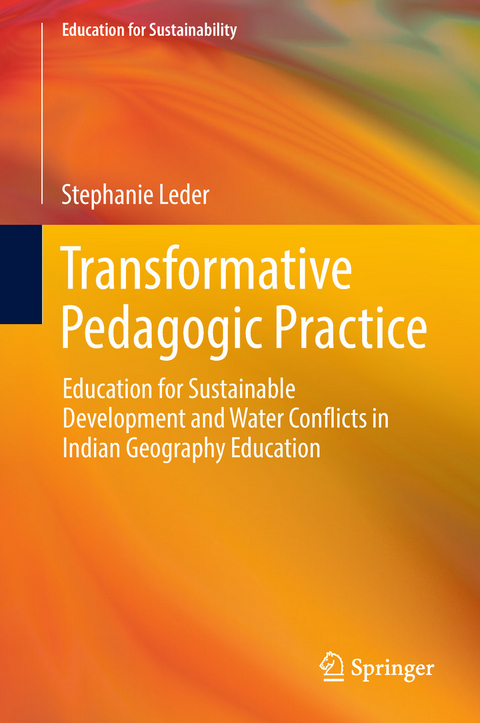
Transformative Pedagogic Practice (eBook)
XXVIII, 308 Seiten
Springer Singapore (Verlag)
978-981-13-2369-0 (ISBN)
This book explores how the transnational Education for Sustainable Development (ESD) policy is being translated into formal school education in India. Stephanie Leder investigates the ESD's transformative potential for pedagogic practice and builds a set of principles for how the global objectives of the ESD can be interpreted in diverse socio-cultural contexts. Her approach for transformative pedagogic practice emphasizes the promotion of a critical consciousness through argumentation skills. Using the case of water conflicts in geography education in India, the book reveals the contradictions between ESD objectives and curricula, syllabi, textbooks and classroom teaching at secondary schools in Pune, Maharashtra. Leder's approach demonstrates how principles of schooling can be altered towards learner-centered, problem-posing and network-thinking teaching approaches to empower students towards reflective decision-making on the sustainable use of natural resources.
Stephanie Leder holds a PhD in Cultural Geography from the University of Cologne, Germany. She studied geography, English, biology and educational sciences at the University of Cologne and the University of New Brunswick, Canada. For her PhD thesis, she conducted in-depth research on Education for Sustainable Development in policy and practice by examining geography teaching on water resources at secondary schools in Pune, India. She was a Postdoctoral Fellow for Gender, Youth and Inclusive Development at the International Water Management Institute (IWMI) in Kathmandu, Nepal, and led studies in inter- and transdisciplinary projects within the Consultative Group of International Agricultural Research (CGIAR) Program 'Water, Land and Ecosystems' in India, Nepal and Bangladesh. Currently she is a Postdoctoral Researcher for Social and Environmental Justice at the Department of Urban and Rural Development at the Swedish University of Agricultural Sciences (SLU) in Uppsala, Sweden.
This book explores how the transnational Education for Sustainable Development (ESD) policy is being translated into formal school education in India. Stephanie Leder investigates the ESD's transformative potential for pedagogic practice and builds a set of principles for how the global objectives of the ESD can be interpreted in diverse socio-cultural contexts. Her approach for transformative pedagogic practice emphasizes the promotion of a critical consciousness through argumentation skills. Using the case of water conflicts in geography education in India, the book reveals the contradictions between ESD objectives and curricula, syllabi, textbooks and classroom teaching at secondary schools in Pune, Maharashtra. Leder's approach demonstrates how principles of schooling can be altered towards learner-centered, problem-posing and network-thinking teaching approaches to empower students towards reflective decision-making on the sustainable use of natural resources.
Stephanie Leder holds a PhD in Cultural Geography from the University of Cologne, Germany. She studied geography, English, biology and educational sciences at the University of Cologne and the University of New Brunswick, Canada. For her PhD thesis, she conducted in-depth research on Education for Sustainable Development in policy and practice by examining geography teaching on water resources at secondary schools in Pune, India. She was a Postdoctoral Fellow for Gender, Youth and Inclusive Development at the International Water Management Institute (IWMI) in Kathmandu, Nepal, and led studies in inter- and transdisciplinary projects within the Consultative Group of International Agricultural Research (CGIAR) Program “Water, Land and Ecosystems” in India, Nepal and Bangladesh. Currently she is a Postdoctoral Researcher for Social and Environmental Justice at the Department of Urban and Rural Development at the Swedish University of Agricultural Sciences (SLU) in Uppsala, Sweden.
1 Introduction: Education for Sustainable Development in India.- 2 Theoretical Considerations on Pedagogic Practice and its Transformative Potential.- 3 Education for Sustainable Development and Argumentation.- 4 Education and Water Conflicts in Pune, India.- 5 A Framework for Qualitative Geographical Education Research.- 6 Academic Frameworks for Formal School Education and ESD Principles.- 7 Pedagogic Practice, ESD Principles and the Perspectives of Students, Teachers and Educational Stakeholders.- 8 Opportunities for Interpreting ESD Principles through Argumentation in Pedagogic Practice.- 9 The Transformative Potential of Pedagogic Practice.- 10 Research Prospects and Strategies for Translating ESD in Pedagogic Practice.
| Erscheint lt. Verlag | 8.12.2018 |
|---|---|
| Reihe/Serie | Education for Sustainability | Education for Sustainability |
| Zusatzinfo | XXVIII, 308 p. 53 illus., 46 illus. in color. |
| Verlagsort | Singapore |
| Sprache | englisch |
| Themenwelt | Schulbuch / Wörterbuch |
| Naturwissenschaften ► Biologie ► Ökologie / Naturschutz | |
| Sozialwissenschaften ► Pädagogik ► Allgemeines / Lexika | |
| Technik | |
| Schlagworte | Cultural geography • education for sustainable development • Environmental education • geography education • Policy Translation • Schooling in India • Transnational educational policies • Water Conflicts • Water Education • Water resource management |
| ISBN-10 | 981-13-2369-0 / 9811323690 |
| ISBN-13 | 978-981-13-2369-0 / 9789811323690 |
| Informationen gemäß Produktsicherheitsverordnung (GPSR) | |
| Haben Sie eine Frage zum Produkt? |
 PDF (Wasserzeichen)
DRM: Digitales Wasserzeichen
Dieses eBook enthält ein digitales Wasserzeichen und ist damit für Sie personalisiert. Bei einer missbräuchlichen Weitergabe des eBooks an Dritte ist eine Rückverfolgung an die Quelle möglich.
Dateiformat: PDF (Portable Document Format)
Mit einem festen Seitenlayout eignet sich die PDF besonders für Fachbücher mit Spalten, Tabellen und Abbildungen. Eine PDF kann auf fast allen Geräten angezeigt werden, ist aber für kleine Displays (Smartphone, eReader) nur eingeschränkt geeignet.
Systemvoraussetzungen:
PC/Mac: Mit einem PC oder Mac können Sie dieses eBook lesen. Sie benötigen dafür einen PDF-Viewer - z.B. den Adobe Reader oder Adobe Digital Editions.
eReader: Dieses eBook kann mit (fast) allen eBook-Readern gelesen werden. Mit dem amazon-Kindle ist es aber nicht kompatibel.
Smartphone/Tablet: Egal ob Apple oder Android, dieses eBook können Sie lesen. Sie benötigen dafür einen PDF-Viewer - z.B. die kostenlose Adobe Digital Editions-App.
Buying eBooks from abroad
For tax law reasons we can sell eBooks just within Germany and Switzerland. Regrettably we cannot fulfill eBook-orders from other countries.
aus dem Bereich