


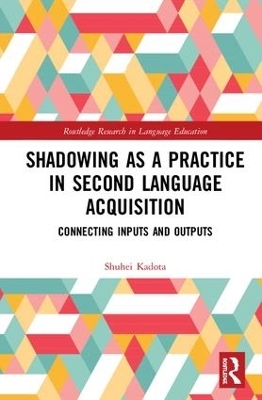
Shadowing as a Practice in Second Language Acquisition
Connecting Inputs and Outputs
Seiten
2019
Routledge (Verlag)
978-1-138-48550-1 (ISBN)
Routledge (Verlag)
978-1-138-48550-1 (ISBN)
Through the research contained within this book, readers will be armed with detailed and useful accounts of the shadowing as a method of learning English and Japanese as L2 from a theoretical and empirical viewpoint.
Shadowing is a theoretically and empirically well-examined method to develop L2 learners’ listening comprehension (input effect); enhance their subvocal rehearsal mechanism in the phonological working memory for learning new words, formula, and constructions (practice effect); simulate some stages of speech production (output effect); and develop metacognitive monitoring and control by their executive working memory (monitoring effect). In Japan and some other Asian countries, shadowing is a well-recognized, popular method of learning English and Japanese as L2, and this book offers the chance for anyone new to this method to benefit. Through the research contained within this book, readers will be armed with detailed and useful accounts of the four effects above (i.e. input, practice, output, and monitoring effects) from a theoretical and empirical viewpoint.
Shadowing is a theoretically and empirically well-examined method to develop L2 learners’ listening comprehension (input effect); enhance their subvocal rehearsal mechanism in the phonological working memory for learning new words, formula, and constructions (practice effect); simulate some stages of speech production (output effect); and develop metacognitive monitoring and control by their executive working memory (monitoring effect). In Japan and some other Asian countries, shadowing is a well-recognized, popular method of learning English and Japanese as L2, and this book offers the chance for anyone new to this method to benefit. Through the research contained within this book, readers will be armed with detailed and useful accounts of the four effects above (i.e. input, practice, output, and monitoring effects) from a theoretical and empirical viewpoint.
Shuhei Kadota is a Professor of Applied Linguistics, Graduate School of Language, Communication and Culture, Department of Law at Kwansei Gakuin University, Japan.
1. What is shadowing? 2. Shadowing for L2 listening comprehension 3. Shadowing for promoting L2 learnability 4. Shadowing for L2 speech production 5. Metacognitive monitoring and control 6. Establishing a new concept of practice in L2 acquisition
| Erscheinungsdatum | 08.05.2019 |
|---|---|
| Reihe/Serie | Routledge Research in Language Education |
| Zusatzinfo | 32 Tables, black and white; 131 Line drawings, black and white; 12 Halftones, black and white; 139 Illustrations, black and white |
| Verlagsort | London |
| Sprache | englisch |
| Maße | 156 x 234 mm |
| Gewicht | 453 g |
| Themenwelt | Schulbuch / Wörterbuch ► Wörterbuch / Fremdsprachen |
| Geisteswissenschaften ► Sprach- / Literaturwissenschaft ► Anglistik / Amerikanistik | |
| Geisteswissenschaften ► Sprach- / Literaturwissenschaft ► Literaturwissenschaft | |
| Geisteswissenschaften ► Sprach- / Literaturwissenschaft ► Sprachwissenschaft | |
| ISBN-10 | 1-138-48550-0 / 1138485500 |
| ISBN-13 | 978-1-138-48550-1 / 9781138485501 |
| Zustand | Neuware |
| Informationen gemäß Produktsicherheitsverordnung (GPSR) | |
| Haben Sie eine Frage zum Produkt? |
Mehr entdecken
aus dem Bereich



aus dem Bereich
Affektordnungen des Sozialen in der Gegenwartsliteratur
Buch | Softcover (2025)
De Gruyter (Verlag)
CHF 62,90


