


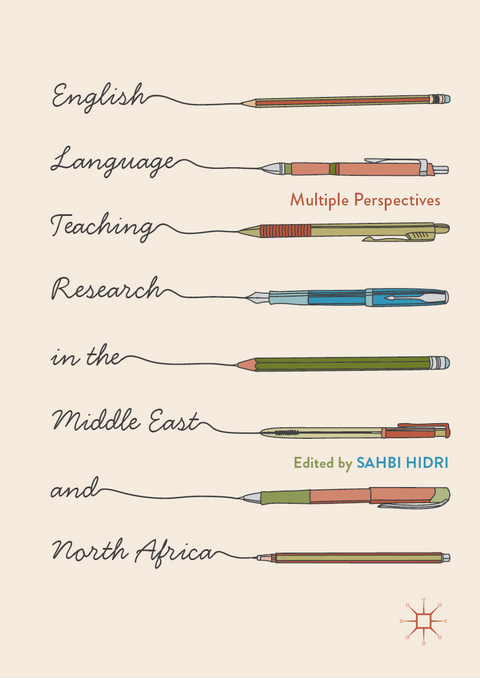
English Language Teaching Research in the Middle East and North Africa (eBook)
716 Seiten
Springer International Publishing (Verlag)
9783319985336 (ISBN)
Sahbi Hidri is Assistant Professor of applied linguistics at the Faculty of Human and Social Sciences of Tunis, Tunisia. He is the founder of Tunisia TESOL, the Arab Journal of Applied Linguistics and the Tunisian Association of Language Assessment and Evaluation. His research interests include language assessment, testing and evaluation, assessment literacy, test-taking strategies, statistics, measurement, specs validation of the language skills, SLA and dynamic assessment.
Sahbi Hidri is Assistant Professor of applied linguistics at the Faculty of Human and Social Sciences of Tunis, Tunisia. He is the founder of Tunisia TESOL, the Arab Journal of Applied Linguistics and the Tunisian Association of Language Assessment and Evaluation. His research interests include language assessment, testing and evaluation, assessment literacy, test-taking strategies, statistics, measurement, specs validation of the language skills, SLA and dynamic assessment.
Introduction, Sahbi HidriPART ONE: TESTING, EVALUATION AND ASSESSMENTChapter One: Assessing Second Language Proficiency under “Unequal” Perspectives: A Call for Research in the MENA Region, Lee McCallumChapter Two: State-of-the-Art of Assessment in Tunisia: The Case of Testing Listening Comprehension, Sahbi HidriChapter Three: Cultural Content Evaluation of English Language Textbooks (Link Up Series Elementary & Intermediate), Hala Salih Mohamed Nur, Asjad Ahmed Saeed and Abdelkaliq AbboodChapter Four: The Washback Effect of the Thanaweya Amma English Test: Drawbacks and Solutions, Mahmoud IbrahimPART TWO: INTERFACES BETWEEN TEACHING AND ASSESSMENTChapter Five: A Proposed Metacognitive-Based Approach to Promoting EFL Cohesion and Coherence in Essay Writing of Algerian Master Students, Manal Boudghene Stambouli and Amine BelmekkiChapter Six: More than a Pyramid of Papers: Students’ Portfolios and Developmental Language Assessment in the ESL Classroom, Charles EdonmiChapter Seven: The Effectiveness of Pre-assessment to Differentiate the Reading Tasks for the Mixed-Abilities EFL Learners, Syeda Saima Ferheen BukhariChapter Eight: Self-Esteem, Self-Expectancy and Oral Achievement in the Tunisian EFL Context, Marwa Mekni Toujani and Tarek HermessiChapter Nine: Investigating the Quality of Argument Structure in First-Year University Writing, Besma AllaguiPART THREE: ARGUMENTATION IN DISCOURSE ANALYSISChapter Ten: Aspects of Cohesion and Coherence in Moroccan EFL Learners’ Written Discourse, Ahmed SahlaneChapter Eleven: Publish or Perish: The Research Letter Genre and Non-Anglophone Scientists’ Struggle for Academic Visibility, Mimoun MellitiChapter Twelve: Hedging in Applied Linguistics Theses: An Exploratory Comparative Study, Nourhan SorourChapter Thirteen: Analyzing Argumentative Essay as an Academic Genre on Assessment Framework of IELTS and TOEFL, Zulfiqar AhmadPART FOUR: TEACHING DIGLOASSIA AND VOCABULARYChapter Fourteen: Including Diglossia in Teaching Arabic as Second Language Programmes: Suggestions and Implications from a Darija Course in Casablanca, Fracesca TabloniChapter Fifteen: Vocabulary Instruction through Patterns of Activity Sequencing Use: Revising the Understanding of Integration in Language Teaching, Ahlam BouiraneChapter Sixteen: Arabic-Speaking Students of EFL, Vocabulary and the Art of Structured Review, Nathaniel LotzePART FIVE: ENGLISH LANGUAGE LEARNING PROBLEMSChapter Seventeen: Understanding English Speaking Difficulties: Implications for the English Language Curriculum for the Arab Students in a Pakistani University, Musharraf AzizChapter Eighteen: Domain-Specific and Domain-General Processing Accounts in Children with Specific Language Impairment (SLI): Contribution of Cross Linguistic Evidence, Areej M. A. Balilah, Yasaman Rafat and Lisa M. D. ArchibaldChapter Nineteen: Difficulties Facing Children in Learning English as a Foreign Language in the Libyan Context, Deya M. R. AL-Osta Omar, Ahmed Ayiad Gaibani and Fadil Elmenfi PART SIX: MOTIVATION AND ERROR ANALYSIS IN FOREIGN LANGUAGE LEARNINGChapter Twenty: The Role of Intrinsic Motivation and Oral Corrective Feedback in the EFL Classroom, Cirine Zouaidi and Tarek HermessiChapter Twenty-one: Omani EFL Written Errors at a College Level, Sharifa Said Ali Al-AdawiChapter Twenty-two: Investigating Motivational Factors in EFL Classroom from the Perspectives of Students at a Tertiary Context in Oman, Iman al-KadieChapter Twenty-three: An Error Analysis of Writing Skills among English Foreign Language Learners at University Utara Malaysia, Ahmed Basher, Fadil Elmenfi and Ahmed GaibaniPART SEVEN: THE ROLE OF CRITICAL THINKING IN FOREIGN LANGUAGE LEARNING AND TEACHINGChapter Twenty-four: Receptivity and Resistance of Students and Teachers to Learner Agency in Topic and Text Selection, Jonathan Mason, Yosri Ben Ammar, Sarra Romdhane and Shahira TarashChapter Twenty-five: Entrepreneurship Skills in Business English: Promoting Regulation and Social Entrepreneurship through Experiential Learning, Tamim Ata AllahChapter Twenty-six: “We Need Writers.” A Case Study of Writer-Illustrator Maitha Al-Khayat and the UAE Children’s Book Publishing Industry, Shelley LawsonPART EIGHT: TECHNOLOGY IN LANGAUGE LEARNING AND TEACHINGChapter Twenty-seven: The Pedagogical Development of Blended Learning, Marine MiladChapter Twenty-eight: The Impact of Online Discussions on the Accuracy of the Written Output of Bahraini L2 University Students, Diana A.K. Al JahromiChapter Twenty-nine: The iPad in the Foundations Program of the Higher Colleges of Technology in Fujairah, Barraq AliChapter Thirty: Incorporating Audio-Visual Aids in the English Language Classroom in Tunisia: A Case Study, Ines Boufahja
| Erscheint lt. Verlag | 23.11.2018 |
|---|---|
| Zusatzinfo | XLVI, 716 p. 80 illus., 35 illus. in color. |
| Verlagsort | Cham |
| Sprache | englisch |
| Themenwelt | Schulbuch / Wörterbuch ► Wörterbuch / Fremdsprachen |
| Geisteswissenschaften ► Sprach- / Literaturwissenschaft ► Sprachwissenschaft | |
| Sozialwissenschaften ► Pädagogik ► Schulpädagogik / Grundschule | |
| Sozialwissenschaften ► Politik / Verwaltung | |
| Schlagworte | Argumentation • Diglossia • Discourse analysis • ELT • English • Error Analysis • Foreign language learning • Language assessment • Language testing • MENA • technology and language teaching • TEFL • TESOL • vocabulary |
| ISBN-13 | 9783319985336 / 9783319985336 |
| Informationen gemäß Produktsicherheitsverordnung (GPSR) | |
| Haben Sie eine Frage zum Produkt? |
 PDF (Wasserzeichen)
DRM: Digitales Wasserzeichen
Dieses eBook enthält ein digitales Wasserzeichen und ist damit für Sie personalisiert. Bei einer missbräuchlichen Weitergabe des eBooks an Dritte ist eine Rückverfolgung an die Quelle möglich.
Dateiformat: PDF (Portable Document Format)
Mit einem festen Seitenlayout eignet sich die PDF besonders für Fachbücher mit Spalten, Tabellen und Abbildungen. Eine PDF kann auf fast allen Geräten angezeigt werden, ist aber für kleine Displays (Smartphone, eReader) nur eingeschränkt geeignet.
Systemvoraussetzungen:
PC/Mac: Mit einem PC oder Mac können Sie dieses eBook lesen. Sie benötigen dafür einen PDF-Viewer - z.B. den Adobe Reader oder Adobe Digital Editions.
eReader: Dieses eBook kann mit (fast) allen eBook-Readern gelesen werden. Mit dem amazon-Kindle ist es aber nicht kompatibel.
Smartphone/Tablet: Egal ob Apple oder Android, dieses eBook können Sie lesen. Sie benötigen dafür einen PDF-Viewer - z.B. die kostenlose Adobe Digital Editions-App.
Buying eBooks from abroad
For tax law reasons we can sell eBooks just within Germany and Switzerland. Regrettably we cannot fulfill eBook-orders from other countries.
aus dem Bereich


