


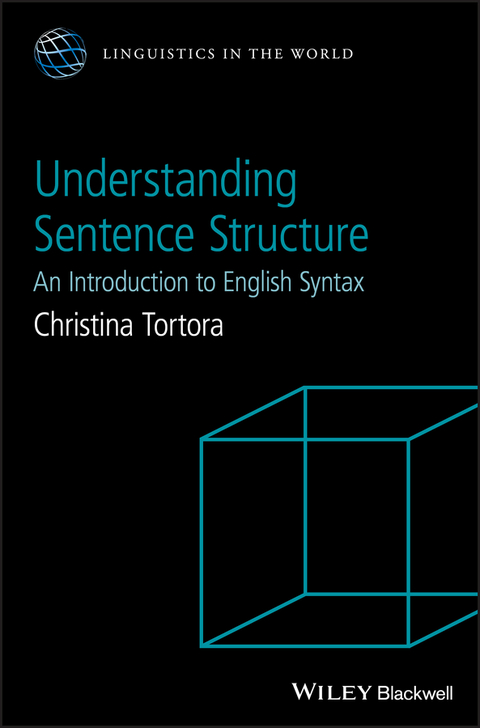
Understanding Sentence Structure (eBook)
John Wiley & Sons (Verlag)
978-1-118-65959-5 (ISBN)
A straightforward guide to understanding English grammar
This book is for people who have never thought about syntax, and who don't know anything about grammar, but who want to learn. Assuming a blank slate on the part of the reader, the book treats English grammar as a product of the speaker's mind, and builds up student skills by exploring phrases and sentences with more and more complexity, as the chapters proceed.
This practical guide excites and empowers readers by guiding them step by step through each chapter with intermittent exercises. In order to capitalize on the reader's confidence as a personal authority on English, Understanding Sentence Structure assumes an inclusive definition of English, taking dialect variation and structures common amongst millions of English speakers to be a fact of natural language.
- Situates grammar as part of what the student already unconsciously knows
- Presupposes no prior instruction, not even in prescriptive grammar
- Begins analyzing sentences immediately, with the 'big picture' (sentences have structure, structure can be ambiguous) and moves through levels of complexity, tapping into students' tacit knowledge of sentence structure
- Includes exercise boxes for in-chapter practicing of skills, side notes that offer further tips/encouragement on topics being discussed, and new terms defined immediately and helpfully in term boxes
- Applies decades of findings in syntactic theory and cognitive science, with an eye towards making English grammar accessible to school teachers and beginning students alike
Understanding Sentence Structure: An Introduction to English Syntax is an ideal book for undergraduates studying modern English grammar and for instructors teaching introductory courses in English grammar, syntax, and sentence structure.
CHRISTINA TORTORA is Professor of Linguistics at The City University of New York, USA, and author of A Comparative Grammar of Borgomanerese (2014). She is the recipient of numerous awards from the National Endowment for the Humanities and the National Science Foundation, to support the creation of corpus tools for investigating grammatical variation in American English.
CHRISTINA TORTORA is Professor of Linguistics at The City University of New York, USA, and author of A Comparative Grammar of Borgomanerese (2014). She is the recipient of numerous awards from the National Endowment for the Humanities and the National Science Foundation, to support the creation of corpus tools for investigating grammatical variation in American English.
Preface xii
Acknowledgments xvii
1 Let's get Parsing! 1
1.1 some introductory words 1
1.2 let's start understanding what those unconscious rules that create structure are 11
1.3 some conclusions, and what to look forward to in the coming chapters 16
list of terms/concepts 17
reference 17
2 The Subject NP -- Outside and In 18
2.1 some introductory words about the noun phrase vs. the subject position 18
2.2 the subject position 20
2.3 let's get inside that NP triangle 23
2.4 possessive NPs 42
2.5 conclusions 47
list of terms/concepts 50
3 The Subject's Better Half: The Verb Phrase 51
3.1 parts of the verb phrase we already know about 51
3.2 building up the VP 53
3.3 revisiting structural ambiguity from Chapter 1 56
3.4 VPs with double objects 58
3.5 VPs with adjectives 61
3.6 constituency test 64
3.7 conclusions 70
list of terms/concepts 71
4 Up Close and Personal with the Prepositional Phrase 73
4.1 aspects of the prepositional phrase we already know about 73
4.2 it's not just the P and NP anymore! 76
4.3 verb-particle constructions 83
4.4 modifiers within PP 89
4.5 lexical vs. functional prepositions 93
4.6 English prepositions are not inflected 95
4.7 conclusions 96
list of terms/concepts 97
5 Infinite Wisdom: Sentences Inside the Verb Phrase 98
5.1 aspects of the verb phrase we already know about 98
5.2 building up VP 99
5.3 the complementizer phrase 108
5.4 embedded adjunct clauses 119
5.5 conclusions 123
list of terms/concepts 124
6 It's More Complex Than That: The Complex Noun Phrase 126
6.1 aspects of the noun phrase we already know about 126
6.2 subordinate clauses within the noun phrase 127
6.3 the noun complement clause 131
6.4 the relative clause 139
6.5 subject relative clauses 152
6.6 conclusions 157
list of terms/concepts 158
7 Making Their Presence Felt: Silent Categories 159
7.1 what is a silent category in sentence structure? 159
7.2 the reality of the trace of movement: wanna-contraction 163
7.3 other kinds of silence: the null pronoun 166
7.4 the null operator in relative clauses 182
7.5 conclusions 184
list of terms/concepts 185
8 The Main Attraction: Main Verbs and the Simple Tenses 186
8.1 overview: the "main verb" and its entourage 186
8.2 main verbs: the present, the past, and the future 191
8.3 conclusions 214
list of terms/concepts 216
reference 217
9 The Support System: Auxiliaries and the Compound Tenses 218
9.1 auxiliary verbs: the support in the English verb system 218
9.2 auxiliary have 221
9.3 auxiliary be 242
9.4 modal auxiliaries 254
9.5 verb selection and word order 260
9.6 conclusions: all 16 possible combinations 264
list of terms/concepts 266
10 It Takes a Village: Main Verbs, Auxiliaries, Tense, and Negation 267
10.1 the syntax of the English verb system 267
10.2 auxiliaries and the syntactic expression of tense 268
10.3 main verbs: in a class by themselves 298
10.4 conclusions 312
list of terms/concepts 313
references 313
11 Unfinished Business 314
11.1 overview 314
11.2 tense as the head of S 315
11.3 matrix interrogatives 318
11.4 x-bar and binary branching 330
11.5 adverbs 335
11.6 conclusions 340
list of terms/concepts 342
references 343
Index 344
"The book is very informative and it is highly recommended for instructors who teach Introduction to Syntax." - Hassan Makhad, Cadi Ayyad University, LINGUIST List 30.2945
Preface
welcome, students and teachers and DIYers!
I wrote this book for my beginning syntax students. But since I believe that my students are no different from any other English‐speakers studying syntax for the first time, this book is for all those people out there who have no background in this area but who want to learn. The reader I have in mind has never thought about syntax and doesn’t know anything about grammar. Maybe you’ve never been taught anything substantive about grammar in primary or secondary school, and maybe you just have a few preconceived notions about English grammar which amount to no more than deep‐seated, culturally‐based dogmas, like “ain’t isn’t a word,” or “two negatives make a positive.” You might not even be sure what it means to say that “two negatives make a positive,” or if you are, perhaps you secretly wonder why the latter is patently not true for languages like Spanish and Italian (and so why would it be true for English?). You may be an undergraduate or MA student studying to be an English Language Arts teacher and feel insecure about your knowledge in this area and want to change that. Perhaps you’ve heard of “syntactic trees” but have never drawn one and wonder if you can learn to do it. You might have tried to read a more advanced book on the subject (and were intrigued) but thought you’d do better if you could start at a more basic level. Maybe you have no self‐confidence with grammatical terms like object, verb, preposition, relative clause, pronoun, tense, intransitive, accusative, and the like, but you want to build your confidence up. Or you might be a budding computer scientist who wants a basic understanding of the structure of natural language. Whatever your personal goals, fears, desires, insecurities, or curiosities are as a beginning syntax student — and whether you’re in a class, or you simply want to learn on your own — this book welcomes you with open arms.
what you already bring to this book
Like many linguists, I take sentence structure to be a product of the human mind. This book is therefore designed to bring into your consciousness knowledge which you already have. If you’re reading this book, you know English, so you’re already an authority on the subject. If you’ve been speaking English as one of your native languages since childhood, this book helps you use this native knowledge to your advantage, to learn about syntax. If English is not your only native language, your other languages will give you even more power to learn. Those of you who instead came to learn English as an older child (or as an early teen or adult) will also bring to the table tools you already have at your disposal from the different languages you speak.
this book and variation in English world‐wide
Since there are so many different “Englishes” spoken in the world, I can’t anticipate what variety of English (or, which English dialect) you’re a personal authority on. So while I can push you to tap into your individual knowledge, the existing regional and sociolinguistic variation dictate that each reader will have a different understanding of what is possible and what is not possible in their own English.
To give just a few very simple examples: some English speakers use the reflexive pronoun theirselves while others use only themselves, for the “third plural.” The form theirselves is consistent with myself, yourself, and herself (because their, my, your, and her are all possessive pronouns). The form themselves is consistent with himself and herself (because him and her are accusative pronouns). Thus, both uses are perfectly logical and rule‐governed, and the variation exists precisely because of this. (You’ll learn more about reflexives in Chapter 7.)
Similarly, for embedded questions, some speakers might use “subject–auxiliary inversion” (as in Mary wondered what wouldSue fix next), where the word order is would > Sue, while other speakers might not, as in Mary wondered what Suewould fix next (where the word order is Sue > would). Again, the variation exists precisely because both uses are perfectly logical and rule‐governed. (You’ll learn more about embedded questions and why grammatical structure gives rise to these variant possibilities in Chapters 5 and 11.)
Likewise, for the verb to run, some people predominantly use the form run for the past tense (Sue run to school this morning), while others are more likely to use the form ran (Sue ran to school this morning). Use of the form run as the past tense of to run is consistent with use of the form put as the past tense of to put (Sue already put her tools away). On the other hand, use of the form ran as the past tense of to run is consistent with use of the form dug as the past tense of to dig (Sue dug a hole to plant the azalea). There are thus systematic reasons for either choice, and therefore this book has to take such syntactic variation into account. (You’ll learn more about verb forms in Chapter 8.)
But since it’s completely impossible to cover all the existing variation in one book, the reader should not expect comprehensive coverage in this regard. Nevertheless, the book includes enough analysis of variation across the United States and in the world to provide the reader with the necessary tools to analyze their own English, even if there’s a particular regional or social variant that you realize you use which I haven’t been able to cover. My main concern is for you to use whatever English(es) you know as a vehicle to learn about the complexities of sentence structure. This is one of the features of this book which makes it a fit for Wiley’s series Linguistics in the World.
features of this book
Since the primary purpose of this book is to get the beginning student comfortable with syntactic analysis, it doesn’t adopt the most current phrase structure theories. If you’ve never thought about grammar in your life, I don’t believe that it helps you to use more advanced tools to introduce basic concepts. This is because there are features of more advanced tools whose motivation you can only genuinely understand once you’ve first had enough practice with the more fundamental principles of sentence structure. For example: one of the most basic skills to develop when learning syntax for the first time is the ability to properly analyze constituent structure. It’s essential to automatize (= to make automatic) your ability to recognize the hierarchical relationships between major sentential constituents and to become comfortable talking about them using the language of syntax. This takes practice with basic tools. Such skills can’t be developed overnight, and it isn’t always productive to try to build up such basic skills with advanced phrase structure theories whose complexity relies on an already automatized facility with the basics. Perhaps you’ve seen structures in some introductory textbooks that utilize more current theories of phrase structure involving “bar‐levels,” like those I introduce in Section 11.4. In my own experience, if a student new to syntax is asked from the start to draw trees using bar‐levels — when they haven’t yet automatized the ability to pick out lexical categories or major sentential constituents — then their ability to manipulate bar‐levels can become just an exercise in guesswork (at worst), or an exercise in manipulating a system without appreciating the motivation for it (at best). A student’s well‐meaning desire to “get the bar‐levels right” (for example, to make their teacher happy) can result in focusing their energies on the wrong thing, such that development of the more foundational skills ends up getting neglected. So while the phrase structure rules I use in this book might seem outdated to syntactic theorists of today, I assure the reader that I use these tools for very specific pedagogical purposes. Once you work through this book, you’ll be ready to really appreciate the elegance of more advanced theories of phrase structure, like that presented in Liliane Haegeman’s Introduction to Government and Binding Theory or Andrew Carnie’ Syntax: A Generative Introduction, which you will find referenced later.
As you work through this book, you will develop different kinds of skills simultaneously. You’ll become an adept analyzer of more and more complex structures. This in turn means that you’ll develop a greater and greater appreciation of the fact that sentence structure is a product of the human mind. You’ll see that the “rules” we’re using are not something out there in the world, created by some authority outside of your own brain: rather, they represent the grammatical rules that are part of your own (unconscious) structural instincts. This book will engage you in a discovery process in which you’ll learn how to best create tools that accurately capture what we do as humans, and you’ll thus develop a greater appreciation of...
| Erscheint lt. Verlag | 27.7.2018 |
|---|---|
| Reihe/Serie | LAWZ - Linguistics in the World |
| LAWZ - Linguistics in the World | Linguistics in the World |
| Sprache | englisch |
| Themenwelt | Schulbuch / Wörterbuch ► Lektüren / Interpretationen |
| Schulbuch / Wörterbuch ► Wörterbuch / Fremdsprachen | |
| Geisteswissenschaften ► Sprach- / Literaturwissenschaft ► Anglistik / Amerikanistik | |
| Geisteswissenschaften ► Sprach- / Literaturwissenschaft ► Sprachwissenschaft | |
| Schlagworte | beginning syntax • Bildungswesen • cognitive science • Education • Englische Sprache • Englisch /Sprache • English grammar • English Language • guide to English • guide to linguistics • guide to syntax • Language Teaching • Lehrpläne / Sprachen • Linguistics • speaking English • Sprachwissenschaften • Syntactic structure • syntactic theory • Syntax • Teaching English • teaching syntax • Understanding English Sentence Structure • understanding past participles • verb forms and tenses |
| ISBN-10 | 1-118-65959-7 / 1118659597 |
| ISBN-13 | 978-1-118-65959-5 / 9781118659595 |
| Informationen gemäß Produktsicherheitsverordnung (GPSR) | |
| Haben Sie eine Frage zum Produkt? |
 EPUB (Adobe DRM)
Kopierschutz: Adobe-DRM
Adobe-DRM ist ein Kopierschutz, der das eBook vor Mißbrauch schützen soll. Dabei wird das eBook bereits beim Download auf Ihre persönliche Adobe-ID autorisiert. Lesen können Sie das eBook dann nur auf den Geräten, welche ebenfalls auf Ihre Adobe-ID registriert sind.
Details zum Adobe-DRM
Dateiformat: EPUB (Electronic Publication)
EPUB ist ein offener Standard für eBooks und eignet sich besonders zur Darstellung von Belletristik und Sachbüchern. Der Fließtext wird dynamisch an die Display- und Schriftgröße angepasst. Auch für mobile Lesegeräte ist EPUB daher gut geeignet.
Systemvoraussetzungen:
PC/Mac: Mit einem PC oder Mac können Sie dieses eBook lesen. Sie benötigen eine
eReader: Dieses eBook kann mit (fast) allen eBook-Readern gelesen werden. Mit dem amazon-Kindle ist es aber nicht kompatibel.
Smartphone/Tablet: Egal ob Apple oder Android, dieses eBook können Sie lesen. Sie benötigen eine
Geräteliste und zusätzliche Hinweise
Buying eBooks from abroad
For tax law reasons we can sell eBooks just within Germany and Switzerland. Regrettably we cannot fulfill eBook-orders from other countries.
aus dem Bereich


