


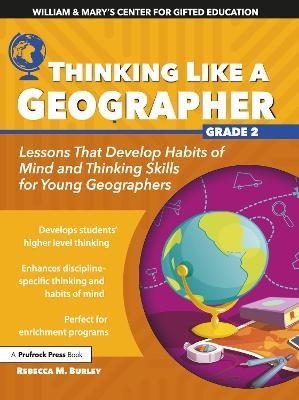
Thinking Like a Geographer
Prufrock Press (Verlag)
978-1-61821-822-3 (ISBN)
Grade 2
The Center for Gifted Education at The College of William and Mary, a research and development center, was established in 1988 under the direction of Dr. Joyce VanTassel-Baska. The center provides services to educators, policy makers, graduate students, researchers, parents, and students in support of the needs of gifted and talented individuals. Located in Williamsburg, VA, the center has established a national reputation for excellence in research, curriculum development, and service. Several major grants, including funding from the Jacob K. Javits Gifted and Talented Students Education Act, have provided significant support for the work of the Center.
Introduction Unit 1: What Do Geographers Do? Lesson 1.1: What Is a Geographer? Lesson 1.2: The Process of Geographic Inquiry Unit 2: What Tools Do Geographers Use? Lesson 2.1: How Do Geographers Use Maps? Lesson 2.2: Explore Cartographic Skills Lesson 2.3: Communicate With Directions Lesson 2.4: Create a Map of Your School or Community Unit 3: How Do People Move? Lesson 3.1: Geographic Movement Lesson 3.2: Identify Traits of Explorers Lesson 3.3: Explore Modes of Transportation Lesson 3.4: Research Movement and Place Lesson 3.5: Write About Movement and Place Unit 4: What Is a Region? Lesson 4.1: Region, Environment, and Change Lesson 4.2: Explore the Concept of a Region Lesson 4.3: Categorize and Identify Regions Lesson 4.4: Create a Museum Exhibit Unit 5: Where Do People Live? Lesson 5.1: Population and Diversity Lesson 5.2: Explore Your Community Lesson 5.3: Compare and Contrast Community Services Lesson 5.4: Plan a New Community Unit 6: How Do Geographers Learn About People? Lesson 6.1: Use Census Data to Understand Populations Lesson 6.2: Explore Characteristics of Populations Lesson 6.3: Create a Population Pyramid Lesson 6.4: Promote Services for a Population in Need Unit 7: How Do Countries Connect With Each Other? Lesson 7.1: How Does Trade Work? Lesson 7.2: Explore Economic Interdependence Lesson 7.3: Productions of Goods Around the Globe Lesson 7.4: Move Goods Around the Globe Final Project: You Can Be a Geographer Reference About the Author
| Erscheinungsdatum | 16.01.2019 |
|---|---|
| Sprache | englisch |
| Maße | 210 x 280 mm |
| Gewicht | 340 g |
| Themenwelt | Schulbuch / Wörterbuch |
| Sozialwissenschaften ► Pädagogik | |
| ISBN-10 | 1-61821-822-0 / 1618218220 |
| ISBN-13 | 978-1-61821-822-3 / 9781618218223 |
| Zustand | Neuware |
| Informationen gemäß Produktsicherheitsverordnung (GPSR) | |
| Haben Sie eine Frage zum Produkt? |
aus dem Bereich


