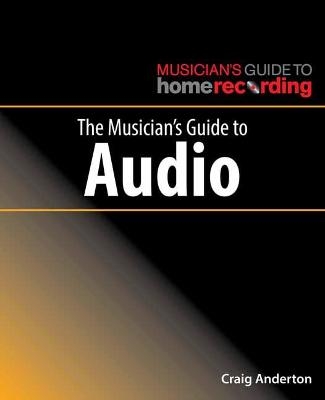
The Musician's Guide to Audio
Hal Leonard Corporation (Verlag)
978-1-5400-2692-7 (ISBN)
Everything in the studio starts and ends with audio – both analog and digital – yet many musicians know a lot more about the principles of music than the principles behind audio. The Musician's Guide to Audio will include:
• Audio theory – sound waves in the real world
• Bit resolution
• Sample rates
• Distortion
• The different types of decibels
• The meaning of audio specifications
• Frequency response
• The different types of distortion
• Signal-to-noise ratio
• Dynamic range
• How the human ear hears sound, and more
The book then segues into specifications regarding levels, connection standards (both analog and digital), and resolving potential incompatibilities among different pieces of gear. Additional topics include information on the practical ramifications of audio, such as the basics of room acoustics, why speaker placement matters, audio distribution methods including data-compressed formats like MP3, the unique constraints of vinyl, and more.
Filled with illustrations and featuring selected “tech talk” sidebars to give details on specific topics for those who want to know “why” as well as “how ” The Musician's Guide to Audio fills a unique need by avoiding overly-technical details, and instead emphasizing the practical implications involved in working with audio in the studio.
Craig Anderton is an internationally recognized authority on music and technology. He has played on, produced, or mastered over 20 major label recordings, did session work in New York in the 1970s on guitar and keyboards, played Carnegie Hall, and more recently, mastered well over a hundred tracks for various artists. His onstage career spans from the 60s to current, EDM-oriented solo performances. As an author, he co-founded Electronic Musician magazine, and has written over 35 books on musical electronics and over a thousand articles. He has also lectured on technology and the arts in 10 countries, 38 U.S. states, and three languages.
Acknowledgments
Introduction
About This Book
Getting the Most out of Your Audio
Tips and References
Chapter 1. Introduction to Audio
Analog Audio Basics
Digital Audio Basics
Frequency, Period, and Wavelength
About Waveforms and Harmonics
Key Takeaways
Chapter 2. Analog and Digital Audio Connections
Balanced and Unbalanced Lines
Signal Level Categories
Analog Audio Connector Types
Digital Audio Connector Types
Computer Audio Connectors
Chapter 3. Measuring and Specifying Audio
Measuring Audio
Understanding Audio Specifications
Why Flat Response Is Good
The Decibel
Common Audio Specifications
Key Takeaways
Chapter 4. Digital Audio Sample Rates
Understanding and Choosing Sample Rates
The “High-Resolution” Sample Rate Controversy
Direct Stream Digital (DSD)
Key Takeaways
Chapter 5. Bit Resolution
Headroom in Digital Systems
Dithering Demystified
Data Compression and Audio
Key Takeaways
Appendix A. Obtaining the Benefits of Higher Sample Rates in
Lower-Sample-Rate Projects
Solution 1
Solution 2
Appendix B. Clocking and Networked Audio
Clocking With External Devices
Word Clock
Networked Audio
| Erscheinungsdatum | 13.12.2018 |
|---|---|
| Reihe/Serie | The Musician's Guide to Home Recording |
| Sprache | englisch |
| Maße | 191 x 235 mm |
| Gewicht | 277 g |
| Themenwelt | Kunst / Musik / Theater ► Musik |
| Schulbuch / Wörterbuch ► Unterrichtsvorbereitung ► Unterrichts-Handreichungen | |
| Sozialwissenschaften ► Pädagogik | |
| ISBN-10 | 1-5400-2692-2 / 1540026922 |
| ISBN-13 | 978-1-5400-2692-7 / 9781540026927 |
| Zustand | Neuware |
| Informationen gemäß Produktsicherheitsverordnung (GPSR) | |
| Haben Sie eine Frage zum Produkt? |
aus dem Bereich