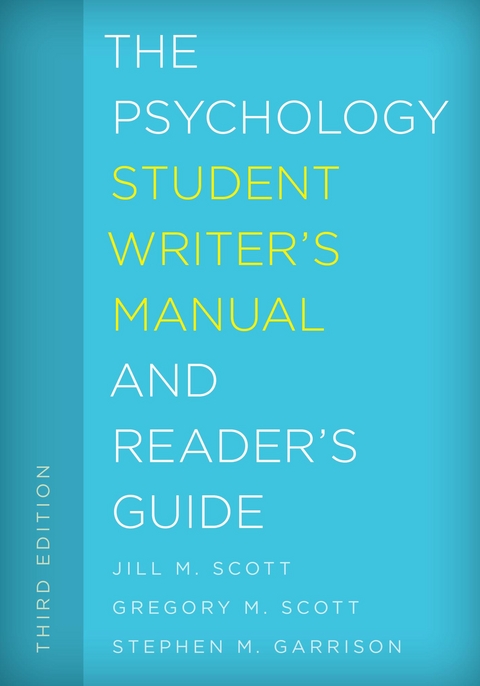
Psychology Student Writer's Manual and Reader's Guide (eBook)
176 Seiten
Rowman & Littlefield Publishers (Verlag)
978-1-4422-6700-8 (ISBN)
The Psychology Student Writer's Manual 3/E is a practical guide to research, reading, and writing in the discipline.Ideal as either a companion or stand-alone text for any psychology course that requires students to write papers. This clear and functional handbook shows how to research and write in psychology as well as improve one's overall writing ability. Covering every fundamental aspect of writing (from content to form, grammar, tracking sources of information, and citing sources), it assists students in preparing two specific types of papers: research reports and term papers.Comprehensive source-Contains all the information needed to write most types of papers typically assigned in the discipline of psychology. Provides students with a complete, one-stop, easy-to-follow reference source on how to research and write papers-including how to conduct research in psychology, how to find information on topics related to psychology, how to incorporate citations, and more. Thorough review of writing basics and formatting instructions-Addresses fundamental concerns of all writers, exploring the reasons why we write, describing the writing process itself, and examining those elements of grammar, style, and punctuation that cause the most confusion among writers in general.Shows students the key elements of good writing and effective communication, gives students a quick and handy grammar reference source, and provides them with a detailed, easy-to-follow guide to preparing papers according to accepted formats. Creative writing assignments-Offers practical writing exercises with step-by-step instructions.Heightens students' interest in the study of psychology, and frees professors from the duty of teaching students to write the papers most often assigned in psychology classes. APA standards-Complies with all APA style requirements, displays formats for text, title pages, reference pages, tables of contents in APA format, details the APA citation system, and discusses the crucial responsibility of every psychology writer to use source material ethically.General analysis of psychology -?Helps students obtain a deeper understanding of what constitutes the discipline of psychology so that they will become better and more educated writers on the subject.
Gregory Scott, University of Central Oklahoma, Emeritus ProfessorGregory Scott is Professor Emeritus and former Chair of the Department of Political Science at the University of Central Oklahoma. Scott received a BA from Ohio Wesleyan University, an M.Div. from Oral Roberts University, and an MA and a PhD in political philosophy from the University of Virginia. He taught an array of political science courses, specializing in political philosophy (ancient, medieval, modern and contemporary) and religion and politics. He is the faculty editor for CHOICES: An American Government Reader (Pearson Higher Education, 2000-2013) and is author or co-author of eleven political science and writing texts published by Pearson Higher Education.Stephen Garrison, University of Central Oklahoma, ProfessorStephen Garrison is Professor of English and Creative Writing, former Chair of the Department of English, and Director of the Creative Writing Program at the University of Central Oklahoma (UCO). He received a BA and an MA from Baylor University and a PhD from the University of South Carolina. Garrison teaches writing, creative writing, fiction, and poetry. Author of the novel Shoveling Smoke (Chronicle Books 2003), Garrison has co-authored seven writer’s manuals in separate disciplines with Gregory Scott and has published numerous scholarly works.
To the Student: Welcome to a Community of Skilled Observers and Helpers To the Teacher: What’s New in the Third Edition? PART 1 READING AND WRITING FOR INTRODUCTORY PSYCHOLOGY COURSES 1 Read and Write to Understand People1.1 Reading Psychology Analytically Read & Write 1.1: Analyze a Chapter from a Psychology Classic 1.2 Reading News as Interpersonal Influence Read & Write 1.2: Critique a Lead News Article 2 Read and Write Effectively 2.1 Get into the Flow of Writing Read & Write 2.1: Identify an Unanswered Question in Psychology 2.2 Organize Your Qualitative Writing Read & Write 2.2: Write a Chapter Outline 2.3 Draft, Revise, Edit, and Proofread Read & Write 2.3: Discover Your Own Style 3 Practice the Craft of Scholarship 3.1 The Competent Writer Read & Write 3.1: Correct a Sentence Fragment 3.2 Avoid Errors in Grammar and Punctuation Read & Write 3.2: Proofread the Mental Health Bill 3.3 Format Your Paper and Its Contents Professionally Read & Write 3.3: Explain the Data in the Table 3.4 Cite Your Sources Properly in APA Style Read & Write 3.4: Compile a Usable Bibliography 3.5 Avoid Plagiarism Read & Write 3.5: Summarize an Article from In-Mind4 Become Familiar with Perspectives in Psychology 4.1 Psychodynamic Read & Write 4.1: Meet Dali and Freud 4.2 Behaviorist Read & Write 4.2: Discover What TED Talks Says about Behavior 4.3 Cognitive Read & Write 4.3: Explore Problems and Potentials of Artificial Intelligence 5 Become Familiar with Skilled Observation 5.1 Skilled Listening Read & Write 5.1: Conduct a Focus Group 5.2 Social Behavior Read & Write 5.2: Interview a Counseling Psychologist PART 2 BECOMING A PSYCHOLOGIST BY LEARNING SCHOLARSHIP SKILLS 6 Read and Write Professionally and Critically 6.1 Read and Write Qualitative Articles in Psychology Read & Write 6.1: Write a Genogram as a Personal Case Study 6.2 Critique an Academic Article Read & Write 6.2: Critique a Scholarly Psychology Article 6.3 Write a Book Review Read & Write 6.3: Review a New Psychology Book 6.4 Write a Literature Review Read & Write 6.4: Write a Psychology Literature Review 7 Research Effectively: Preliminary Scholarship 7.1 Institute an Effective Research Process Read & Write 7.1: Write a Research Proposal 7.2 Evaluate the Quality of Online and Printed Information Read & Write 7.2: Locate and List a Dozen High-Quality Sources PART 3PRACTICING PSYCHOLOGY IN ADVANCED COURSES 8 Brain and Body 8.1 Biological Psychology Read & Write 8.1: Explore the Relationship of Climate Change to Mental Health 8.2 Sensation Perception Read & Write 8.2: Discover Movement and Depth in Art 9 Becoming Ourselves 9.1 Developmental Psychology Read & Write 9.1: Explore the Perils of Pseudomaturity 9.2 Motivation and Emotion Read & Write 9.2: Discover a Diary of Anger, Sadness, and Fear 9.3 Personality Read & Write 9.3: Know Thyself 9.4 Social Psychology Read & Write 9.4: Reflect on the Psychological Foundations of Ideology 9.5 Abnormal Psychology Read & Write 9.5: Explore the Psychology of Violence 10 Fundamentals of Psychological Science 10.1Experimental Psychology Read & Write 10.1: Write an Experimental Research Paper 10.2 Statistics for Psychology Read & Write 10.2: Calculate Statistical Significance References Index
| Reihe/Serie | The Student Writer's Manual: A Guide to Reading and Writing |
|---|---|
| Zusatzinfo | 19 Illustrations including: - 5 Black & White Illustrations; - 14 Tables. |
| Sprache | englisch |
| Themenwelt | Schulbuch / Wörterbuch ► Lexikon / Chroniken |
| Schulbuch / Wörterbuch ► Wörterbuch / Fremdsprachen | |
| Geisteswissenschaften ► Psychologie | |
| Geisteswissenschaften ► Sprach- / Literaturwissenschaft ► Literaturwissenschaft | |
| Geisteswissenschaften ► Sprach- / Literaturwissenschaft ► Sprachwissenschaft | |
| Schlagworte | psychology and reading • psychology and writing • psychology student writer's manual • psychology writer's manual • reading and writing • reading in psychology • research methods in psychology • student reader's guide • Student Resources • Writing in psychology |
| ISBN-10 | 1-4422-6700-3 / 1442267003 |
| ISBN-13 | 978-1-4422-6700-8 / 9781442267008 |
| Informationen gemäß Produktsicherheitsverordnung (GPSR) | |
| Haben Sie eine Frage zum Produkt? |
 EPUB (Adobe DRM)
Kopierschutz: Adobe-DRM
Adobe-DRM ist ein Kopierschutz, der das eBook vor Mißbrauch schützen soll. Dabei wird das eBook bereits beim Download auf Ihre persönliche Adobe-ID autorisiert. Lesen können Sie das eBook dann nur auf den Geräten, welche ebenfalls auf Ihre Adobe-ID registriert sind.
Details zum Adobe-DRM
Dateiformat: EPUB (Electronic Publication)
EPUB ist ein offener Standard für eBooks und eignet sich besonders zur Darstellung von Belletristik und Sachbüchern. Der Fließtext wird dynamisch an die Display- und Schriftgröße angepasst. Auch für mobile Lesegeräte ist EPUB daher gut geeignet.
Systemvoraussetzungen:
PC/Mac: Mit einem PC oder Mac können Sie dieses eBook lesen. Sie benötigen eine
eReader: Dieses eBook kann mit (fast) allen eBook-Readern gelesen werden. Mit dem amazon-Kindle ist es aber nicht kompatibel.
Smartphone/Tablet: Egal ob Apple oder Android, dieses eBook können Sie lesen. Sie benötigen eine
Geräteliste und zusätzliche Hinweise
Buying eBooks from abroad
For tax law reasons we can sell eBooks just within Germany and Switzerland. Regrettably we cannot fulfill eBook-orders from other countries.
aus dem Bereich