


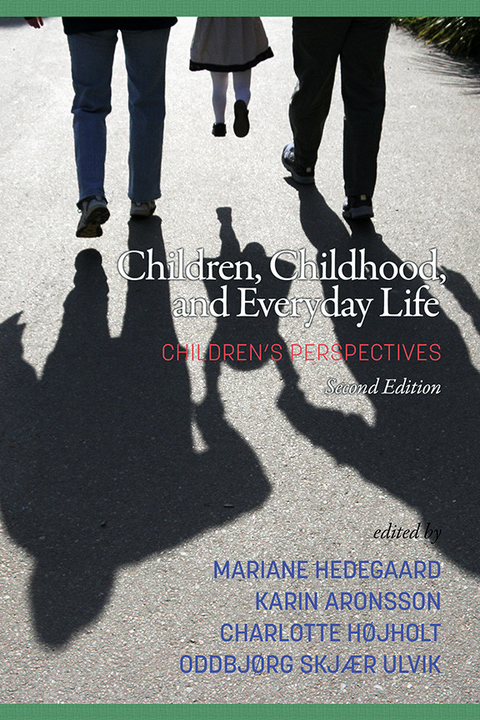
This volume offers a toolkit for analyzing children’s perspectives and participation over time. In prior work, the interview has often been seen as the cardinal method – or the only method – for studying children’s perspectives. This anthology includes vignettes and case studies, with descriptions of children’s actions in situated activity settings as well as illustrative transcripts from videorecorded social interaction. It opens up toward a broader view of ‘development’ in that it documents how children’s and youths’ perspectives and agency can be studied through their ways of interacting (or not interacting) in everyday life. One aspect of this is their verbal and nonverbal participation in family life and the social landscape of schools. Another feature is that it involves several chapters that problematize ‘impaired practices’ and dilemmas in the teaching of children with dysfunctions. The book as a whole is rich in empirical ethnographic examples that highlight life trajectories in and across social contexts.
Moreover, it features interview data and narratives that include children’s and youths’ own reflections on their lives and experiences of the social demands of family and school. This includes their own thoughts on being or becoming members of local communities.
Traditional work on child development is often based on notions of an individual and decontextualized child. This volume involves a contribution to the rethinking of development: it presents a number of situated studies where children's perspectives are documented through their interaction with others in situated practices, in family life and school and across social contexts.This volume offers a toolkit for analyzing children's perspectives and participation over time. In prior work, the interview has often been seen as the cardinal method - or the only method - for studying children's perspectives. This anthology includes vignettes and case studies, with descriptions of children's actions in situated activity settings as well as illustrative transcripts from video-recorded social interaction. It opens up toward a broader view of 'development' in that it documents how children's and youths' perspectives and agency can be studied through their ways of interacting (or not interacting) in everyday life. One aspect of this is their verbal and nonverbal participation in family life and the social landscape of schools. Another feature is that it involves several chapters that problematize 'impaired practices' and dilemmas in the teaching of children with dysfunctions. The book as a whole is rich in empirical ethnographic examples that highlight life trajectories in and across social contexts.Moreover, it features interview data and narratives that include children's and youths' own reflections on their lives and experiences of the social demands of family and school. This includes their own thoughts on being or becoming members of local communities.
Cover 1
Children, Childhood, and Everyday Life 4
Library of Congress Cataloging-in-Publication Data 5
Contents 6
CHAPTER 1: Rethinking Development 8
SECTION I: FAMILY LIFE AS A SOCIAL ARENA 22
CHAPTER 2: Children’s Creative Modeling of Conflict Resolutions in Everyday Life 24
CHAPTER 3: Daily Practices and The Time Politics of Family Life 44
CHAPTER 4: Money Talks 62
CHAPTER 5: Constructions of a Culturally Adequate Child 80
SECTION II: THE SOCIAL LANDSCAPE OF SCHOOLS AND RESIDENTIAL CARE 98
CHAPTER 6: Children’s Perspectives and Learning Communities 100
CHAPTER 7: Family Problems 120
CHAPTER 8: Paradoxes of Inclusion 136
CHAPTER 9: Using the Child Perspective to Support Children With Severe Impairments in Becoming Active Subjects 156
CHAPTER 10: Residential Care and Children’s Development of Agency in Everyday Life 174
SECTION III: CHILDREN’S OWN REFLECTIONS ON SOCIAL LIFEAND DEVELOPMENT 192
CHAPTER 11: “Being Oneself” and “Being of Use” 194
CHAPTER 12: Being a Child, Coming of Age 210
CHAPTER 13: Social Identity in Transition 228
CHAPTER 14: “Remaining the Same” and Children’s Experience of Development 248
| Erscheint lt. Verlag | 1.2.2018 |
|---|---|
| Sprache | englisch |
| Themenwelt | Schulbuch / Wörterbuch ► Lexikon / Chroniken |
| Geisteswissenschaften ► Psychologie ► Entwicklungspsychologie | |
| Geisteswissenschaften ► Psychologie ► Pädagogische Psychologie | |
| Sozialwissenschaften ► Pädagogik | |
| ISBN-10 | 1-64113-171-3 / 1641131713 |
| ISBN-13 | 978-1-64113-171-1 / 9781641131711 |
| Informationen gemäß Produktsicherheitsverordnung (GPSR) | |
| Haben Sie eine Frage zum Produkt? |
 PDF (Adobe DRM)
Größe: 2,1 MB
Kopierschutz: Adobe-DRM
Adobe-DRM ist ein Kopierschutz, der das eBook vor Mißbrauch schützen soll. Dabei wird das eBook bereits beim Download auf Ihre persönliche Adobe-ID autorisiert. Lesen können Sie das eBook dann nur auf den Geräten, welche ebenfalls auf Ihre Adobe-ID registriert sind.
Details zum Adobe-DRM
Dateiformat: PDF (Portable Document Format)
Mit einem festen Seitenlayout eignet sich die PDF besonders für Fachbücher mit Spalten, Tabellen und Abbildungen. Eine PDF kann auf fast allen Geräten angezeigt werden, ist aber für kleine Displays (Smartphone, eReader) nur eingeschränkt geeignet.
Systemvoraussetzungen:
PC/Mac: Mit einem PC oder Mac können Sie dieses eBook lesen. Sie benötigen eine
eReader: Dieses eBook kann mit (fast) allen eBook-Readern gelesen werden. Mit dem amazon-Kindle ist es aber nicht kompatibel.
Smartphone/Tablet: Egal ob Apple oder Android, dieses eBook können Sie lesen. Sie benötigen eine
Geräteliste und zusätzliche Hinweise
Buying eBooks from abroad
For tax law reasons we can sell eBooks just within Germany and Switzerland. Regrettably we cannot fulfill eBook-orders from other countries.
 EPUB (Adobe DRM)
Kopierschutz: Adobe-DRM
Adobe-DRM ist ein Kopierschutz, der das eBook vor Mißbrauch schützen soll. Dabei wird das eBook bereits beim Download auf Ihre persönliche Adobe-ID autorisiert. Lesen können Sie das eBook dann nur auf den Geräten, welche ebenfalls auf Ihre Adobe-ID registriert sind.
Details zum Adobe-DRM
Dateiformat: EPUB (Electronic Publication)
EPUB ist ein offener Standard für eBooks und eignet sich besonders zur Darstellung von Belletristik und Sachbüchern. Der Fließtext wird dynamisch an die Display- und Schriftgröße angepasst. Auch für mobile Lesegeräte ist EPUB daher gut geeignet.
Systemvoraussetzungen:
PC/Mac: Mit einem PC oder Mac können Sie dieses eBook lesen. Sie benötigen eine
eReader: Dieses eBook kann mit (fast) allen eBook-Readern gelesen werden. Mit dem amazon-Kindle ist es aber nicht kompatibel.
Smartphone/Tablet: Egal ob Apple oder Android, dieses eBook können Sie lesen. Sie benötigen eine
Geräteliste und zusätzliche Hinweise
Buying eBooks from abroad
For tax law reasons we can sell eBooks just within Germany and Switzerland. Regrettably we cannot fulfill eBook-orders from other countries.
aus dem Bereich


