


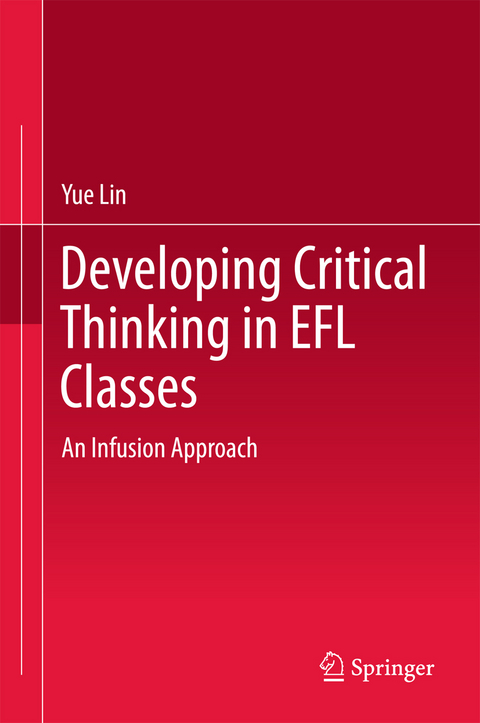
Developing Critical Thinking in EFL Classes (eBook)
XIX, 194 Seiten
Springer Singapore (Verlag)
978-981-10-7784-5 (ISBN)
Yue Lin currently is a lecturer at Shenzhen University, teaching College English for undergraduate students, and Modern English Pedagogy and English Language Testing for mater students. She studied in Educational and Applied Linguistics and received her PhD degree from University of Newcastle (U.K) in 2014. Her current research focuses on the second language teaching and learning, and the teaching of critical thinking.
This book presents an innovative teaching experiment and an analytical study of critical thinking and the sociocultural theory of learning to illustrate the cognitive learning development mechanisms. It addresses the issues in developing critical thinking, including the controversy surrounding the definition, measurement and teaching of critical thinking, particularly in the L2 context.The book explains how infusion-thinking lessons can be structured to help students develop critical thinking along with language learning. Further, it uses a case study as a real-world example to examine the applicability and feasibility of infusion-thinking lessons in the EFL context and their effectiveness in developing students' critical thinking and language learning.Packed with thinking activities and techniques, this practical, hands-on manual provides original ideas and empirical data, giving teachers everything they need to plan theirlessons to improve students' critical thinking within language courses and evaluate their teaching.
Yue Lin currently is a lecturer at Shenzhen University, teaching College English for undergraduate students, and Modern English Pedagogy and English Language Testing for mater students. She studied in Educational and Applied Linguistics and received her PhD degree from University of Newcastle (U.K) in 2014. Her current research focuses on the second language teaching and learning, and the teaching of critical thinking.
CHAPTER ONE – Core issues in developing critical thinking skills1.1 Introduction 1.2 What Is Critical Thinking?1.3 Can Critical Thinking Be Taught?1.4 Should we teach thinking skills in EFL classrooms?1.5 Can It Be Assessed?CHAPTER TWO- Infusion Approach2.1 Theoretical Basis of Infusion Approach2.2 Conceptual Framework of Infusion Approach2.3 Thinking TasksCHAPTER THREE- Critical Thinking and Writing3.1 Relationship between Thinking and Writing 3.2 Writing and Critical Thinking CHAPTER FOUR- Effectiveness of Teaching Thinking Skills4.1 Teaching Thinking Skills in L1 Classroom 4.2 Teaching Thinking Skills in L2 Classroom 4.3 Effectiveness of Teaching Critical Thinking in L2 Writing Classes4.4 Effectiveness of Infusion Lessons 5.1 Rationale and Aims5.2 Research Questions 5.3 Mixed-Methods Approach and Case Study5.4 Research Context and Participants5.5 Teaching Intervention CHAPTER SIX- Data Collection6.1 Date Collection Instruments6.2 Piloting the Research Instruments 6.3 Data Analysis CHAPTER SEVEN- Effects on Critical Thinking 7.1 Students’ Perceptions of the Effects on Thinking 7.2 Effect on Critical Thinking Dispositions 7.3 Effect on Critical Thinking Performance7.4 Contexts for Critical Thinking 7.5 Design of Thinking Tasks 7.6 Thinking Tasks as a Context for Enhancing Critical Thinking CHAPTER EIGHT- Impact on Writing 8.1 Students’ Perception of Effect on Writing 8.2 Effects on Overall Writing Proficiency 8.3 Effects on Accuracy 8.4 Effects on Complexity 8.5 Effects on Fluency of Writing8.6 The Development of Writing8.7 Mutual Reinforcement of Critical Thinking and Language Learning CHAPTER NIGHT- Students’ Attitudes towards and Perceptions of Infusion Lessons 9.1 Attitudes towards and Perceptions of Infusion Lessons 9.2 Perceptions of the Effects on English Learning 9.3 Perceptions of Thinking Tasks 9.4 Attitudes towards and Perceptions of Group Discussion 9.5 Suggestions for Future Lessons CHAPTER TEN-Implications10.1 Implications to Educational Policy10.2 Implications to the Teaching of Critical Thinking 10.3 Implications to Research MethodologyAPPENDIXES Appendix A: Consent Form Appendix B. Example of Guideline in Textbook Appendix C. Design of Tasks Appendix D. CCTDI and CCTST Appendix E. Self-Evaluation Questionnaire Appendix F. Post-Intervention Questionnaire Appendix G. English Writing Rating Criteria of NECC Appendix H. Guideline of Clause, T-unit and Errors Appendix I. Example of Transcription of Interview Appendix I. Criteria of Coding Critical Thinking Elements in Writing
| Erscheint lt. Verlag | 9.2.2018 |
|---|---|
| Zusatzinfo | XIX, 194 p. 32 illus., 30 illus. in color. |
| Verlagsort | Singapore |
| Sprache | englisch |
| Themenwelt | Schulbuch / Wörterbuch ► Wörterbuch / Fremdsprachen |
| Geisteswissenschaften ► Sprach- / Literaturwissenschaft ► Sprachwissenschaft | |
| Schlagworte | Argumentative Writing • Case study • Classroom • critical thinking • Education Policy • Infusion Approach • Language Learning • Learning Effects • Teaching effectiveness • Teaching Intervention • Thinking Skills • Writing Fluency |
| ISBN-10 | 981-10-7784-3 / 9811077843 |
| ISBN-13 | 978-981-10-7784-5 / 9789811077845 |
| Informationen gemäß Produktsicherheitsverordnung (GPSR) | |
| Haben Sie eine Frage zum Produkt? |
 PDF (Wasserzeichen)
DRM: Digitales Wasserzeichen
Dieses eBook enthält ein digitales Wasserzeichen und ist damit für Sie personalisiert. Bei einer missbräuchlichen Weitergabe des eBooks an Dritte ist eine Rückverfolgung an die Quelle möglich.
Dateiformat: PDF (Portable Document Format)
Mit einem festen Seitenlayout eignet sich die PDF besonders für Fachbücher mit Spalten, Tabellen und Abbildungen. Eine PDF kann auf fast allen Geräten angezeigt werden, ist aber für kleine Displays (Smartphone, eReader) nur eingeschränkt geeignet.
Systemvoraussetzungen:
PC/Mac: Mit einem PC oder Mac können Sie dieses eBook lesen. Sie benötigen dafür einen PDF-Viewer - z.B. den Adobe Reader oder Adobe Digital Editions.
eReader: Dieses eBook kann mit (fast) allen eBook-Readern gelesen werden. Mit dem amazon-Kindle ist es aber nicht kompatibel.
Smartphone/Tablet: Egal ob Apple oder Android, dieses eBook können Sie lesen. Sie benötigen dafür einen PDF-Viewer - z.B. die kostenlose Adobe Digital Editions-App.
Buying eBooks from abroad
For tax law reasons we can sell eBooks just within Germany and Switzerland. Regrettably we cannot fulfill eBook-orders from other countries.
aus dem Bereich


