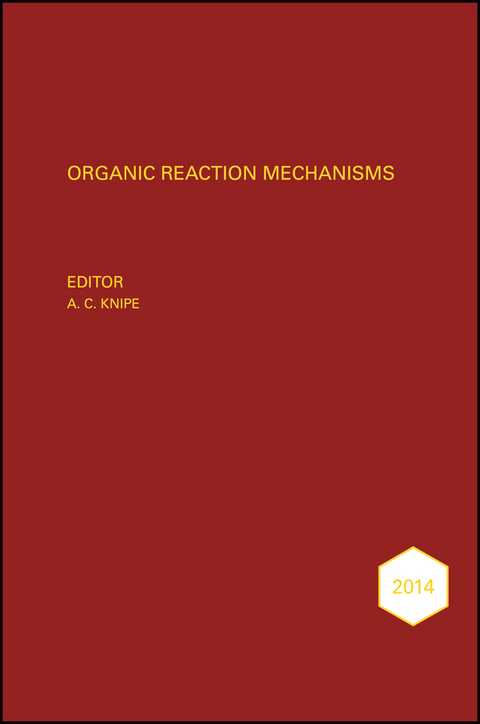
Organic Reaction Mechanisms 2014 (eBook)
John Wiley & Sons (Verlag)
978-1-118-94181-2 (ISBN)
Organic Reaction Mechanisms 2014, the 50th annual volume in this highly successful and unique series, surveys research on organic reaction mechanisms described in the available literature dated 2014. The following classes of organic reaction mechanisms are comprehensively reviewed:
- Reaction of Aldehydes and Ketones and their Derivatives
- Reactions of Carboxylic, Phosphoric, and Sulfonic Acids and their Derivatives
- Oxidation and Reduction
- Carbenes and Nitrenes
- Nucleophilic Aromatic Substitution
- Electrophilic Aromatic Substitution
- Carbocations
- Nucleophilic Aliphatic Substitution
- Carbanions and Electrophilic Aliphatic Substitution
- Elimination Reactions
- Polar Addition Reactions
- Cycloaddition Reactions
- Molecular Rearrangements
An experienced team of authors compile these reviews every year, so that the reader can rely on a continuing quality of selection and presentation. This volume includes a 5-year cumulative index.
Organic Reaction Mechanisms 2014, the 50th annual volume in this highly successful and unique series, surveys research on organic reaction mechanisms described in the available literature dated 2014. The following classes of organic reaction mechanisms are comprehensively reviewed: Reaction of Aldehydes and Ketones and their Derivatives Reactions of Carboxylic, Phosphoric, and Sulfonic Acids and their Derivatives Oxidation and Reduction Carbenes and Nitrenes Nucleophilic Aromatic Substitution Electrophilic Aromatic Substitution Carbocations Nucleophilic Aliphatic Substitution Carbanions and Electrophilic Aliphatic Substitution Elimination Reactions Polar Addition Reactions Cycloaddition Reactions Molecular Rearrangements An experienced team of authors compile these reviews every year, so that the reader can rely on a continuing quality of selection and presentation. This volume includes a 5-year cumulative index.
Professor A.C. Knipe, School of BMS, The University of Ulster, Northern Ireland.
1. Reactions of Aldehydes and Ketones and their Derivatives
by B. A. Murray 1
2. Reactions of Carboxylic, Phosphoric, and Sulfonic Acids and their Derivatives
by C. T. Bedford 87
3. Oxidation and Reduction
by K. K. Banerji 123
4. Carbenes and Nitrenes
by E. Gras and S. Chassaing 227
5. Aromatic Substitution
by M. R. Crampton 267
6. Carbocations
by D. A. Klumpp 339
7. Nucleophilic Aliphatic Substitution
by A. C. Knipe 367
8. Carbanions and Electrophilic Aliphatic Substitution
by M. L. Birsa 399
9. Elimination Reactions
by M. L. Birsa 423
10. Addition Reactions: Polar Addition
by P. Ko!covsk´y 435
11. Addition Reactions: Cycloaddition
by N. Dennis 583
12. Molecular Rearrangements
by J. M. Coxon 621
Author Index 713
Cumulative Subject Index, 2010-2014 763
Chapter 1
Reactions of Aldehydes and Ketones and their Derivatives
B. A. Murray
Department of Science, Institute of Technology Tallaght (ITT Dublin), Dublin, Ireland
- Formation and Reactions of Acetals and Related Species
- Reactions of Glucosides
- Reactions of Ketenes and Keteniminium Species
- Formation and Reactions of Nitrogen Derivatives
- Imines: Synthesis, and General and Iminium Chemistry
- Reduction and Oxidation of Imines
- Mannich, Mannich-type, and Nitro-Mannich Reactions
- Addition of Organometallics to Imines
- Arylations, Alkenylations, Allylations, and Alkynylations of Imines
- Other Additions to Imines
- Aza-Baylis–Hillman Reactions of Imines, and their Morita Variants
- Staudinger and Aza-Henry Reactions, and Additions Involving Nitriles
- Insertion Reactions of Imines
- Cycloadditions of Imines
- Miscellaneous Reactions of Imines
- Oximes, Oxime Ethers, and Oxime Esters
- Hydrazones and Related Species
- Nitrones and Related Species
- C−C Bond Formation and Fission: Aldol and Related Reactions
- Reviews of Aldols, and General Reviews of Asymmetric Catalysis
- Asymmetric Aldols Catalysed by Proline and its Derivatives
- Asymmetric Aldols Catalysed by Other Amino Acids and their Derivatives
- Asymmetric Aldols Catalysed by Other Organocatalysts
- Other Asymmetric Aldols
- The Mukaiyama Aldol
- The Henry (Nitroaldol) Reaction
- The Baylis–Hillman Reaction and its Morita Variant
- Other Aldol and Aldol-type Reactions
- Allylation and Related Reactions
- Alkynylations
- The Stetter Reaction and the Benzoin Condensation
- Michael Additions and Related Reactions
- Miscellaneous Condensations
- Other Addition Reactions
- Enolization, Reactions of Enolates, and Related Reactions
- Oxidation and Reduction of Carbonyl Compounds
- Other Reactions
- References
Formation and Reactions of Acetals and Related Species
1,11-Dihydroxy-undec-9-en-5-one derivatives (1; R = H, Me) undergo a novel and highly stereoselective palladium(II)-catalysed intramolecular cyclization via unstable hemiacetal intermediates, to give spiroketals (2).1
Conversion of aldehydes (RCHO) to their cyclic dithioacetals (3; X = R) has been simplified by the use of 2-chloro-1,3-dithiane (3; X = Cl) in dichloroethane at 50 °C, employing a simple iron catalyst, FeCl3. A single-electron transfer (SET) mechanism is proposed.2
Unsaturated spiroacetal (5) has been prepared as a single regioisomer with de > 96% from a cyclic acetonide (4) with an appropriate alkyne–alcohol tether; the arrowed oxygen is lost with the extrusion of acetone. Catalysed by gold(I), the reaction also works for non-cyclic alkyne–triol chains, but much less cleanly. The acetone → acetonide preparative step can be considered to be a regioselectivity regulator, masking the 1,3-diol's alcohol groups.3
N-Boc-protected amino acid esters derived from serine and threonine forms (natural and unnatural) combine with tetramethoxyalkanes [1,2-diacetals: R1−{C(OMe)2}2−R2] to give chiral bi- and tri-cyclic N,O-acetals in high diasteriomeric excess (de), via an intramolecular trans-carbamoylation cascade.4
2-Substituted and 2,2-disubstituted 1,3-diols, HO−CH2−CR1R2−CH2OH, have been desymmetrized through their para-methoxy benzylidene acetals (6), using dimethyldioxirane (DMDO) to form an intermediate orthoester (7), followed by proton transfer using a chiral phosphoric acid to deliver the monoester product (8). Density functional theory (DFT) calculations indicate that the DMDO oxidation step is rate-determining, and a suitable auxiliary – a buttressed BINOL-phosphoric acid – gives yields/ee up to 99/95%.5
DFT has been used to study the thermal racemization of spiropyrans.6
Based on the reaction of a quinone monoacetal (9) with methylhydroxylamine hydrochloride (MeNHOH·HCl) to give a bridged isoxazolidine (10a) via a double hetero-Michael addition, the analogous diaza process was attempted, using the appropriate hydrazine MeNHNHMe(·2HCl) in refluxing acetonitrile. Surprisingly, this gave a new nucleophilic chlorination to yield a substituted chlorophenol (11) regio-selectively, presumably via acid-catalysed methoxide loss and chloride attack, or vice versa. The intended bridged pyrazolidines (10b) could be accessed via base catalysis in a protic solvent.7
Trimethylsilyl triflate is an efficient Lewis acid catalyst for oxygen-to-carbon rearrangement of vinyl and ketene acetals (12 and 13) to give chain-extended ketones or esters, respectively, giving fair yields in 30 min in dichloromethane (DCM) at −78 °C, with 0.01 mol% trimethylsilyl trifluoromethanesulfonate (TMSOTf). The method has been applied to stereoselective synthesis of C-glycosides from the corresponding anomeric vinyl ethers. Starter (12) can be prepared by methenylation of the corresponding acetal-ester with Tebbe's reagent, and (13) via elimination of an appropriate β-iodo-acetal.8
Selective Heck arylation of acrolein diethyl acetal in water has been achieved by appropriate choice of base: sodium acetate favours reaction with cinnamaldehydes, while diisopropylamine works with 3-propionic esters. In the presence of such a base, the ligands in the [Pd(NH3)4]Cl2 catalyst are exchanged.9
Alkynyldimethylaluminium reagents, derived from terminal alkynes and trimethylaluminium, doubly add to N,N-disubstituted formamides, or to the corresponding O,O-acetals, while similar N,O-acetals undergo mono-addition.10
Alkynylation of N,O-acetals and related pro-electrophiles has been carried out using Au(I) carbophilic catalysts, LAuX, with specific counteranions, X− = −OTf or −NTf2.11
A study of nucleophilic substitutions of five-membered ring acetals bearing fused rings indicates that subtle changes in the structure of the latter can dramatically affect de. An unconstraining ring allowed selectivity comparable to a non-fused analogue, with ‘inside’ attack on the oxocarbenium ion, but if the second ring included at least one oxygen, the de fell considerably. DFT-calculated transition states (TSs) for the addition of allyltrimethylsilane correlated with the results, which are also compared with the better known six-membered series.12
An experimental and theoretical study examines why silylated nucleobase additions to acyclic α-alkoxythiacarbenium intermediates proceed with high 1,2-syn stereocontrol, opposite to that expected for the corresponding activated aldehydes. The acyclic thioaminals formed undergo intramolecular cyclizations to provide nucleoside analogues.13
A new oxidant, N-chloroisonipecotamide, has been characterized and tested with benzaldehyde di-n-alkyl acetals in acetonitrile: kinetic orders are first and zero, respectively.14
An easily prepared and handled palladium(II) complex has been used for the deprotection of acetals and dioxolanes while leaving acid-sensitive groups unaffected.15
For reports on acetals termed ‘aziridine aldehyde dimers’, see the Ugi reaction under ‘Imines: Synthesis and General and Iminium Ion Chemistry’ section. For preparation of bicyclic acetals via an acetalization/oxa-Michael process, see ‘Michael Additions and Related Reactions’ section.
Reactions of Glucosides
The ‘formose reaction’, in which formaldehyde is dimerized to glycolaldehyde (HOCH2CHO) and onward to sugar-like substances, is a candidate for prebiotic simple sugars. Though a mechanism was proposed by Breslow in 1959,16a it has remained controversial. New deuterium studies have clarified the route, retaining the original intermediates but changing some connecting steps. Glycolaldehyde formation is autocatalytic, and...
| Erscheint lt. Verlag | 7.12.2017 |
|---|---|
| Reihe/Serie | Organic Reaction Mechanisms |
| Organic Reaction Mechanisms | Organic Reaction Mechanisms |
| Sprache | englisch |
| Themenwelt | Schulbuch / Wörterbuch ► Lexikon / Chroniken |
| Naturwissenschaften ► Chemie ► Organische Chemie | |
| Schlagworte | Chemie • Chemistry • Organic Chemistry • Organic Reaction Mechanisms, Aldehydes, Ketones , Carboxylic Acids, Phosphoric Acids, Sulfonic Acids, Oxidation, Reduction, Carbenes, Nitrenes, Nucleophilic Aromatic Substitution, Electrophilic Aromatic Substitution, Carbocations, Nucleophilic Aliphatic Substitution, Carbanions, Electrophilic Aliphatic Substitution, Elimination Reactions, Polar Addition Reactions, Cycloaddition Reactions, Molecular Rearrangements • Organische Chemie • Physical Chemistry • Physical Organic Chemistry • Physikalische Chemie • Physikalische Organische Chemie |
| ISBN-10 | 1-118-94181-0 / 1118941810 |
| ISBN-13 | 978-1-118-94181-2 / 9781118941812 |
| Informationen gemäß Produktsicherheitsverordnung (GPSR) | |
| Haben Sie eine Frage zum Produkt? |
 EPUB (Adobe DRM)
Kopierschutz: Adobe-DRM
Adobe-DRM ist ein Kopierschutz, der das eBook vor Mißbrauch schützen soll. Dabei wird das eBook bereits beim Download auf Ihre persönliche Adobe-ID autorisiert. Lesen können Sie das eBook dann nur auf den Geräten, welche ebenfalls auf Ihre Adobe-ID registriert sind.
Details zum Adobe-DRM
Dateiformat: EPUB (Electronic Publication)
EPUB ist ein offener Standard für eBooks und eignet sich besonders zur Darstellung von Belletristik und Sachbüchern. Der Fließtext wird dynamisch an die Display- und Schriftgröße angepasst. Auch für mobile Lesegeräte ist EPUB daher gut geeignet.
Systemvoraussetzungen:
PC/Mac: Mit einem PC oder Mac können Sie dieses eBook lesen. Sie benötigen eine
eReader: Dieses eBook kann mit (fast) allen eBook-Readern gelesen werden. Mit dem amazon-Kindle ist es aber nicht kompatibel.
Smartphone/Tablet: Egal ob Apple oder Android, dieses eBook können Sie lesen. Sie benötigen eine
Geräteliste und zusätzliche Hinweise
Buying eBooks from abroad
For tax law reasons we can sell eBooks just within Germany and Switzerland. Regrettably we cannot fulfill eBook-orders from other countries.
aus dem Bereich