


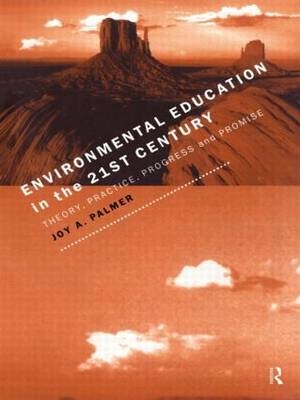
Environmental Education in the 21st Century
Theory, Practice, Progress and Promise
Seiten
1998
Routledge (Verlag)
978-0-415-13197-1 (ISBN)
Routledge (Verlag)
978-0-415-13197-1 (ISBN)
There is an urgency and importance in learning to live in sustainable ways, but environmental education does not hold the priority position in formal schooling that it should. This text sets out to discover why this is so.
Environmental education is a field characterised by a paradox. Few would doubt the urgency and importance of learning to live in sustainable ways, but environmental education holds nowhere near the priority position in formal schooling around the world that this would suggest. This text sets out to find out why this is so. It is divided into six parts:
Part 1 is a concise history of the development of environmental education from an international perspective;
Part 2 is an overview of the 'global agenda', or subject knowledge of environmental education;
Part 3 introduces perspectives on theory and research in environmental education;
Part 4 moves on to practice, and presents an integrated model for planning environmental education programmes;
Part 5 brings together invited contributors who talk about environmental education in their own countries - from 15 countries including China, South Africa, Sri Lanka and the USA;
Part 6 returns to the core questions of how progress can be made, and how we can maximise the potential of environmental education for the twenty first century.
Environmental education is a field characterised by a paradox. Few would doubt the urgency and importance of learning to live in sustainable ways, but environmental education holds nowhere near the priority position in formal schooling around the world that this would suggest. This text sets out to find out why this is so. It is divided into six parts:
Part 1 is a concise history of the development of environmental education from an international perspective;
Part 2 is an overview of the 'global agenda', or subject knowledge of environmental education;
Part 3 introduces perspectives on theory and research in environmental education;
Part 4 moves on to practice, and presents an integrated model for planning environmental education programmes;
Part 5 brings together invited contributors who talk about environmental education in their own countries - from 15 countries including China, South Africa, Sri Lanka and the USA;
Part 6 returns to the core questions of how progress can be made, and how we can maximise the potential of environmental education for the twenty first century.
Joy Palmer
Section 1: History and Development of Environmental Education; Section 2: The Global Agenda; Section 3: Perspectives on Theory and Research in Environmental Education; Section 4: Environmental Education: Structure and Practice; Section 5: The Global Scene; Section 6: Towards Progress and Promise in the 21st Century
| Erscheint lt. Verlag | 1.1.1998 |
|---|---|
| Verlagsort | London |
| Sprache | englisch |
| Maße | 156 x 234 mm |
| Gewicht | 550 g |
| Themenwelt | Schulbuch / Wörterbuch |
| Sozialwissenschaften ► Pädagogik ► Schulpädagogik / Sekundarstufe I+II | |
| ISBN-10 | 0-415-13197-9 / 0415131979 |
| ISBN-13 | 978-0-415-13197-1 / 9780415131971 |
| Zustand | Neuware |
| Informationen gemäß Produktsicherheitsverordnung (GPSR) | |
| Haben Sie eine Frage zum Produkt? |
Mehr entdecken
aus dem Bereich
aus dem Bereich
Buch | Softcover (2025)
Verlag an der Ruhr
CHF 34,95
Buch | Softcover (2025)
Don Bosco Medien (Verlag)
CHF 11,90


