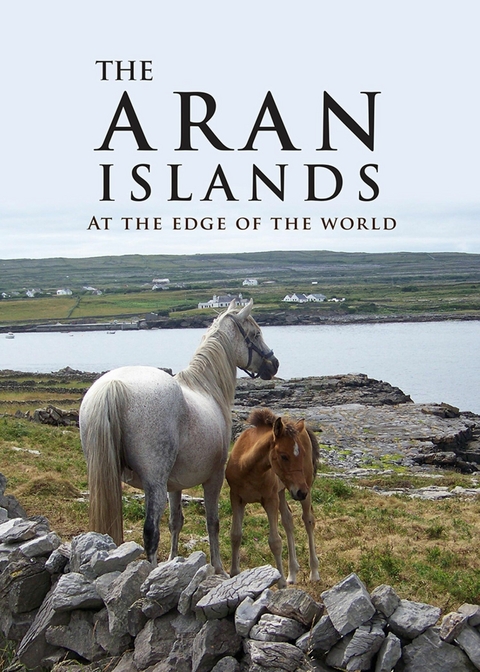

Inishmore, Inishmaan, Inisheer: wild, isolated, starkly beautiful and of great historical importance. Lying in the Atlantic Ocean off Galway Bay, the Aran Islands are a place apart. Here island life has preserved many aspects of Irish culture - its language, customs and traditions. These islands bear witness to events from earliest times and have experienced Celtic occupation, the arrival of Christianity, invasions, sieges, famine and evictions. This history is evident in the massive Iron Age forts, the Early Christian ruins, and in the literature, songs and images from these 'three stepping stones out of Europe'. A comprehensive, beautifully illustrated introduction to and lasting memento of these unique islands.
‘The Evening Land’
By Seamus Heaney
From Connemara, or the Moher clifftop,
Where the land ends with a sheer drop,
You can see three stepping stones out of Europe.
Anchored like hulls at the dim horizon
Against the winds’ and the waves’ explosion.
The Aran Islands are all awash.
East coastline’s furled in the foam’s white sash.
The clouds melt over them like slush.
And on Galway Bay, between shore and shore,
The ferry plunges to Aranmore.
The Aran Islands are a group of windswept, grey rock ledges off the west coast of Ireland. Creeping one by one away from the Connacht mainland, and facing the open Atlantic, they harbour memories of ancient Ireland, the history and traditions of Gaelic culture, and the spirit, songs and stories of an island people.
The three main islands, Inishmore, Inishmaan and Inisheer, are long and low, resembling a group of stranded whales, and together they extend over twenty-five kilometres in an almost perfectly straight line across the mouth of Galway Bay. About 1,250 people live on the islands, but in the summer season visitors swell the numbers considerably.
The Aran Islands are a native Gaeltacht, in which the Irish language is the predominant vernacular or language of the home. The name Aran may have been derived from the Irish word ara, which means ‘kidney’, because of the kidney shape of Inishmore. It equally may have been abbreviated from the Irish expression ard-thuinn, meaning ‘the height of the waves’. According to legend, the islands are the remnants of a rock barrier that once stretched from Galway to Clare, trapping the waters of the present Galway Bay in a gigantic lake. All three islands are alike in their rock base and also similar to the nearby Burren on the north Clare mainland.
Inisheer (Inis Oírr: the Eastern Island) is the nearest to County Clare, lying just under ten kilometres north-west of Doolin. It is the smallest of Aran’s three main islands, almost square in shape, with an area of ten square kilometres. The broad sweep of the South Sound isolates Inisheer from the mainland, and boats cross regularly from Doolin.
Inishmaan (Inis Meáin: the Middle Island) is the next along, separated from Inisheer by three kilometres of water known as Foul Sound. On the other side, it is separated from Inishmore by two kilometres of open sea known as Gregory’s Sound, named after a revered hermit saint, Gregory of the Golden Mouth, who is reputed to have lived and died on Inishmaan. It is much smaller than Inishmore and more compact in shape, extending just five kilometres from east to west.
The wind-swept cliffs of Inishmore, the largest Aran island.
Inishmore (Inis Mór: the Big Island) lies nearest to the Galway mainland and is the largest and best-known island. It is regarded as the ‘capital’ of the Aran Islands. The sheltered harbour at Kilronan (Cill Rónáin) has long been the main entry point for visitors to Aran. The island’s inhabitants occupy an area amounting to little more than thirty-one kilometres. The bay of Killeany (Cill Éinne) forms a natural ‘waist’ to the island. From there, Inishmore rises north-westward and achieves its greatest width before descending to the narrow ‘neck’ at Port Murvey (Port Mhuirbhigh), less than a kilometre wide. A second, slightly lower ridge rises to the west of this bay, widening the island once more before it slopes gently down to the Atlantic at its north-western tip.
A patchwork of small fields on Inishmaan.
Other small, uninhabited islands complete the Aran group: Rock Island and Straw Island, both home to lighthouses; and Brannock Island (Oileán dá Bhranóg: the island of the two small ravens).
Nowadays, the Aran Islands are easily accessible by sea and air. Ferries run from Doolin in County Clare (seasonal) and Rossaveal in County Galway (all year round). Aer Arann Islands operates flights from Inverin in Galway to all three islands. But in times past, isolation was a feature of Aran life. Gale-force winds still occasionally sever shipping links, and back when this was the only form of transport, the population would have been cut off from the outside world, often for weeks on end. The shelving sea bed around the islands makes for a particularly treacherous sea during a storm – the waves break more than a kilometre from the shore, sending gigantic white combers rushing towards the rocks. Communications were then cut off, mail and visitors failed to arrive, and supplies of food ran low – the community had to rely on its own resources. If one of the inhabitants fell ill during storm conditions and needed hospitalisation, sometimes a crossing had to be attempted. The islanders grimly joked that a patient, in his terror, forgot about his illness until he reached the safety of Rossaveal on the mainland, where his condition immediately deteriorated once more!
Traditional currachs.
The Naomh Éanna ferry sailed for thirty years between Galway and the Aran Islands, before it was taken out of action in 1986.
THE JOURNEY TO ARAN IN THE NINETEENTH AND EARLY TWENTIETH CENTURIES
In those years, travel to the islands was usually undertaken in the traditional currach (pr: cur-rock) or curragh, a boat made of skin fixed over a wooden frame, thus giving a light but fragile vessel that pitched and tossed with the high waves. What was it like to travel out to Aran this way? Here we have a description from John Millington Synge, the famous playwright, who visited Aran every summer from 1898 to 1902, living with families on Inishmore and Inishmaan. His book The Aran Islands is an account of life in that era.
We set off. It was a four-oared curragh, and I was given the last seat so as to leave the stern for the man who was steering with an oar, worked at right angles to the others by an extra thole-pin in the stern gunnel.
When we had gone about a hundred yards they ran up a bit of a sail in the bow and the pace became extraordinarily rapid.
The shower had passed over and the wind had fallen, but large magnificently brilliant waves were rolling down on us at right angles to our course.
Every instant the steersman whirled us round with a sudden stroke of his oar, the prow reared up and then fell into the next furrow with a crash, throwing up masses of spray. As it did so, the stern in its turn was thrown up, and both the steersman, who let go his oar and clung with both hands to the gunnel, and myself, were lifted high above the sea.
The wave passed, we regained our course and rowed violently for a few yards, when the same manoeuvre had to be repeated. As we worked out into the sound we began to meet another class of waves, that could be seen from some distance towering above the rest.
When one of these came in sight, the first effort was to get beyond its reach. The steersman began crying out in Gaelic ‘Siubhal, siubhal’ (‘Run, run’), and sometimes, when the mass was gliding towards us with horrible speed, his voice rose to a shriek. Then the rowers themselves took up the cry, and the curragh seemed to leap and quiver with the frantic terror of a beast till the wave passed behind it or fell with a crash beside the stern.
It was in this racing with the waves that our chief danger lay. If the wave could be avoided, it was better to do so, but if it overtook us while we were trying to escape, and caught us on the broadside, our destruction was certain. I could see the steersman quivering with the excitement of his task, for any error in his judgement would have swamped us.
We had one narrow escape. A wave appeared high above the rest, and there was the usual moment of intense exertion. It was of no use, and in an instant the wave seemed to be hurling itself upon us. With a yell of rage the steersman struggled with his oar to bring our prow to meet it. He had almost succeeded, when there was a crash and rush of water round us. I felt as if I had been struck on the back with knotted ropes. White foam gurgled round my knees and eyes. The curragh reared up, swaying and trembling for a moment, then fell safely into the furrow.
This was our worst moment, though more than once, when several waves came so closely together that we had no time to regain control of the canoe between them, we had some dangerous work. Our lives depended upon the skill and...
| Erscheint lt. Verlag | 20.3.2017 |
|---|---|
| Verlagsort | London |
| Sprache | englisch |
| Themenwelt | Reisen ► Reiseführer |
| Schulbuch / Wörterbuch ► Lexikon / Chroniken | |
| ISBN-10 | 1-84717-939-8 / 1847179398 |
| ISBN-13 | 978-1-84717-939-5 / 9781847179395 |
| Informationen gemäß Produktsicherheitsverordnung (GPSR) | |
| Haben Sie eine Frage zum Produkt? |
 EPUB (Adobe DRM)
Kopierschutz: Adobe-DRM
Adobe-DRM ist ein Kopierschutz, der das eBook vor Mißbrauch schützen soll. Dabei wird das eBook bereits beim Download auf Ihre persönliche Adobe-ID autorisiert. Lesen können Sie das eBook dann nur auf den Geräten, welche ebenfalls auf Ihre Adobe-ID registriert sind.
Details zum Adobe-DRM
Dateiformat: EPUB (Electronic Publication)
EPUB ist ein offener Standard für eBooks und eignet sich besonders zur Darstellung von Belletristik und Sachbüchern. Der Fließtext wird dynamisch an die Display- und Schriftgröße angepasst. Auch für mobile Lesegeräte ist EPUB daher gut geeignet.
Systemvoraussetzungen:
PC/Mac: Mit einem PC oder Mac können Sie dieses eBook lesen. Sie benötigen eine
eReader: Dieses eBook kann mit (fast) allen eBook-Readern gelesen werden. Mit dem amazon-Kindle ist es aber nicht kompatibel.
Smartphone/Tablet: Egal ob Apple oder Android, dieses eBook können Sie lesen. Sie benötigen eine
Geräteliste und zusätzliche Hinweise
Buying eBooks from abroad
For tax law reasons we can sell eBooks just within Germany and Switzerland. Regrettably we cannot fulfill eBook-orders from other countries.
aus dem Bereich