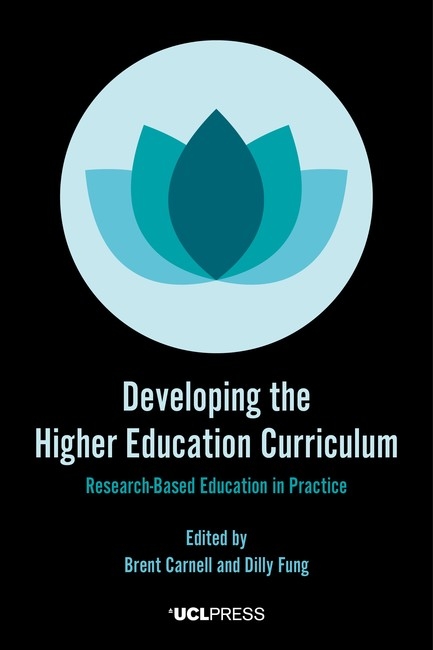
Developing the Higher Education Curriculum (eBook)
A complementary volume to Dilly Fung's A Connected Curriculum for Higher Education (2017), this book explores 'research-based education' as applied in practice within the higher education sector. A collection of 15 chapters followed by illustrative vignettes, it showcases approaches to engaging students actively with research and enquiry across disciplines. It begins with one institution's creative approach to research-based education - UCL's Connected Curriculum, a conceptual framework for integrating research-based education into all taught programmes of study - and branches out to show how aspects of the framework can apply to practice across a variety of institutions in a range of national settings.The 15 chapters are provided by a diverse range of authors who all explore research-based education in their own way. Some chapters are firmly based in a subject-discipline - including art history, biochemistry, education, engineering, fashion and design, healthcare, and veterinary sciences - while others reach across geopolitical regions, such as Australia, Canada, China, England, Scotland and South Africa. The final chapter offers 12 short vignettes of practice to highlight how engaging students with research and enquiry can enrich their learning experiences, preparing them not only for more advanced academic learning, but also for professional roles in complex, rapidly changing social contexts.
lt;p>Brent Carnell is Senior Teaching Fellow at both the Arena Centre for Research-based Education and the Bartlett School of Architecture, UCL. His research interests are varied, and he has published in journals such as Assessment & Evaluation in Higher Education, Geographical Research and Gender, Place and Culture, and edited volumes such as Sexuality and Gender at Home.
Dilly Fung is Professor of Higher Education Development and Academic Director of the Arena Centre for Research-Based Education at UCL. Drawing on her long career as an educator in both further and higher education, she leads a team that focuses on advancing research-based education at UCL and beyond. Fung also speaks regularly across the UK and internationally about research-based education.
Editors’ introduction: Developing the higher education curriculum:
Research-based education in practice
Brent Carnell and Dilly Fung
1. Cultivating student expectations of a research-informed
curriculum: Developing and promoting pedagogic resonance
in the undergraduate student learning pathway
Corony Edwards and Mike McLinden, with Sarah Cooper, Helen
Hewertson, Emma Kelly, David Sands and Alison Stokes
2. Development of a connected curriculum in biochemistry
at a large, research-intensive university in Canada
Rachel E. Milner
3. Inspiring learning through research and enquiry: The Summer
Undergraduate Research Fellowship (SURF) at Xi’an JiaotongLiverpool
University (XJTLU)
James Wilson, Yao Wu, Jianmei Xie, Dawn Johnson
and Henk Huijser
4. The materials of life: Making meaning through object-based
learning in twenty-first century higher education
Thomas Kador, Helen Chatterjee and Leonie Hannan
5. Foundation skills for veterinary medical research
Sharon Boyd, Andrew Gardiner, Claire Phillips, Jessie
Paterson, Carolyn Morton, Fiona J. L. Brown and Iain J. Robbé
6. Connecting the curriculum with the iGEM student research
competition
Darren N. Nesbeth
7. Curating connections in the art history curriculum
Nicholas Grindle and Ben Thomas
8. Developing online resources to support student research
theses and dissertations: Evidence from the EdD at the UCL
Institute of Education
Denise Hawkes
9. Connected disciplinary responses to the call to decolonise
curricula in South African higher education
Lynn Quinn and Jo-Anne Vorster
10. Connecting research and teaching through curricular
and pedagogic design: From theory to practice
Elizabeth Cleaver and Derek Wills, with Sinead Gormally,
David Grey, Colin Johnson and Julie Rippingale
11. Connecting research, enquiry and communities in
the creative curriculum
Alison James
12. Interprofessional education development at Leeds: Making
connections between different healthcare students, staff,
universities, and clinical settings
Shelley Fielden and Alison Ledger
13. Digital education and the Connected Curriculum: Towards
a connected learning environment
Eileen Kennedy, Tim Neumann, Steve Rowett
and Fiona Strawbridge
14. Connecting students and staff for teaching and learning
enquiry: The McMaster Student Partners Programme
Elizabeth Marquis, Zeeshan Haqqee, Sabrina Kirby,
Alexandra Liu, Varun Puri, Robert Cockcroft, Lori Goff and
Kris Knorr
15. A jigsaw model for student partnership through research
and teaching in small-group engineering classes
Chris Browne
16. Vignettes of current practice
A. Learning through research and enquiry: A graduate
certificate for working professionals – a research-based
education, with flexibility and online learning
Gwyneth Hughes
B. Using social media to equip students with research skills to
improve stakeholder engagement in the energy and resources sector
Craig Styan
C. Developing students’ understanding of historical practice
through connections with the university’s research
Edward Coleman
D. Speech and Language Therapy students learn through
scaffolded research development and turn their final dissertations into a journal article
Rachael-Anne Knight
E. Designing a throughline and a research-culture in Biochemistry
Andrea Townsend-Nicholson
F. A throughline of research in a music programme
Louise Jackson
G. History students researching their university
and engaging an audience
Charlotte Behr
H. E-portfolio assessments: Creating connections
Panos Vlachopoulos
I. Using graduate attributes to link academic learning
with the world of work
Susan Smith
J. An Alumni Mentoring Network enabling student
connections with alumni and career mentoring
Mark De Freitas
K. Student–staff partnerships: Students partnering with
staff to improve education
Jenny Marie
L. Establishing an individual and peer coaching support
network for an MSc dissertation in Voluntary Sector Policy
and Management in UCL’s School of Public Policy
Sarabajaya Kumar
Afterword
Brent Carnell and Dilly Fung
| Erscheint lt. Verlag | 13.11.2017 |
|---|---|
| Verlagsort | London |
| Sprache | englisch |
| Themenwelt | Schulbuch / Wörterbuch ► Schulbuch / Allgemeinbildende Schulen |
| Sozialwissenschaften ► Pädagogik ► Allgemeines / Lexika | |
| Sozialwissenschaften ► Pädagogik ► Bildungstheorie | |
| Sozialwissenschaften ► Pädagogik ► Erwachsenenbildung | |
| Schlagworte | connected curriculum • Curricula • Curriculum • curriculum, higher education, UCL, research and education, curricula, learning, real-world learning, connected curriculum, philosophical hermeneutics, educational values, diversity, student values, research groups, teaching departments, learning communities, research-based education, research engagement • Diversity • educational values • higher education • learning • Learning Communities • Philosophical Hermeneutics • real-world learning • Research and Education • research-based education • research engagement • Research groups • student values • teaching departments • UCL |
| ISBN-13 | 9781787350908 / 9781787350908 |
| Informationen gemäß Produktsicherheitsverordnung (GPSR) | |
| Haben Sie eine Frage zum Produkt? |
 EPUB (Adobe DRM)
Kopierschutz: Adobe-DRM
Adobe-DRM ist ein Kopierschutz, der das eBook vor Mißbrauch schützen soll. Dabei wird das eBook bereits beim Download auf Ihre persönliche Adobe-ID autorisiert. Lesen können Sie das eBook dann nur auf den Geräten, welche ebenfalls auf Ihre Adobe-ID registriert sind.
Details zum Adobe-DRM
Dateiformat: EPUB (Electronic Publication)
EPUB ist ein offener Standard für eBooks und eignet sich besonders zur Darstellung von Belletristik und Sachbüchern. Der Fließtext wird dynamisch an die Display- und Schriftgröße angepasst. Auch für mobile Lesegeräte ist EPUB daher gut geeignet.
Systemvoraussetzungen:
PC/Mac: Mit einem PC oder Mac können Sie dieses eBook lesen. Sie benötigen eine
eReader: Dieses eBook kann mit (fast) allen eBook-Readern gelesen werden. Mit dem amazon-Kindle ist es aber nicht kompatibel.
Smartphone/Tablet: Egal ob Apple oder Android, dieses eBook können Sie lesen. Sie benötigen eine
Geräteliste und zusätzliche Hinweise
Buying eBooks from abroad
For tax law reasons we can sell eBooks just within Germany and Switzerland. Regrettably we cannot fulfill eBook-orders from other countries.
aus dem Bereich