Selling Hope and College (eBook)
240 Seiten
Ilr Press (Verlag)
978-1-5017-0839-8 (ISBN)
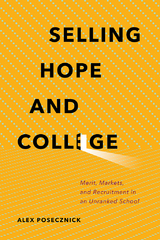
Posecznick documents what it takes to keep a "mediocre" college open and running, and the struggles, tensions, and battles that members of the community tangle with daily as they carefully walk the line between empowering marginalized students and exploiting them.
It has long been assumed that college admission should be a simple matter of sorting students according to merit, with the best heading off to the Ivy League and highly ranked liberal arts colleges and the rest falling naturally into their rightful places. Admission to selective institutions, where extremely fine distinctions are made, is characterized by heated public debates about whether standardized exams, high school transcripts, essays, recommendation letters, or interviews best indicate which prospective students are "worthy."And then there is college for everyone else. But what goes into less-selective college admissions in an era when everyone feels compelled to go, regardless of preparation or life goals? "Ravenwood College," where Alex Posecznick spent a year doing ethnographic research, was a small, private, nonprofit institution dedicated to social justice and serving traditionally underprepared students from underrepresented minority groups. To survive in the higher education marketplace, the college had to operate like a business and negotiate complex categories of merit while painting a hopeful picture of the future for its applicants. Selling Hope and College is a snapshot of a particular type of institution as it goes about the business of producing itself and justifying its place in the market. Admissions staff members were burdened by low enrollments and worked tirelessly to fill empty seats, even as they held on to the institution's special spirit. Posecznick documents what it takes to keep a "mediocre" institution open and running, and the struggles, tensions, and battles that members of the community tangle with daily as they carefully walk the line between empowering marginalized students and exploiting them.
It has long been assumed that college admission should be a simple matter of sorting students according to merit, with the best heading off to the Ivy League and highly ranked liberal arts colleges and the rest falling naturally into their rightful places. Admission to selective institutions, where extremely fine distinctions are made, is characterized by heated public debates about whether standardized exams, high school transcripts, essays, recommendation letters, or interviews best indicate which prospective students are "worthy."
And then there is college for everyone else. But what goes into less-selective college admissions in an era when everyone feels compelled to go, regardless of preparation or life goals? "Ravenwood College," where Alex Posecznick spent a year doing ethnographic research, was a small, private, nonprofit institution dedicated to social justice and serving traditionally underprepared students from underrepresented minority groups. To survive in the higher education marketplace, the college had to operate like a business and negotiate complex categories of merit while painting a hopeful picture of the future for its applicants. Selling Hope and College is a snapshot of a particular type of institution as it goes about the business of producing itself and justifying its place in the market. Admissions staff members were burdened by low enrollments and worked tirelessly to fill empty seats, even as they held on to the institution's special spirit. Posecznick documents what it takes to keep a "mediocre" institution open and running, and the struggles, tensions, and battles that members of the community tangle with daily as they carefully walk the line between empowering marginalized students and exploiting them.
An anthropologist by training, Alex Posecznick manages the programs in Education, Culture, and Society, and International Education Development at the University of Pennsylvania’s Graduate School of Education, where he also serves as a member of the Associated Faculty.
Introduction: An Uncertain Beginning1. Extraordinary Mediocrity2. How to Sell Hope and Mobility3. It's All about the Numbers4. Being a "Real" College in America5. Financing Education and the Crisis of SustainabilityConclusion: Whither Ravenwood College?
| Erscheint lt. Verlag | 25.4.2017 |
|---|---|
| Verlagsort | Ithaca |
| Sprache | englisch |
| Maße | 150 x 150 mm |
| Themenwelt | Schulbuch / Wörterbuch ► Lernhilfen ► Sekundarstufe I |
| Sozialwissenschaften ► Ethnologie | |
| Sozialwissenschaften ► Pädagogik ► Erwachsenenbildung | |
| Sozialwissenschaften ► Soziologie ► Makrosoziologie | |
| Schlagworte | education, college admission, higher education, mediocrity in higher education, ethnographic research, educational institute ranking systems, meritocracy |
| ISBN-10 | 1-5017-0839-2 / 1501708392 |
| ISBN-13 | 978-1-5017-0839-8 / 9781501708398 |
| Informationen gemäß Produktsicherheitsverordnung (GPSR) | |
| Haben Sie eine Frage zum Produkt? |
 EPUB (Adobe DRM)
Kopierschutz: Adobe-DRM
Adobe-DRM ist ein Kopierschutz, der das eBook vor Mißbrauch schützen soll. Dabei wird das eBook bereits beim Download auf Ihre persönliche Adobe-ID autorisiert. Lesen können Sie das eBook dann nur auf den Geräten, welche ebenfalls auf Ihre Adobe-ID registriert sind.
Details zum Adobe-DRM
Dateiformat: EPUB (Electronic Publication)
EPUB ist ein offener Standard für eBooks und eignet sich besonders zur Darstellung von Belletristik und Sachbüchern. Der Fließtext wird dynamisch an die Display- und Schriftgröße angepasst. Auch für mobile Lesegeräte ist EPUB daher gut geeignet.
Systemvoraussetzungen:
PC/Mac: Mit einem PC oder Mac können Sie dieses eBook lesen. Sie benötigen eine
eReader: Dieses eBook kann mit (fast) allen eBook-Readern gelesen werden. Mit dem amazon-Kindle ist es aber nicht kompatibel.
Smartphone/Tablet: Egal ob Apple oder Android, dieses eBook können Sie lesen. Sie benötigen eine
Geräteliste und zusätzliche Hinweise
Buying eBooks from abroad
For tax law reasons we can sell eBooks just within Germany and Switzerland. Regrettably we cannot fulfill eBook-orders from other countries.
aus dem Bereich