Cornell '69 (eBook)
384 Seiten
Cornell University Press (Verlag)
978-0-8014-6612-0 (ISBN)
In April 1969, one of America's premier universities was celebrating parents' weekend—and the student union was an armed camp, occupied by over eighty defiant members of the campus's Afro-American Society. Marching out Sunday night, the protesters...
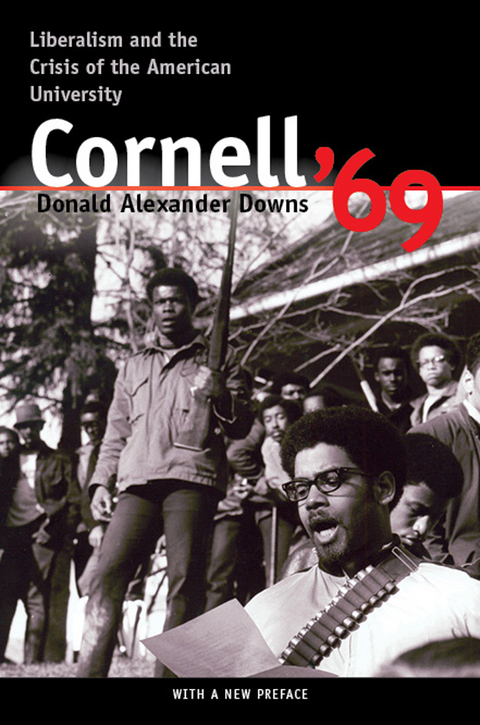
In April 1969, one of America's premier universities was celebrating parents' weekend—and the student union was an armed camp, occupied by over eighty defiant members of the campus's Afro-American Society. Marching out Sunday night, the protesters brandished rifles, their maxim: "If we die, you are going to die." Cornell '69 is an electrifying account of that weekend which probes the origins of the drama and describes how it was played out not only at Cornell but on campuses across the nation during the heyday of American liberalism.
Donald Alexander Downs tells the story of how Cornell University became the battleground for the clashing forces of racial justice, intellectual freedom, and the rule of law. Eyewitness accounts and retrospective interviews depict the explosive events of the day and bring the key participants into sharp focus: the Afro-American Society, outraged at a cross-burning incident on campus and demanding amnesty for its members implicated in other protests; University President James A. Perkins, long committed to addressing the legacies of racism, seeing his policies backfire and his career collapse; the faculty, indignant at the university's surrender, rejecting the administration's concessions, then reversing itself as the crisis wore on.
The weekend's traumatic turn of events is shown by Downs to be a harbinger of the debates raging today over the meaning of the university in American society. He explores the fundamental questions it posed, questions Americans on and off campus are still struggling to answer: What is the relationship between racial justice and intellectual freedom? What are the limits in teaching identity politics? And what is the proper meaning of the university in a democratic polity?
In April 1969, one of America's premier universities was celebrating parents' weekend—and the student union was an armed camp, occupied by over eighty defiant members of the campus's Afro-American Society. Marching out Sunday night, the protesters brandished rifles, their maxim: "If we die, you are going to die." Cornell '69 is an electrifying account of that weekend which probes the origins of the drama and describes how it was played out not only at Cornell but on campuses across the nation during the heyday of American liberalism.Donald Alexander Downs tells the story of how Cornell University became the battleground for the clashing forces of racial justice, intellectual freedom, and the rule of law. Eyewitness accounts and retrospective interviews depict the explosive events of the day and bring the key participants into sharp focus: the Afro-American Society, outraged at a cross-burning incident on campus and demanding amnesty for its members implicated in other protests; University President James A. Perkins, long committed to addressing the legacies of racism, seeing his policies backfire and his career collapse; the faculty, indignant at the university's surrender, rejecting the administration's concessions, then reversing itself as the crisis wore on. The weekend's traumatic turn of events is shown by Downs to be a harbinger of the debates raging today over the meaning of the university in American society. He explores the fundamental questions it posed, questions Americans on and off campus are still struggling to answer: What is the relationship between racial justice and intellectual freedom? What are the limits in teaching identity politics? And what is the proper meaning of the university in a democratic polity?
DONALD ALEXANDER DOWNS, an undergraduate at Cornell during the uprising, is the Alexander Meiklejohn Professor of Political Science, Law, and Journalism and the Glenn B. and Cleone Orr Hawkins Professor of Political Science at the University of Wisconsin–Madison. His other books include More than Victims and Restoring Free Speech and Liberty on Campus.
Preface to the 2012 Paperback Edition1. Overview of the CrisisPart I. The Road to Straight
2. Student Militancy
3. The Rise of Racial Politics
4. Racial Justice versus Academic Freedom
5. Separation or Integration?
6. Progress or Impasse?
7. Liberal Justice or RacismPart II. The Straight Crisis
8. Day 1: The Takeover and the Arming of the Campus
9. Day 2: The Deal
10. Day 3: A "Revolutionary Situation"
11. Day 4: Student Power
12. Day 5: A New OrderPart III. The Aftermath
13. Reform, Reaction, and Resignation
14. Cornell and the Failure of LiberalismChronology
Participants
Notes
Index
| Erscheint lt. Verlag | 24.1.2014 |
|---|---|
| Zusatzinfo | 25 halftones |
| Verlagsort | Ithaca |
| Sprache | englisch |
| Maße | 160 x 160 mm |
| Themenwelt | Schulbuch / Wörterbuch ► Lernhilfen ► Sekundarstufe I |
| Schulbuch / Wörterbuch ► Schulbuch / Allgemeinbildende Schulen | |
| Geschichte ► Teilgebiete der Geschichte ► Kulturgeschichte | |
| Sozialwissenschaften ► Ethnologie | |
| Sozialwissenschaften ► Pädagogik ► Erwachsenenbildung | |
| Sozialwissenschaften ► Politik / Verwaltung ► Politische Systeme | |
| Sozialwissenschaften ► Politik / Verwaltung ► Politische Theorie | |
| Sozialwissenschaften ► Soziologie | |
| Schlagworte | history of education, academia and society, power politics in education, educational racism, cornell uprising, cornell protests, intellectual honesty, afro american society cornell |
| ISBN-10 | 0-8014-6612-1 / 0801466121 |
| ISBN-13 | 978-0-8014-6612-0 / 9780801466120 |
| Informationen gemäß Produktsicherheitsverordnung (GPSR) | |
| Haben Sie eine Frage zum Produkt? |
 EPUB (Adobe DRM)
Kopierschutz: Adobe-DRM
Adobe-DRM ist ein Kopierschutz, der das eBook vor Mißbrauch schützen soll. Dabei wird das eBook bereits beim Download auf Ihre persönliche Adobe-ID autorisiert. Lesen können Sie das eBook dann nur auf den Geräten, welche ebenfalls auf Ihre Adobe-ID registriert sind.
Details zum Adobe-DRM
Dateiformat: EPUB (Electronic Publication)
EPUB ist ein offener Standard für eBooks und eignet sich besonders zur Darstellung von Belletristik und Sachbüchern. Der Fließtext wird dynamisch an die Display- und Schriftgröße angepasst. Auch für mobile Lesegeräte ist EPUB daher gut geeignet.
Systemvoraussetzungen:
PC/Mac: Mit einem PC oder Mac können Sie dieses eBook lesen. Sie benötigen eine
eReader: Dieses eBook kann mit (fast) allen eBook-Readern gelesen werden. Mit dem amazon-Kindle ist es aber nicht kompatibel.
Smartphone/Tablet: Egal ob Apple oder Android, dieses eBook können Sie lesen. Sie benötigen eine
Geräteliste und zusätzliche Hinweise
Buying eBooks from abroad
For tax law reasons we can sell eBooks just within Germany and Switzerland. Regrettably we cannot fulfill eBook-orders from other countries.
aus dem Bereich