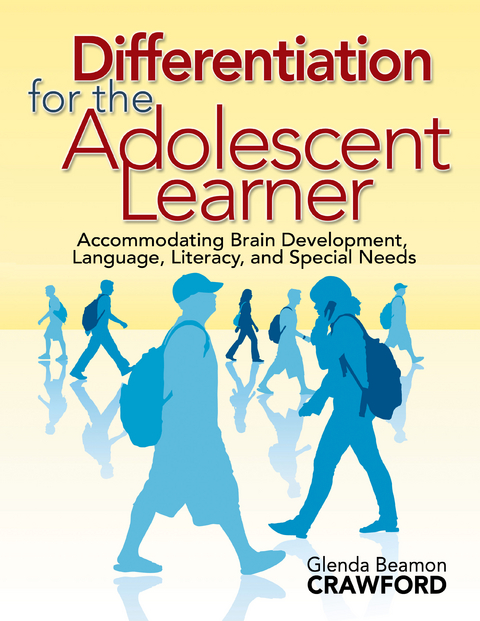
Differentiation for the Adolescent Learner (eBook)
184 Seiten
Corwin (Verlag)
978-1-4522-9412-4 (ISBN)
Foreword by David H. Reilly
Acknowledgments
About the Author
Introduction and Overview
1. Differentiation and the Learning Brain
It′s All About Good Teaching Practice
The Learning Brain
Universal Design for Learning (UDL)
Cognitive Access for Learning
Evolving Conversations About Differentiation
Developmentally Responsive Differentiation
The Language of Differentiation
Content Differentiation
Process Differentiation
Product Differentiation
Powerful Learning Experiences
Differentiation Design Principles
Summary and Looking Ahead
2. Differentiation and Adolescent Development
Adolescent Development
Adolescents as Learners
Personal Connection
Emotional Engagement
Appropriate Intellectual Challenge
Purposeful Social Interaction
Metacognitive Development
A Supportive Learning Environment
A Prime Time for Learning
Brain-Compatible Instruction: A Summary
Summary and Looking Ahead
3. Adolescent-Centered Differentiation: Evaluation, Expectation, Engagement, and Exploration
Start With the Students
A Curriculum of Consequence
Getting and Keeping Their Attention
Flexigle Opportunities for Interaction
Summary and Looking Ahead
4. Metacognitive Extension in Adolescent-Centered Differentiation
The Power of Adolescent Metacognition
Cognitive Modeling
Metacognitive Coaching
Guided Metacognitive Inquiry
Teaching for Transfer
Differentiation in PBL: Two Examples
Summary and Looking Ahead
5. A Differentiated Learning Environment: The Affective, Social-Emotional, and Physical Dimensions
Invitations to Learn
The Social Dimension of the Learning Environment
Varying the Physical Environment
Managing the Differentiated Learning Environment
Summary and Looking Ahead
6. The Intellectual Dimension in the Differentiated Environment
The Intellectual Dimension of the Learning Environment
Interaction in the Differentiated Learning Environment
The New Geography of Learning
Summary and Looking Ahead
7. Learning Patterns and Profiles
Patterns of Responsive Teaching
Determining Student Variance
Clusters of Commonality
Cluster 1: Gifted or Advanced Learners
Cluster 2: English Language Learners (ELL)
Cluster Group 3: Students With Learning Challenges
Summary and Looking Ahead
Epilogue: A Shared Commitment to Equity
Project-Based Learning
In Conclusion
Glossary of Adolescent-Centered Differentiation Terminology
References
Index
| Erscheint lt. Verlag | 22.5.2008 |
|---|---|
| Verlagsort | Thousand Oaks |
| Sprache | englisch |
| Themenwelt | Schulbuch / Wörterbuch ► Unterrichtsvorbereitung |
| Sozialwissenschaften ► Pädagogik ► Didaktik | |
| Sozialwissenschaften ► Pädagogik ► Schulpädagogik / Sekundarstufe I+II | |
| Schlagworte | adolescent brain • Adolescent Development • Brain-Based Teaching • Cognitive Functioning • cognitive strategies • collaborative inquiry • Culminating student assessment • Diagnostic student assessment • ELL • English Language Learners • Formative student assessment • Inclusive Education • learning brain • Learning Community • Learning environment • Metacognition • Metacognitive coaching • Metacognitive development • middle school • Neuroscience • student assessment • Teaching methods • UDL Model |
| ISBN-10 | 1-4522-9412-7 / 1452294127 |
| ISBN-13 | 978-1-4522-9412-4 / 9781452294124 |
| Informationen gemäß Produktsicherheitsverordnung (GPSR) | |
| Haben Sie eine Frage zum Produkt? |
 EPUB (Adobe DRM)
Kopierschutz: Adobe-DRM
Adobe-DRM ist ein Kopierschutz, der das eBook vor Mißbrauch schützen soll. Dabei wird das eBook bereits beim Download auf Ihre persönliche Adobe-ID autorisiert. Lesen können Sie das eBook dann nur auf den Geräten, welche ebenfalls auf Ihre Adobe-ID registriert sind.
Details zum Adobe-DRM
Dateiformat: EPUB (Electronic Publication)
EPUB ist ein offener Standard für eBooks und eignet sich besonders zur Darstellung von Belletristik und Sachbüchern. Der Fließtext wird dynamisch an die Display- und Schriftgröße angepasst. Auch für mobile Lesegeräte ist EPUB daher gut geeignet.
Systemvoraussetzungen:
PC/Mac: Mit einem PC oder Mac können Sie dieses eBook lesen. Sie benötigen eine
eReader: Dieses eBook kann mit (fast) allen eBook-Readern gelesen werden. Mit dem amazon-Kindle ist es aber nicht kompatibel.
Smartphone/Tablet: Egal ob Apple oder Android, dieses eBook können Sie lesen. Sie benötigen eine
Geräteliste und zusätzliche Hinweise
Buying eBooks from abroad
For tax law reasons we can sell eBooks just within Germany and Switzerland. Regrettably we cannot fulfill eBook-orders from other countries.
aus dem Bereich