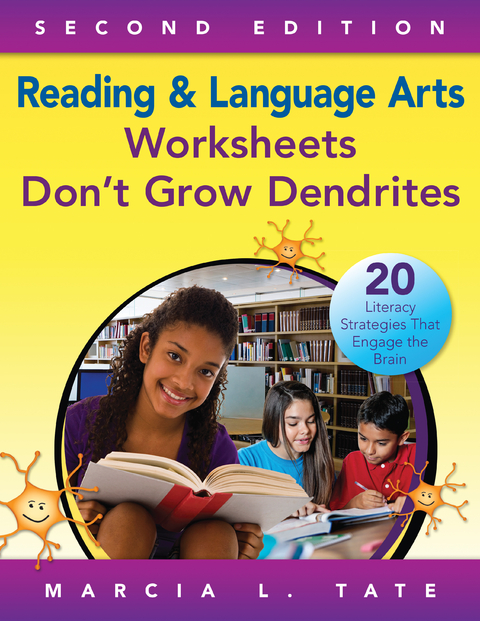
Reading and Language Arts Worksheets Don′t Grow Dendrites (eBook)
200 Seiten
Corwin (Verlag)
978-1-4522-8024-0 (ISBN)
Acknowledgments
About the Author
Introduction
Strategy 1: Brainstorming and Discussion
What: Defining the Strategy
Why: Theoretical Framework
How: Instructional Activities
Reflection and Application
Strategy 2: Drawing and Artwork
What: Defining the Strategy
Why: Theoretical Framework
How: Instructional Activities
Reflection and Application
Strategy 3: Field Trips
What: Defining the Strategy
Why: Theoretical Framework
How: Instructional Activities
Reflection and Application
Strategy 4: Games
What: Defining the Strategy
Why: Theoretical Framework
How: Instructional Activities
Reflection and Application
Strategy 5: Graphic Organizers, Semantic Maps, and Word Webs
What: Defining the Strategy
Why: Theoretical Framework
How: Instructional Activities
Reflection and Application
Strategy 6: Humor
What: Defining the Strategy
Why: Theoretical Framework
How: Instructional Activities
Reflection and Application
Strategy 7: Manipulatives, Experiments, Labs, and Models
What: Defining the Strategy
Why: Theoretical Framework
How: Instructional Activities
Reflection and Application
Strategy 8: Metaphors, Analogies, and Similes
What: Defining the Strategy
Why: Theoretical Framework
How: Instructional Activities
Reflection and Application
Strategy 9: Mnemonic Devices
What: Defining the Strategy
Why: Theoretical Framework
How: Instructional Activities
Reflection and Application
Strategy 10: Movement
What: Defining the Strategy
Why: Theoretical Framework
How: Instructional Activities
Reflection and Application
Strategy 11: Music, Rhythm, Rhyme, and Rap
What: Defining the Strategy
Why: Theoretical Framework
How: Instructional Activities
Reflection and Application
Strategy 12: Project-Based and Problem-Based Instruction
What: Defining the Strategy
Why: Theoretical Framework
How: Instructional Activities
Reflection and Application
Strategy 13: Reciprocal Teaching and Cooperative Learning
What: Defining the Strategy
Why: Theoretical Framework
How: Instructional Activities
Reflection and Application
Strategy 14: Role Plays, Drama, Pantomimes, and Charades
What: Defining the Strategy
Why: Theoretical Framework
How: Instructional Activities
Reflection and Application
Strategy 15: Storytelling
What: Defining the Strategy
Why: Theoretical Framework
How: Instructional Activities
Reflection and Application
Strategy 16: Technology
What: Defining the Strategy
Why: Theoretical Framework
How: Instructional Activities
Reflection and Application
Strategy 17: Visualization and Guided Imagery
What: Defining the Strategy
Why: Theoretical Framework
How: Instructional Activities
Reflection and Application
Strategy 18: Visuals
What: Defining the Strategy
Why: Theoretical Framework
How: Instructional Activities
Reflection and Application
Strategy 19: Work Study and Apprenticeships
What: Defining the Strategy
Why: Theoretical Framework
How: Instructional Activities
Reflection and Application
Strategy 20: Writing and Journals
What: Defining the Strategy
Why: Theoretical Framework
How: Instructional Activities
Reflection and Application
Resource A: Brain-Compatible Lesson Design
Resource B: Graphic Organizers
Bibliography
Index
| Erscheint lt. Verlag | 5.11.2013 |
|---|---|
| Verlagsort | Thousand Oaks |
| Sprache | englisch |
| Themenwelt | Schulbuch / Wörterbuch ► Schulbuch / Allgemeinbildende Schulen |
| Schulbuch / Wörterbuch ► Wörterbuch / Fremdsprachen | |
| Geisteswissenschaften ► Sprach- / Literaturwissenschaft ► Anglistik / Amerikanistik | |
| Geisteswissenschaften ► Sprach- / Literaturwissenschaft ► Sprachwissenschaft | |
| Sozialwissenschaften ► Pädagogik ► Schulpädagogik / Grundschule | |
| Schlagworte | brain • Brain-based literacy • Reading Comprehension • Reading fluency • reading strategies • vocabulary |
| ISBN-10 | 1-4522-8024-X / 145228024X |
| ISBN-13 | 978-1-4522-8024-0 / 9781452280240 |
| Informationen gemäß Produktsicherheitsverordnung (GPSR) | |
| Haben Sie eine Frage zum Produkt? |
 EPUB (Adobe DRM)
Kopierschutz: Adobe-DRM
Adobe-DRM ist ein Kopierschutz, der das eBook vor Mißbrauch schützen soll. Dabei wird das eBook bereits beim Download auf Ihre persönliche Adobe-ID autorisiert. Lesen können Sie das eBook dann nur auf den Geräten, welche ebenfalls auf Ihre Adobe-ID registriert sind.
Details zum Adobe-DRM
Dateiformat: EPUB (Electronic Publication)
EPUB ist ein offener Standard für eBooks und eignet sich besonders zur Darstellung von Belletristik und Sachbüchern. Der Fließtext wird dynamisch an die Display- und Schriftgröße angepasst. Auch für mobile Lesegeräte ist EPUB daher gut geeignet.
Systemvoraussetzungen:
PC/Mac: Mit einem PC oder Mac können Sie dieses eBook lesen. Sie benötigen eine
eReader: Dieses eBook kann mit (fast) allen eBook-Readern gelesen werden. Mit dem amazon-Kindle ist es aber nicht kompatibel.
Smartphone/Tablet: Egal ob Apple oder Android, dieses eBook können Sie lesen. Sie benötigen eine
Geräteliste und zusätzliche Hinweise
Buying eBooks from abroad
For tax law reasons we can sell eBooks just within Germany and Switzerland. Regrettably we cannot fulfill eBook-orders from other countries.
aus dem Bereich