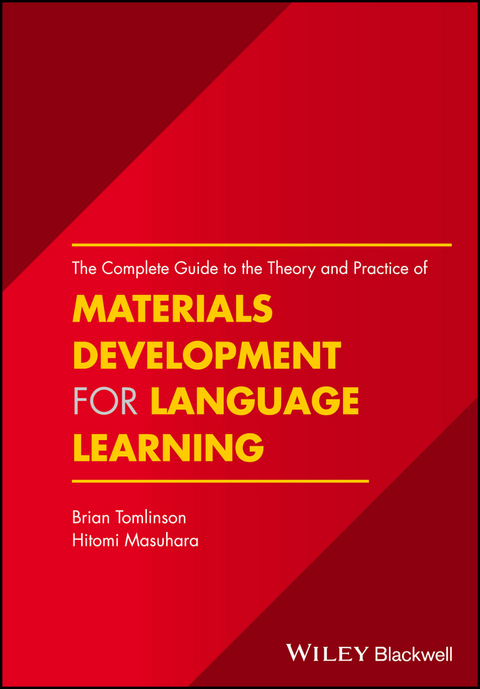
The Complete Guide to the Theory and Practice of Materials Development for Language Learning (eBook)
John Wiley & Sons (Verlag)
978-1-119-05498-6 (ISBN)
The Complete Guide to the Theory and Practice of Materials Development for Language Learning provides undergraduate and graduate-level students in applied linguistics and TESOL, researchers, materials developers, and teachers with everything they need to know about the latest theory and practice of language learning materials development for all media.
The past two decades have seen historic change in the field of language learning materials development. The four main drivers of that change include a shift in emphasis from materials for language teaching to language learning; evidenced-based development; the huge increase in digital delivery technologies; and the wedding of materials developed for the learning of English with those for other second or foreign languages.
Timely, authoritative, and global in scope, this text represents the ideal resource for all those studying and working in the field of language learning.
Brian Tomlinson, PhD is TESOL Professor at Anaheim University, California, a Chair Professor at Shanghai International Studies University and a Visiting Professor at the University of Liverpool. He is the Founder and President of MATSDA, an association dedicated to the bringing together of researchers, writers, publishers, and teachers to facilitate the development of effective language learning materials. He has over one hundred publications, including SLA Theory and Materials Development for Language Learning (2016), Developing Materials for Language Teaching (2014), Applied Linguistics and Materials Development (2013), Materials Development in Language Teaching (2011), and Research for Materials Development in Language Learning (2010, with Hitomi Masuhara).
Hitomi Masuhara, PhD is Lecturer at the University of Liverpool and a Fellow of the Higher Education Academy. She is a founding member and Secretary of MATSDA, and has authored many books, book chapters, and articles. She has worked in Japan, Oman, Singapore and the UK, has been involved in numerous international projects, and has given plenary presentations and workshops in more than 30 countries. Her recent publications include Materials and Methods in ELT: A Teacher's Guide, Third Edition (2013, with Jo McDonough and Christopher Shaw) and Practice and Theory for Materials Development in Second Language Learning (2017, with Freda Mishan and Brian Tomlinson).
Brian Tomlinson, PhD is TESOL Professor at Anaheim University, California, a Chair Professor at Shanghai International Studies University and a Visiting Professor at the University of Liverpool. He is the Founder and President of MATSDA, an association dedicated to the bringing together of researchers, writers, publishers, and teachers to facilitate the development of effective language learning materials. He has over one hundred publications, including SLA Theory and Materials Development for Language Learning (2016), Developing Materials for Language Teaching (2014), Applied Linguistics and Materials Development (2013), Materials Development in Language Teaching (2011), and Research for Materials Development in Language Learning (2010, with Hitomi Masuhara). Hitomi Masuhara, PhD is Lecturer at the University of Liverpool and a Fellow of the Higher Education Academy. She is a founding member and Secretary of MATSDA, and has authored many books, book chapters, and articles. She has worked in Japan, Oman, Singapore and the UK, has been involved in numerous international projects, and has given plenary presentations and workshops in more than 30 countries. Her recent publications include Materials and Methods in ELT: A Teacher's Guide, Third Edition (2013, with Jo McDonough and Christopher Shaw) and Practice and Theory for Materials Development in Second Language Learning (2017, with Freda Mishan and Brian Tomlinson).
Preface vii
1 Materials Development So Far 1
2 Issues in Materials Development 25
3 Materials Evaluation 52
4 Materials Adaptation 82
5 The Development of Materials 117
6 The Process of Publishing Coursebooks 145
7 Developing Digital Materials 171
8 Developing Materials for the Acquisition of Language 189
9 Developing Materials for the Development of Skills 220
10 Developing Materials for Young Learners 246
11 Developing Materials for Teenagers and Adults 270
12 Developing Materials for Different Levels, Users, and Purposes 291
13 Visuals, Layout, and Design 325
14 Writing Instructions for Language-Learning Activities 342
15 Materials Development Research 355
Conclusion 389
Resources Useful for Materials Developers 391
Index 399
"This thought-provoking and resourceful book will be of great help for teachers, publishers, and researchers interested in materials development. In addition to informing the reader about historical tradition, providing the results of the latest empirical findings, and summarizing the existing trends in materials development, the authors voice their own beliefs coming from their many years of personal and professional experience." - LINGUIST LIST, June 2019
"Everyone in this profession needs a copy of this book at hand to consult in their everyday working lives, be they teachers, teacher trainers, directors of study or publishers. The language in the book is accessible and the book will prove useful for those new to materials development as well as those who have been developing and adapting materials for years but who perhaps have not thought about it concisely as a distinct activity." - Naeema B. Han, Leeds Beckett University, UK, Folio 18/2 September 2018
"All in all, the book is informative and inspiring, and it is worthy of a thorough study by practitioners and esearchers who are interested in materials development, L1 and L2 acquisition, language teaching, curriculum design, language testing and teacher education." - System, Volume 87 (December 2019) Article 102160
1
Materials Development So Far
Introduction
Materials Development
The term “materials development” is used in this book to refer to all the different processes in the development and use of materials for language learning and teaching. “Such processes include materials evaluation, materials adaptation, materials design, materials production, materials exploitation and materials research.” All of these processes are important and should ideally “interact in the making of any materials designed to help learners to acquire a language” (Tomlinson, 2012, pp. 143–144).
As well as being the practical undertaking described above, materials development has also become, since the mid-1990s, a popular field of academic study that investigates the principles and procedures of the design, writing, implementation, and evaluation of materials. “Ideally these two aspects of materials development are interactive in that the theoretical studies inform, and are informed by, the actual development and use of learning materials” (Tomlinson, 2001, p. 66). This is true of many recent publications about materials development, for example Tomlinson (2008, 2010a, 2011, 2013a, 2013c, 2015, 2016a), Mukundan (2009), Harwood (2010a, 2014), Tomlinson and Masuhara (2010), McDonough, Shaw, and Masuhara (2013), McGrath (2013, 2016), Garton and Graves (2014), Mishan and Timmis (2015), Masuhara, Mishan, and Tomlinson (2017), and Maley and Tomlinson (in press). Nearly all the writers in these books are both practitioners and researchers and their focus is on the theoretical principles and the practical realizations of materials development. The interaction between theory and practice and between practice and theory is also a deliberately distinctive feature of The complete guide to the theory and practice of materials development for language learning. Like the other writers referred to above, we have both worked on many coursebooks, supplementary books and web materials (for example, for Bulgaria, China, Ethiopia, Japan, Morocco, Namibia, Nigeria, Singapore, Zambia and the global market), we have worked on many research projects, and we have published many articles and books on theoretical and practical aspects of materials development.
Materials
There are many different definitions of what language-learning materials are. For example, “any systematic description of the techniques and exercises to be used in classroom teaching” (Brown, 1995, p. 139). Many of these definitions focus on exercises for teaching (as Brown's definition does). We prefer to focus on materials for learning and the definition we are using for this book is that materials are anything that can be used by language learners to facilitate their learning of the target language. So materials could be a coursebook, a CD ROM, a story, a song, a video, a cartoon, a dictionary, a mobile phone interaction, a lecture, or even a photograph used to stimulate a discussion. They could also be an exercise, an activity, a task, a presentation, or even a project.
Materials can be informative (in that they inform the learner about the target language), instructional (in that they guide the learner to practice the language), experiential (in that they provide the learner with experience of the language in use), eliciting (in that they encourage the learner to use the language) or exploratory (in that they help the learner to make discoveries about the language). (Tomlinson, 2012, p. 143)
Since L2 language teaching began, the vast majority of institutions that have provided language learning classes have either bought materials for their learners or have required their learners to buy materials for themselves. Some experts question whether commercial materials are actually necessary (e.g. Thornbury & Meddings, 2001) and some institutions even forbid their use at certain levels. For example, the Berlitz schools actually forbid the use of reading and writing at the lower levels. Their classes do not have a coursebook and their classrooms do not have whiteboards. Instead, the learners have to rely on the teacher as the source of oral input and the model of the target language. Interestingly, a Berlitz teacher at a school in Germany tried to teach Brian beginner's German in this way. Brian just could not segment the flow of language he was being exposed to by the teacher and, in desperation, the teacher took out a cigarette packet and wrote his sentences on it—thus creating useful materials and facilitating learning of the German being taught.
Materials can also be in design, as designed, in action, or in reflection. Materials in design are those that are in the process of being developed; materials as designed are those that have been finalized and are in a form ready for use; materials in action are those that are actually in the process of being used, and materials in reflection are those that are represented when users of the materials recollect their use. In theory the more thorough and principled the design process is the more effective the materials as designed are likely to be both when in action and when in reflection. However, in reality, user factors such as teacher / student rapport, teacher impact, teacher beliefs and learner motivation can mean that principled design becomes ineffective use and vice versa. This means that, ideally, materials need to be evaluated in all four states. The first three states receive a lot of attention in this book but the concept of materials in reflection has only just occurred to us. This could be a fruitful area of enquiry as knowing how users represent the materials in their minds, which they have used, could be very informative. The four states mentioned above are not necessarily just progressive; they can be recursive and interactive too. For example, the perception of materials in reflection can influence the subsequent use of the materials and / or the redesign of the materials. See Chapter 3, 4, and 15 for discussion of pre-use, whilst-use and post-use evaluation, of adaptation and of use of materials, and Ellis (2016) for a distinction between materials as work plans and materials as work plans in implementation.
In our travels around the classrooms of the world we have seen many examples of resourceful teachers creating useful homemade materials when effective commercial materials were not available. For example, a teacher in a Vanuatu primary school presented an English version of a local folk story by unrolling it across the cut-out “screen” of a make-believe cardboard television for the students to read, as well as getting puppets made by the pupils to act out dialogues. A different teacher in another Vanuatu primary school passed round a single photo of a Vietnamese girl running screaming down a road to stimulate groups to discuss the effects of war. There was a remarkably rich resource room full of wonderful homemade materials, which embarrassed the teachers in an Ethiopian primary school. And we both talked to three 7 year olds in a Guangzhou primary school who were the only pupils who could not only chant out rehearsed responses to the textbook drills but could hold a conversation with us in English. All three were dissatisfied with the teachers’ limited use of the coursebook and looked out for materials of their own. One surfed the web in English every night; one subscribed to a soccer magazine written for native-speaker adults, and one went to Foreigners’ Corner every weekend to talk to foreigners in English. Our point is that language learning materials can be produced commercially by professionals, they can be created by teachers, they can be found by learners, and they can even be created by learners (as when a class at one level writes stories for a class at a lower level). All four types of materials can facilitate language learning. And all four types can fail to facilitate language learning too. It all depends on the match between the materials and the needs, wants, and engagement of the learners using them (see Chapter 3).
For a discussion of whether or not commercial materials are typically necessary and useful, see Chapter 2 in this book. For suggestions about how the teacher can help learners to look for English outside the classroom see Barker (2010), Tomlinson (2014a) and Pinnard (2016).
Commercial Publications
Coursebooks
Although often under attack for inflexibility, shallowness, and lack of local relevance, the coursebook has been (and arguably still is) the main aid to learning a second or foreign language since language classes began. For example, when the learning of English first became popular in China in the early part of the nineteenth century many coursebooks were written by eminent Chinese scholars for teachers to use in their classrooms. In Daoyi and Zhaoyi (2015) there are accounts of the coursebooks used in 1920 and a reference to a general review of textbooks that listed over 200 English coursebooks published in China in the period 1912–1949.
A coursebook is usually written to contain the information, instruction, exposure, and activities that learners at a particular level need in order to increase their communicative competence in the target language. Of course, this is never enough and ideally even the best coursebook ever written needs supplementation. However, the reality for many learners and teachers is that the...
| Erscheint lt. Verlag | 16.6.2017 |
|---|---|
| Sprache | englisch |
| Themenwelt | Schulbuch / Wörterbuch ► Lektüren / Interpretationen |
| Geisteswissenschaften ► Sprach- / Literaturwissenschaft ► Sprachwissenschaft | |
| Sozialwissenschaften ► Pädagogik ► Bildungstheorie | |
| Schlagworte | applied linguistics language learning materials development • applied linguistics practices • applied linguistics texts • Bildungswesen • brian tomlinson • developing digital language learning materials • developing language course materials • developing materials for language teaching • digital language learning • Education • Educational linguistics • hitomi masuhara • how to develop language learning materials • language learning curriculum development</p> • language learning guides • language learning materials development • language learning materials development evidence • language learning materials development research • language learning materials theory • language learning research • language learning theory • Language Teaching • Language teaching materials • Lehrpläne / Sprachen • Linguistics • Linguistik • Linguistik / Bildung • <p>MATSDA • matsda conference • Sprachwissenschaften • studies of first and other language learning • TESOL • tesol language learning materials |
| ISBN-10 | 1-119-05498-2 / 1119054982 |
| ISBN-13 | 978-1-119-05498-6 / 9781119054986 |
| Informationen gemäß Produktsicherheitsverordnung (GPSR) | |
| Haben Sie eine Frage zum Produkt? |
 EPUB (Adobe DRM)
Kopierschutz: Adobe-DRM
Adobe-DRM ist ein Kopierschutz, der das eBook vor Mißbrauch schützen soll. Dabei wird das eBook bereits beim Download auf Ihre persönliche Adobe-ID autorisiert. Lesen können Sie das eBook dann nur auf den Geräten, welche ebenfalls auf Ihre Adobe-ID registriert sind.
Details zum Adobe-DRM
Dateiformat: EPUB (Electronic Publication)
EPUB ist ein offener Standard für eBooks und eignet sich besonders zur Darstellung von Belletristik und Sachbüchern. Der Fließtext wird dynamisch an die Display- und Schriftgröße angepasst. Auch für mobile Lesegeräte ist EPUB daher gut geeignet.
Systemvoraussetzungen:
PC/Mac: Mit einem PC oder Mac können Sie dieses eBook lesen. Sie benötigen eine
eReader: Dieses eBook kann mit (fast) allen eBook-Readern gelesen werden. Mit dem amazon-Kindle ist es aber nicht kompatibel.
Smartphone/Tablet: Egal ob Apple oder Android, dieses eBook können Sie lesen. Sie benötigen eine
Geräteliste und zusätzliche Hinweise
Buying eBooks from abroad
For tax law reasons we can sell eBooks just within Germany and Switzerland. Regrettably we cannot fulfill eBook-orders from other countries.
aus dem Bereich