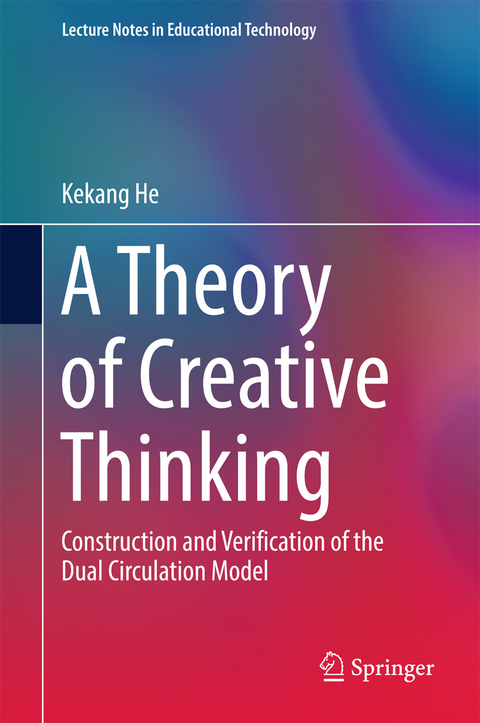
A Theory of Creative Thinking (eBook)
211 Seiten
Springer Singapore (Verlag)
978-981-10-5053-4 (ISBN)
This book examines research on creative thinking, both current and historical. It explores two dimensions of human thought (time and space) and two modes of thinking (conscious and unconscious) as well as both left and right brain functions and artistic and scientific creative activities. The book proposes a "e;Double Circulation"e; model of creative thinking and argues that imagery thinking, intuitive thinking and logical thinking are main parts of creative thinking and that dialectical thinking and horizontal-vertical thinking are the guides for highly complex problem-solving thoughts and strategies.The book focuses on education and psychology and also covers how to use ICT to promote students' creative thinking skills.Researchers will benefit from the "e;Double Circulation"e; model, which provides a new perspective on conducting creative thinking research. The book is also a valuable resource for graduate students in the fields of educational technology and psychology and for all readers who are interested in creative thinking.
He Kekang is currently an Honorary Professor (tenured professor) at Northeast Normal University and the director of Beijing Normal University’s modern education technology research institute. He has successively won the state education ministry and the Beijing Municipal Science and Technology Progress Award six times since 1978.He was awarded the title of expert with outstanding contributions by the National Ministry of Personnel in 1992, was named one of the outstanding teachers in Beijing in 1993, ranked among the famous university instructors in Beijing in 2006, and was selected as the national Baogang excellent teacher in 2007.From June 2001 to May 2006, Prof. Kekang was appointed director of the national Education Ministry Educational Technology Professional Teaching Steering Committee. He is currently Director of the National Teacher Education Informatization Experts Committee, Director of the China Educational Technology Association’s Academic Committee, First Vice-Chairman of the Global Chinese Society on Computers in Education (GCSCE), and an Editorial Board member of the internationally respected Journal of Computer Assisted Learning (JCAL).For many years, Prof. Kekang and his research team have been engaged in the fields of education informatization engineering, primary and secondary school teaching reform experiment and education innovation theory.
Introduction.- Basic forms of human thought.- Status Quo and existing problems in creative thinking research.- A model of creative thinking: the mental model of DC.- Theoretical basis of creative thinking - the DC model.- Cultivation of creative thinking.
| Erscheint lt. Verlag | 13.6.2017 |
|---|---|
| Reihe/Serie | Lecture Notes in Educational Technology | Lecture Notes in Educational Technology |
| Zusatzinfo | XII, 211 p. 24 illus. |
| Verlagsort | Singapore |
| Sprache | englisch |
| Themenwelt | Schulbuch / Wörterbuch ► Unterrichtsvorbereitung ► Unterrichts-Handreichungen |
| Geisteswissenschaften ► Psychologie ► Pädagogische Psychologie | |
| Sozialwissenschaften ► Pädagogik ► Schulpädagogik / Grundschule | |
| Schlagworte | Creative thinking • Cultivation of creative thinking • Dual Circulation model • Human thinkng • Imagery thinking • Intuitive thinking • Left/right brain • Logical thinking • Neural physiology • Thinking models |
| ISBN-10 | 981-10-5053-8 / 9811050538 |
| ISBN-13 | 978-981-10-5053-4 / 9789811050534 |
| Informationen gemäß Produktsicherheitsverordnung (GPSR) | |
| Haben Sie eine Frage zum Produkt? |
 PDF (Wasserzeichen)
DRM: Digitales Wasserzeichen
Dieses eBook enthält ein digitales Wasserzeichen und ist damit für Sie personalisiert. Bei einer missbräuchlichen Weitergabe des eBooks an Dritte ist eine Rückverfolgung an die Quelle möglich.
Dateiformat: PDF (Portable Document Format)
Mit einem festen Seitenlayout eignet sich die PDF besonders für Fachbücher mit Spalten, Tabellen und Abbildungen. Eine PDF kann auf fast allen Geräten angezeigt werden, ist aber für kleine Displays (Smartphone, eReader) nur eingeschränkt geeignet.
Systemvoraussetzungen:
PC/Mac: Mit einem PC oder Mac können Sie dieses eBook lesen. Sie benötigen dafür einen PDF-Viewer - z.B. den Adobe Reader oder Adobe Digital Editions.
eReader: Dieses eBook kann mit (fast) allen eBook-Readern gelesen werden. Mit dem amazon-Kindle ist es aber nicht kompatibel.
Smartphone/Tablet: Egal ob Apple oder Android, dieses eBook können Sie lesen. Sie benötigen dafür einen PDF-Viewer - z.B. die kostenlose Adobe Digital Editions-App.
Buying eBooks from abroad
For tax law reasons we can sell eBooks just within Germany and Switzerland. Regrettably we cannot fulfill eBook-orders from other countries.
aus dem Bereich