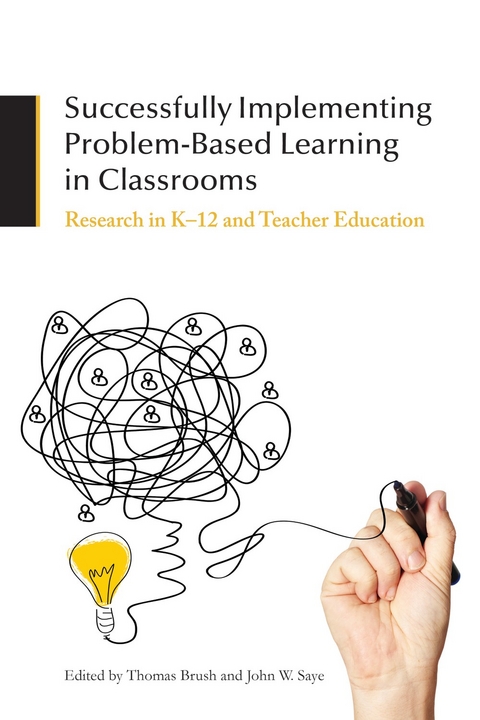
Successfully Implementing Problem-Based Learning in Classrooms (eBook)
300 Seiten
Purdue University Press (Verlag)
978-1-61249-495-1 (ISBN)
Dr. Thomas Brush is the Barbara B. Jacobs Chair in Education and Technology and chair of the Department of Instructional Systems Technology within the School of Education at Indiana University Bloomington as well as codirector of the Persistent Issues in History Network. Dr. Brush's research interests focus on developing methods and strategies to promote inquiry-oriented learning, particularly with more open-ended instruction.John W. Saye is the Mildred Cheshire Fraley Distinguished Professor of secondary social science education at Auburn University. He is the codirector of the Persistent Issues in History Network and director of the Social Studies Inquiry Research Collaborative, a coalition of university researchers studying the effects of challenging social studies and history instruction on student learning. Prior to his appointment to Auburn University in 1994, Dr. Saye was a high school history teacher for twelve years. His research interests include authentic pedagogy, problem-based inquiry, teacher thinking, and collaborative communities of practice.
Problem-Based Learning in K–12 and Teacher Education: Introduction and Current Trends, by Thomas Brush and John Saye
Part I: Problem-Based Learning in Teacher Education
1. Transforming Preservice Secondary Mathematics Teachers’ Practices: Promoting Problem Solving and Sense Making, by Marilyn E. Strutchens and W. Gary Martin
2. Conexiones: Fostering Socioscientific Inquiry in Graduate Teacher Preparation, by Krista D. Glazewski, Michèle I. Shuster, Thomas Brush, and Andrea Ellis
3. An Instructional Model to Support Problem-Based Historical Inquiry: The Persistent Issues in History Network, by Thomas Brush and John Saye
4. Preservice Elementary Teachers Learning to Teach PBL Through Science-Integrated Engineering Design, by Pamela S. Lottero-Perdue
Part II: Problem-Based Learning in K–12 Contexts
5. Teacher as Designer: A Framework for Analysis of Mathematical Model-Eliciting Activities, by Margret A. Hjalmarson and Heidi Diefes-Dux
6. The Grand Challenge: Using a PBL Approach to Teach Cutting-Edge Science, by Peggy A. Ertmer, Sarah Schlosser, Kari Clase, and Omolola Adedokun
7. Using Technology-Enhanced Learning Environments to Support Problem-Based Historical Inquiry in Secondary School Classrooms, by John Saye and Thomas Brush
8. Engaging Teachers’ Pedagogical Content Knowledge: Adopting a Nine-Step PBL Model, by Karen C. Goodnough and Woei Hung
Conclusion: What Is Missing; What Is Needed? Future Research Directions With PBL in K–12 and Teacher Education, by Michael M. Grant and Krista D. Glazewski
Index
| Erscheint lt. Verlag | 15.3.2017 |
|---|---|
| Verlagsort | West Lafayette |
| Sprache | englisch |
| Themenwelt | Schulbuch / Wörterbuch ► Schulbuch / Allgemeinbildende Schulen |
| Sozialwissenschaften ► Pädagogik | |
| ISBN-10 | 1-61249-495-1 / 1612494951 |
| ISBN-13 | 978-1-61249-495-1 / 9781612494951 |
| Informationen gemäß Produktsicherheitsverordnung (GPSR) | |
| Haben Sie eine Frage zum Produkt? |
 EPUB (Adobe DRM)
Kopierschutz: Adobe-DRM
Adobe-DRM ist ein Kopierschutz, der das eBook vor Mißbrauch schützen soll. Dabei wird das eBook bereits beim Download auf Ihre persönliche Adobe-ID autorisiert. Lesen können Sie das eBook dann nur auf den Geräten, welche ebenfalls auf Ihre Adobe-ID registriert sind.
Details zum Adobe-DRM
Dateiformat: EPUB (Electronic Publication)
EPUB ist ein offener Standard für eBooks und eignet sich besonders zur Darstellung von Belletristik und Sachbüchern. Der Fließtext wird dynamisch an die Display- und Schriftgröße angepasst. Auch für mobile Lesegeräte ist EPUB daher gut geeignet.
Systemvoraussetzungen:
PC/Mac: Mit einem PC oder Mac können Sie dieses eBook lesen. Sie benötigen eine
eReader: Dieses eBook kann mit (fast) allen eBook-Readern gelesen werden. Mit dem amazon-Kindle ist es aber nicht kompatibel.
Smartphone/Tablet: Egal ob Apple oder Android, dieses eBook können Sie lesen. Sie benötigen eine
Geräteliste und zusätzliche Hinweise
Buying eBooks from abroad
For tax law reasons we can sell eBooks just within Germany and Switzerland. Regrettably we cannot fulfill eBook-orders from other countries.
aus dem Bereich